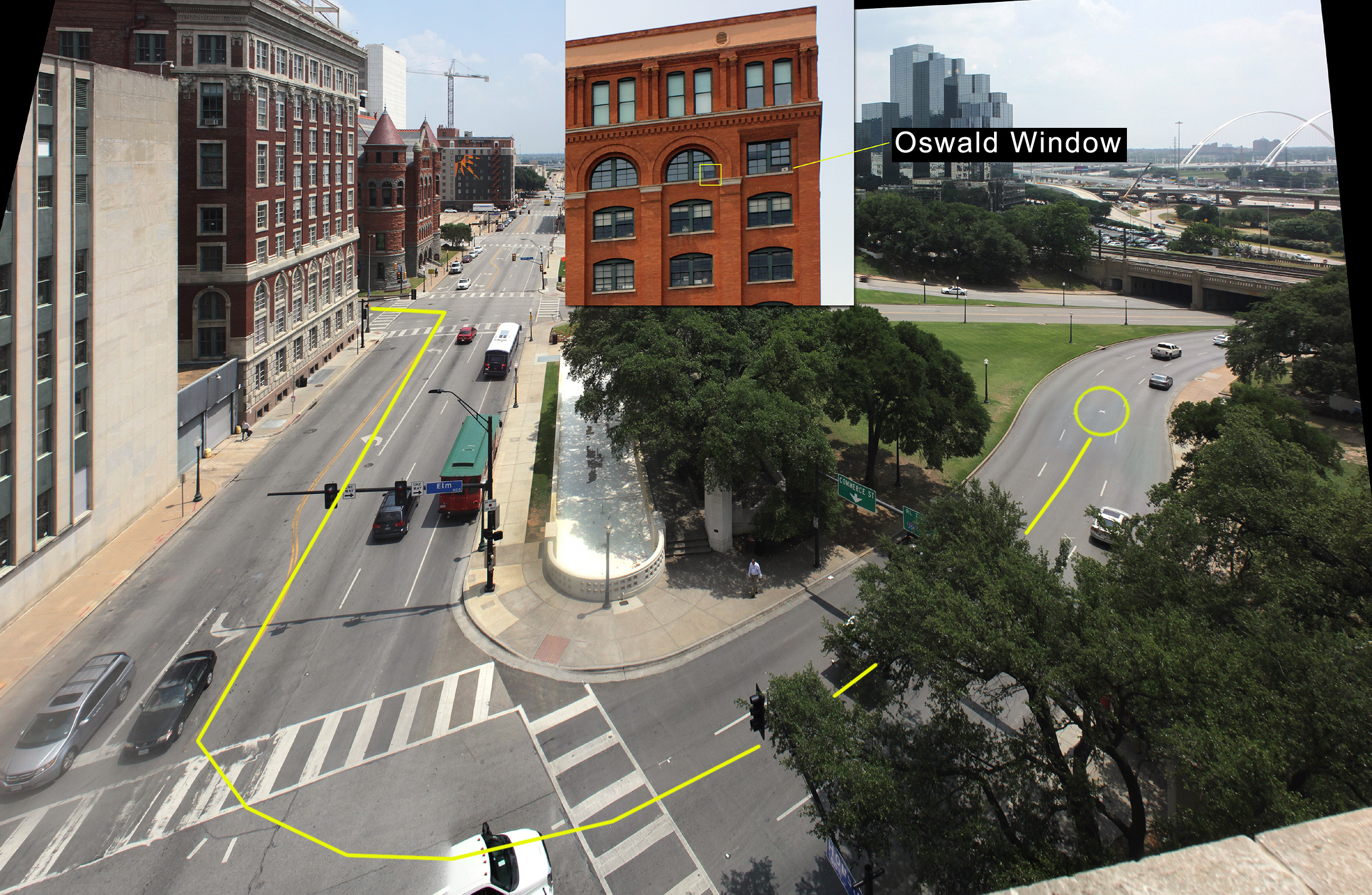
Sixth Floor Museum at Dealey Plaza
For twenty-six years after the assassination of President John F. Kennedy, the sixth floor of the Texas School Book Depository sat empty. Dallas County had acquired the building, restored its 1901 exterior, and put government offices on the first five floors, but nobody could quite agree on what to do with the space where Lee Harvey Oswald had stacked book cartons into a sniper's nest. The community wrestled with it for a decade. Then, on Presidents' Day 1989 -- February 20 -- the Sixth Floor Museum opened its doors, not as a shrine or a memorial, but as a response to a simple reality: people kept coming to Dealey Plaza anyway, searching for answers at the intersection of Elm and Houston Streets, and there was nothing there to greet them.
A Building with Two Lives
The seven-story structure at the corner of Elm and Houston was built in 1901 on the foundation of an 1898 building that had burned down after being struck by lightning. For its first six decades, it served unremarkably as a warehouse -- first for plows and agricultural equipment, then for a grocery wholesaler. In 1963, the Texas School Book Depository Company leased the building as a distribution hub for school textbooks, with regional offices for education publishers. It was the kind of place nobody noticed until November 22. After the assassination, the Depository Company continued its lease until 1970. Dallas County then undertook a major restoration, completing work in 1981 and converting the lower floors to administrative use. The infamous sixth and seventh floors remained sealed off -- too freighted with history to ignore, too painful to confront.
Ninety Thousand Fragments of a Day
The museum's collections now hold more than 90,000 items related to the Kennedy assassination, its aftermath, and the broader culture of the 1960s. The primary exhibit, John F. Kennedy and the Memory of a Nation, uses historic films, photographs, artifacts, and interpretive displays to walk visitors through the events of November 22, 1963, and the government investigations that followed. Among the most significant holdings is the copyright to the Zapruder film, the 26-second home movie that captured the assassination in devastating detail. Abraham Zapruder's family donated the copyright in December 1999, along with one of the first-generation copies made that same day. The original camera negative resides with the National Archives. In 2002, the family of Orville Nix, who filmed the final seconds of the assassination from a different angle, also assigned their film's copyright to the museum. The museum also holds some 2,500 oral history recordings -- first-person accounts that grow more precious as the generation of witnesses ages.
The Conspiracy Theorist Who Became the Archivist
The first curator of the Sixth Floor Museum was Gary Mack, born Larry Dunkel in 1946. Mack spent years consumed by what happened in Dealey Plaza, starting out as a conspiracy theorist before his deep research gradually led him to become the museum's chief historian and archivist. Over his tenure from 2000 to 2015, he partially discredited some conspiracy theories and ultimately supported the official conclusion that Oswald acted alone -- a journey from suspicion to evidence that mirrors the experience of many visitors who walk through the exhibits. Mack died in 2015 at age 68. His successor, Stephen Fagin, continues the museum's Oral History Project and authored Assassination and Commemoration: JFK, Dallas, and The Sixth Floor Museum at Dealey Plaza, published by the University of Oklahoma Press in 2013, which documents the painstaking work of cultivating civic support for a museum that many in Dallas were reluctant to create.
Neither Encouraging Nor Discouraging
The museum occupies a peculiar position in the landscape of American institutions: it is a historical site that neither encourages nor discourages the idea of conspiracy theories. It presents the evidence. It documents the investigations. It preserves the amateur films and the oral histories and the contradictory testimony. A webcam still broadcasts a live view from the sixth-floor window. For the 60th anniversary in November 2023, the museum placed 'JFK Was Here' banners along the 1963 motorcade route from Love Field to Dealey Plaza -- a gesture met with mixed reactions from Dallasites still uncertain about how to remember that day. The museum is entirely self-funded through donations and ticket sales, renting its space from Dallas County. It is a place built on the conviction that remembering honestly, even when memory is painful, is better than the alternative.
From the Air
Located at 32.780°N, 96.808°W in downtown Dallas at the intersection of Elm and Houston Streets. Dealey Plaza, the triple underpass, and the former Texas School Book Depository are identifiable from low altitude as a triangular park area at the western edge of downtown, where three streets converge beneath a railroad overpass. Dallas Love Field (KDAL) is approximately 5 nm northwest; Dallas/Fort Worth International Airport (KDFW) is about 18 nm northwest. The site sits at approximately 430 feet MSL. Best viewed at 1,500-3,000 feet AGL on approach from the west or south, where the distinctive triple underpass and the rectangular depository building are most recognizable against the downtown skyline.