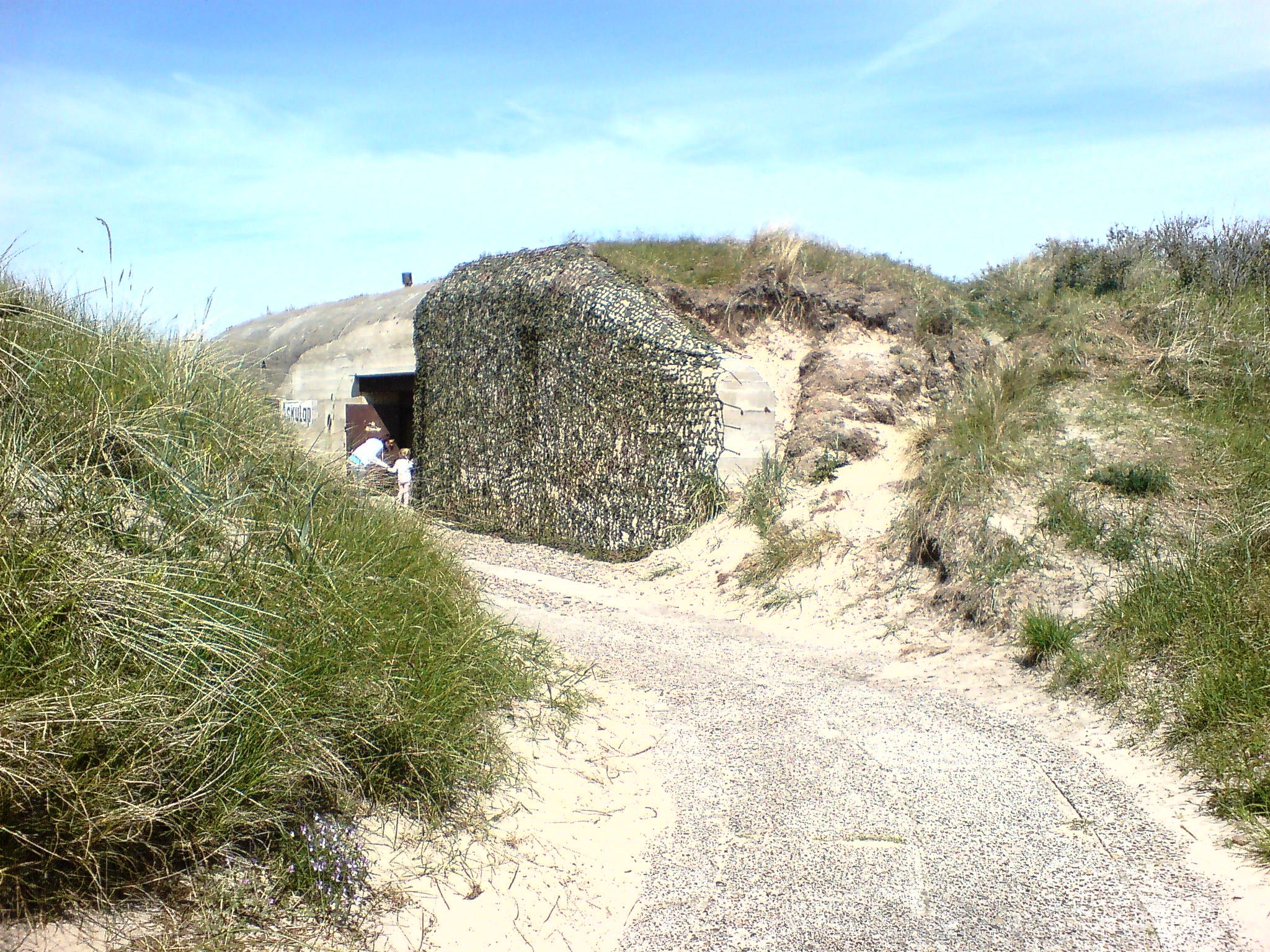
Skagen Bunker Museum
The bunker was built to heal soldiers who would never come. Designated Regelbau 638, the standard Wehrmacht design for a field infirmary, this concrete structure near the tip of Grenen in northern Jutland was fitted out with medical equipment during the Second World War but apparently never treated a single patient. Decades later, it found a purpose its builders never intended -- as a museum that introduces visitors to the vast system of German fortifications that once lined Denmark's western coast.
Where Two Seas Collide
Grenen is the northernmost point of mainland Denmark, a wind-scoured sand spit where the Skagerrak and the Kattegat visibly crash into each other. The shifting currents make the water churn in opposing waves that tourists wade out to straddle, one foot in each sea. During the Second World War, this dramatic geography had strategic value: the tip of Jutland commanded the sea approaches between the North Sea and the Baltic. The Germans fortified the coastline heavily, building bunkers, gun emplacements, and observation posts as part of the Atlantic Wall -- the chain of coastal defenses stretching from Norway to the Spanish border. Many of those structures have since been swallowed by sand or surf, but the Regelbau 638 at Grenen survived.
An Infirmary Without Patients
The bunker's designation tells its intended story: Regelbau 638 was a standardized design used across occupied Europe for medical facilities. Inside, the concrete walls were meant to shelter wounded soldiers from air raids while they recovered. At Grenen, however, the facility was apparently never put to its planned use. Whether the tide of the war moved too quickly, or the anticipated casualties in this sector never materialized, the infirmary stood empty through the conflict. After the war, the bunker sat abandoned for decades, slowly being reclaimed by the sand dunes that characterize this restless coastline.
Concrete Turned to Memory
In 2008, Martin Nielsen and Christian Forman Hansen transformed the abandoned structure into the Skagen Bunker Museum. They fitted the interior with period uniforms, weapons, and artifacts, recreating the atmosphere of a wartime installation. The museum is deliberately small -- a single bunker, not a sprawling complex -- and that intimacy is part of its effect. Visitors descend into the same concrete corridors that German soldiers walked, surrounded by the heavy walls and low ceilings that defined life inside the Atlantic Wall. The museum serves as an introduction to the hundreds of similar structures dotting Denmark's west coast, many of them still visible but inaccessible. Open daily from April through October, it draws visitors who come for Grenen's natural spectacle and discover a layer of history buried just beneath the dunes.
From the Air
Coordinates: 57.74°N, 10.63°E. The museum sits near the very tip of Skagen Odde, Denmark's northernmost point, where the Skagerrak meets the Kattegat. From the air, the sand spit of Grenen is unmistakable -- a narrow finger of land pointing northeast into the sea with visible wave patterns where the two bodies of water collide. The bunker is close to where the Sandormen tractor-train transports visitors. Recommended viewing altitude: 1,500-2,500 feet. Nearest airport: Aalborg (EKYT) about 100 km to the southwest.