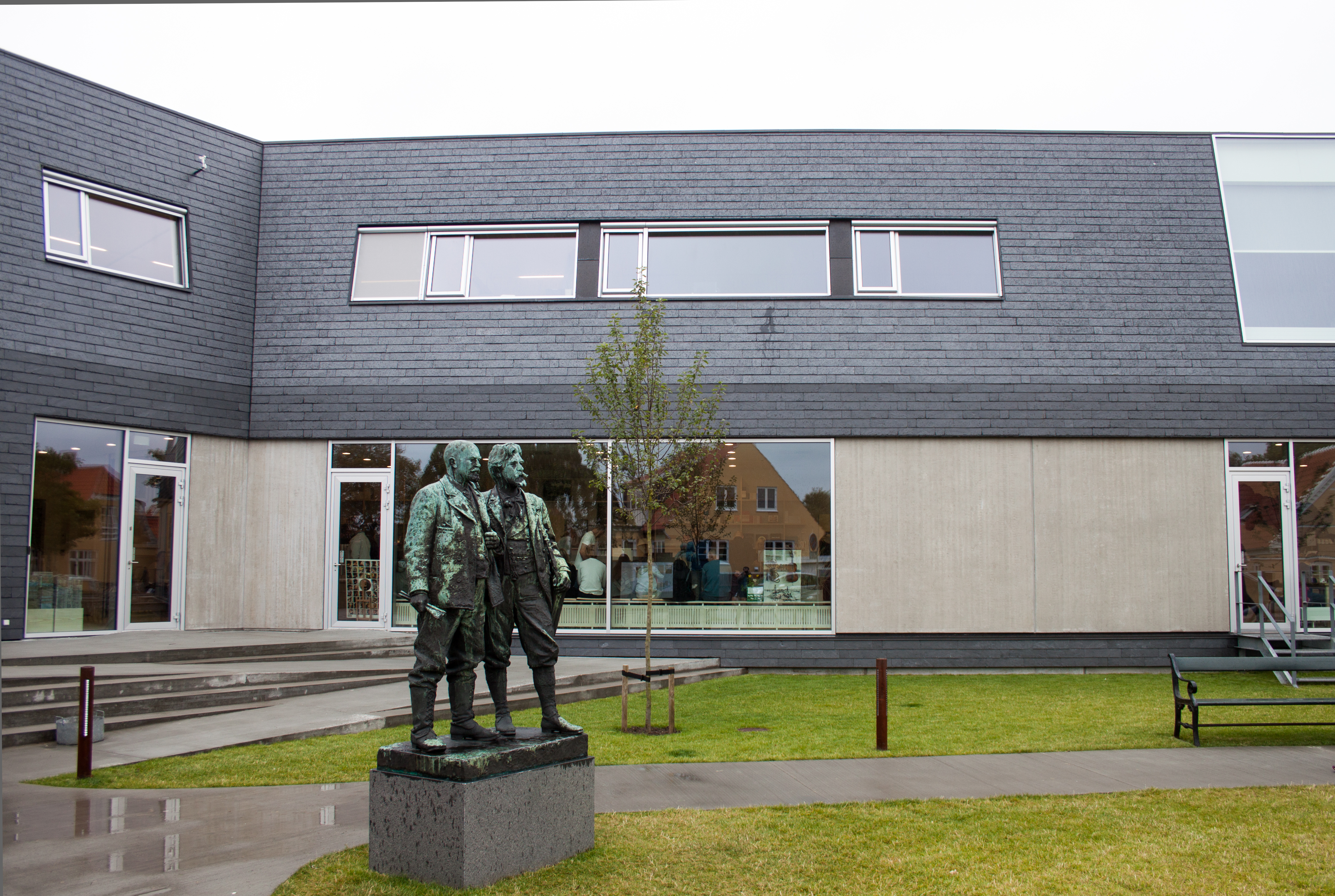
Skagens Museum
The museum began where the paintings did -- in a dining room. In the 1870s, painters started arriving in Skagen, drawn to the peculiar quality of light at Denmark's northernmost tip, where two seas meet and the sky seems to stretch wider than anywhere else in Scandinavia. They gathered at Brondums Hotel, eating, drinking, arguing about art, and painting each other in the golden glow of endless summer evenings. When they decided in 1908 to create a museum for their work, they founded it in that same dining room. It was the only space that made sense.
The Colony of Light
The Skagen Painters were not a school in the formal sense -- they had no manifesto, no shared technique. What they shared was a place. Peder Severin Kroyer, Anna and Michael Ancher, Laurits Tuxen, Viggo Johansen, Holger Drachmann: they came from different backgrounds and painted in different styles, but Skagen's light unified their work. The quality of that light -- diffused by sand, reflected off two converging seas, filtered through salt air -- gave their canvases a luminosity that set them apart from their contemporaries. Anna Ancher painted domestic interiors suffused with the same radiance that Kroyer captured in his famous beach scenes. Together, they created one of the most important artistic movements in Scandinavian history.
From Hotel Garden to Purpose-Built Gallery
Among the museum's founders were Michael Ancher, P.S. Kroyer, and Laurits Tuxen, joined by the local pharmacist Victor Christian Klaebel and Degn Brondum, the hotel proprietor and Anna Ancher's brother. After Kroyer's death in 1909, his house served as a temporary exhibition space. In 1919, Degn Brondum donated the hotel's old garden for a permanent building. Architect Ulrik Plesner, himself embedded in Skagen's artistic community, designed the structure. Financed by private donors and the Ny Carlsberg Foundation, construction began in 1926, and the museum opened on September 22, 1928. The Garden House on the property is one of Skagen's oldest buildings -- Michael and Anna Ancher lived there after their wedding in 1880, and their daughter Helga was born there in 1883. In 1853 it had served as a cholera lazaretto. Since 2009, it has been a cafe.
A Collection That Keeps Growing
In 2014 the museum expanded in two directions at once. Architecturally, the firm Friis and Moltke added 2,000 square meters of new gallery space, nearly doubling the exhibition area and allowing up to half of the museum's 2,000 works to be shown at any time. Institutionally, the museum merged with two historic house museums -- Anchers Hus, the former residence of Michael and Anna Ancher and their daughter Helga, and Drachmanns Hus, dedicated to the writer and marine painter Holger Drachmann. The merger brought thousands of personal objects, photographs, and artworks into the collection, weaving domestic life into the story of artistic creation. Denmark's fifth most popular art museum, Skagens Museum draws up to 200,000 visitors a year.
The Painting That Lives Twice
One of P.S. Kroyer's most celebrated works, Hip, Hip, Hurra!, hangs not in Skagen but in the Gothenburg Museum of Art in Sweden. It depicts the Skagen artists gathered for an outdoor lunch -- the very community the museum commemorates -- and its absence from the collection was always felt. A solution came through the European Regional Development Fund, which funded the creation of a three-dimensional digital version of the painting, installed in the museum next to the actual site where Kroyer originally set his easel. Many of the museum's works have also been digitized through the Google Art Project, making over a hundred paintings accessible worldwide. But the museum's director has noted what any visitor already knows: the originals carry something the screens cannot. In Skagen, where everything began with light, the paintings still need to be seen in person.
From the Air
Coordinates: 57.72°N, 10.60°E. The museum is located in the town of Skagen at the far northern tip of Jutland, Denmark. From the air, the Skagen Odde peninsula is dramatically narrow, tapering to the sandy point of Grenen. The town of Skagen is visible as a compact settlement surrounded by dunes and sea. Recommended viewing altitude: 2,000-3,000 feet. Nearest airport: Aalborg (EKYT) about 100 km southwest. The distinctive yellow houses of Skagen are visible in good conditions.