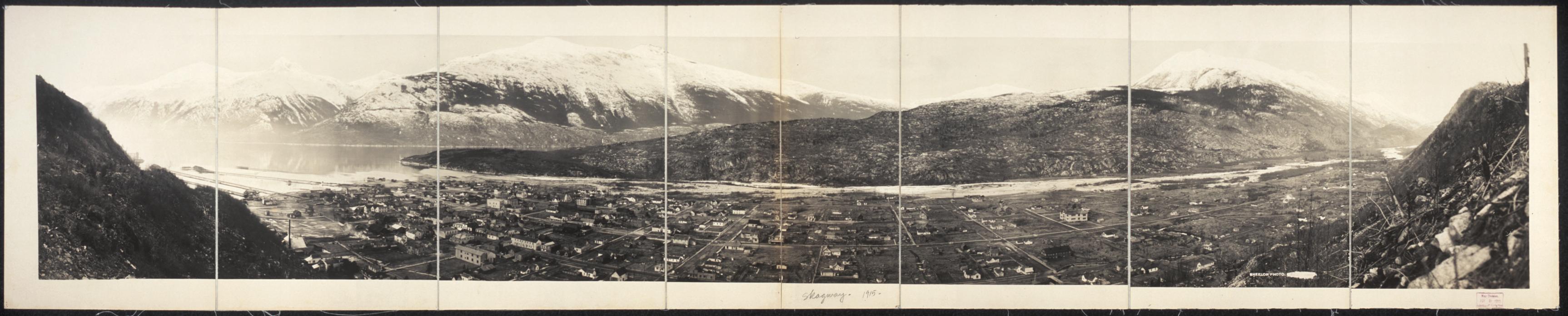
Skagway
In 1897, Skagway didn't exist. By 1898, it had 20,000 residents and was the largest city in Alaska - a tent city at the base of the White Pass, gateway to the Klondike goldfields. Stampeders poured off ships and into a chaos of mud, tents, and lawlessness. The de facto ruler was Jefferson Randolph 'Soapy' Smith, a con man who controlled the town through a network of thugs and rigged games, robbing newcomers of their money before they even reached the pass. His reign ended on July 8, 1898, when he confronted vigilantes on Juneau Wharf and was shot dead by Frank Reid (who died of his wounds days later). Within two years, the railroad was completed, the rush was over, and Skagway had collapsed to a few hundred residents. Today it's a cruise port, carefully preserved to evoke the gold rush chaos that created it.
The Stampede
When word of Klondike gold reached the outside world in July 1897, tens of thousands of people rushed north. Two routes led over the coastal mountains from tidewater to the Yukon River system: the Chilkoot Trail from Dyea and the White Pass Trail from Skagway. Skagway was supposedly the easier route - horses could carry loads, unlike the brutal Chilkoot. In reality, the White Pass was a nightmare. The trail was so steep and muddy that an estimated 3,000 horses died on it, their bodies rotting in the mire. 'Dead Horse Trail,' stampeders called it. Those who survived the pass still had to build boats and float 500 miles to Dawson City.
Soapy Smith
Jefferson Randolph Smith got his nickname from a con game involving soap and money, but his ambitions were grander. He arrived in Skagway in 1897 and quickly established control through a combination of charm, business fronts, and violence. His gang operated fake telegraph offices, rigged gambling games, and outright robbery. Stampeders fresh off the ships were separated from their money before they reached the trail. Smith cultivated an image of civic leadership, organizing a militia and marching in Fourth of July parades. But his reign was brief. When his men robbed a returning miner of $2,700 in gold in July 1898, vigilantes organized. Smith confronted them on the wharf and was shot dead.
The Railroad
The White Pass & Yukon Railway changed everything. Begun in 1898 and completed to Whitehorse in 1900, the narrow-gauge railroad climbed from sea level to 2,865 feet in just 20 miles, winding through tunnels and along cliff faces that stampeders had struggled to climb on foot. The railroad made the trail obsolete and allowed efficient transport of passengers and freight. But by the time it was finished, the gold rush was ending. Dawson's population had crashed. The railroad survived on freight for decades, closed in 1982, and reopened as a tourist attraction in 1988. Today it's one of Skagway's main draws.
The Preservation
Skagway shrank after the gold rush but never quite died. The railroad kept it alive; so did its status as Alaska's first incorporated city and a connection to the Alaska Highway system. When cruise ships began stopping in the 1970s, Skagway found a new gold rush: tourism. The National Park Service now manages Klondike Gold Rush National Historical Park, which includes 15 restored buildings in Skagway's downtown. The town cultivates its gold rush atmosphere with boardwalks, false-fronted buildings, and historical interpretation. In summer, cruise passengers outnumber residents by roughly 100 to 1.
Visiting Skagway
Skagway is accessible by cruise ship, Alaska Marine Highway ferry, or the Klondike Highway from Whitehorse. The town is small - easily walkable in an hour - but offers rich gold rush history. The Klondike Gold Rush National Historical Park Visitor Center provides orientation. The White Pass & Yukon Railway offers scenic excursions to White Pass summit and beyond. The Trail of '98 Museum and the Mascot Saloon (preserved as it was) interpret boomtown life. Jeff Smith's Parlor, Soapy's headquarters, still stands. The Gold Rush Cemetery contains graves of Soapy Smith and Frank Reid, side by side in death. For serious hikers, the Chilkoot Trail (33 miles, 3-5 days) starts in nearby Dyea. Summer is cruise season; shoulder seasons offer more authentic atmosphere.
From the Air
Located at 59.46°N, 135.31°W at the head of Taiya Inlet, a narrow fjord extending from the Lynn Canal in Southeast Alaska. From altitude, Skagway appears as a small grid of streets at the base of steep mountains, with the White Pass visible as a gap in the coastal range. The railroad switchbacks are visible climbing the mountainside. Dyea, at the base of the Chilkoot Trail, is 9 miles to the northwest.