Skara Brae
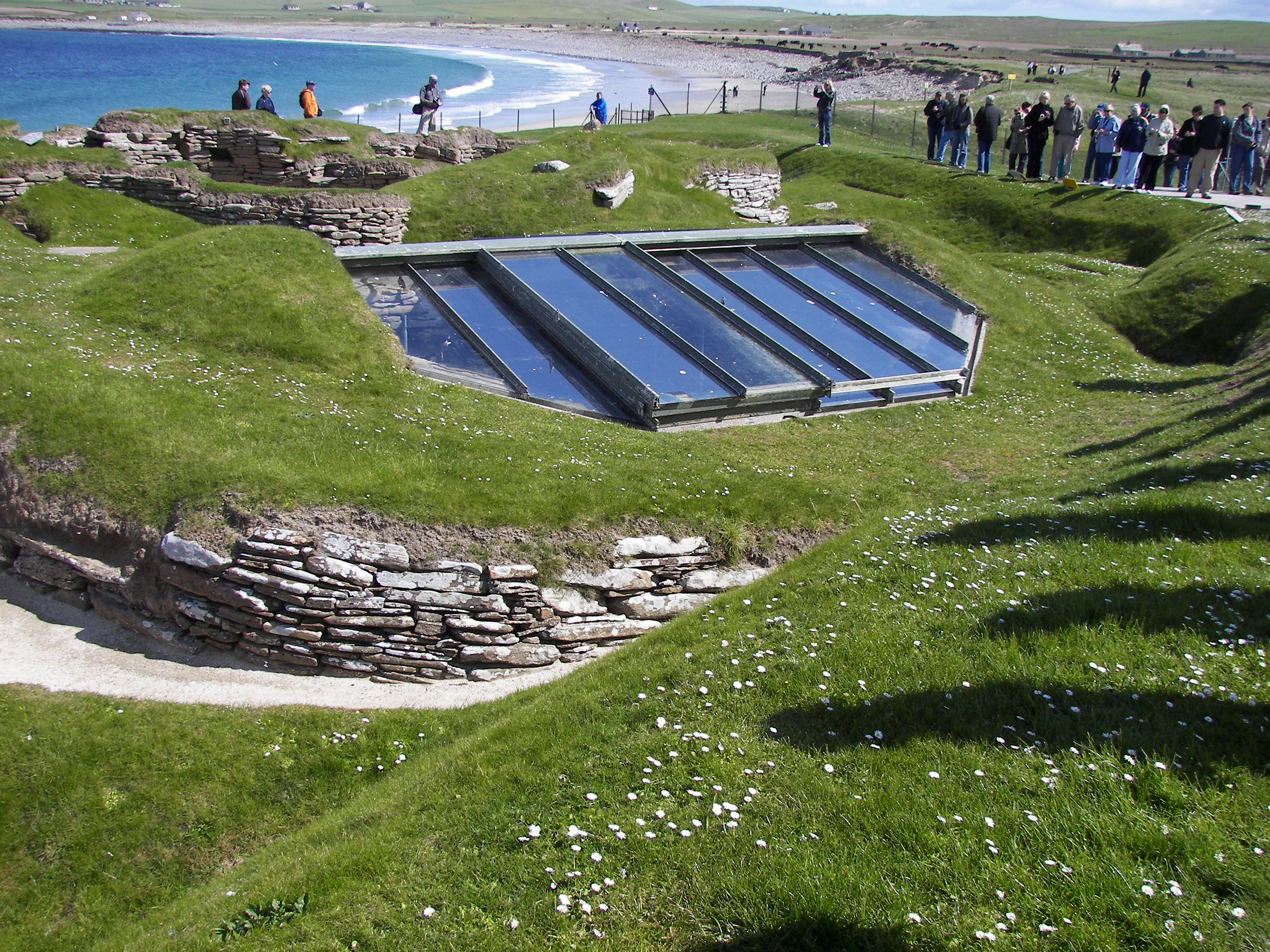
In the winter of 1850, a storm of extraordinary violence struck Scotland, killing more than 200 people and reshaping coastlines across the north. In the Bay of Skaill on Orkney's Mainland, the tempest stripped earth from a grassy knoll and exposed stone walls that no one alive had ever seen. What the storm uncovered was a village -- ten clustered houses with stone hearths, stone beds, stone dressers, even stone-built drains that functioned as a primitive sewer system. The settlement had been occupied from roughly 3180 to 2500 BC, making it older than Stonehenge, older than the Great Pyramids of Giza. It had been called the "Scottish Pompeii" for its remarkable preservation, though the comparison sells Skara Brae short: Pompeii was buried by catastrophe, but Skara Brae was simply forgotten.
Furniture Made of Stone
What makes Skara Brae extraordinary is not its age but its intimacy. Because Orkney had few trees, the inhabitants built everything from flagstone: beds, dressers, cupboards, storage boxes, even the doors, which slid shut with bone bars fitted into carved jambs. Each of the seven residential houses follows the same layout: a central hearth for heating and cooking, a larger bed on the right side of the doorway, a smaller bed on the left, and a dresser standing directly opposite the entrance -- the first thing any visitor saw. The consistency suggests shared customs, perhaps even social rules. Archaeologist Lloyd Laing noted that the arrangement matched Hebridean tradition surviving into the 20th century, where the husband took the larger bed and the wife the smaller. Beads and paint pots found in the smaller beds lend some support to this interpretation. The houses were sunk into midden -- mounds of accumulated domestic waste -- which provided both structural support and insulation against Orkney winters. No more than fifty people likely lived here at any one time.
The Workshop and the Feast
House 8 breaks the pattern. It has no beds, no dresser, no storage boxes. Instead, it is divided into small cubicles, and excavators found fragments of stone, bone, and antler suggesting it served as a workshop for making tools -- bone needles, flint axes. A flue and heat-damaged volcanic rocks support this interpretation. Unlike the other houses, House 8 stands alone, above ground, with walls over two metres thick and a porch guarding its entrance. The residents were pastoralists who raised cattle, pigs, and sheep, supplemented by seafood. Limpet shells, likely used as fish bait, were stored in stone boxes carefully sealed with clay to make them waterproof. One pottery jar yielded something unexpected: chemical analysis of a greenish residue revealed an alcoholic beverage brewed from oats and barley, seasoned with hemlock, deadly nightshade, and henbane -- hallucinogenic ingredients that would have been lethal in large quantities. These people worked, ate, and apparently celebrated with a brew that could kill them.
Lost and Found
After the 1850 storm revealed the site, William Graham Watt, a self-taught geologist and son of the local laird, began digging. He uncovered four houses before work was abandoned in 1868. The site sat neglected until 1913, when a party arrived one weekend with shovels and removed an unknown quantity of artefacts -- an act of archaeological vandalism that has never been fully accounted for. Formal excavation finally began in 1925, and between 1928 and 1930, the pioneering archaeologist V. Gordon Childe systematically uncovered the village. Among the most remarkable finds: carved stone balls of unknown purpose, lumps of red ochre suggesting body painting, ivory pins up to 25 centimetres long resembling examples from Irish passage graves, and a twisted skein of heather that is one of very few surviving examples of Neolithic rope. In 2016, a carved whalebone figurine dubbed the "Skara Brae Buddo" was rediscovered in a box at Stromness Museum -- thought to be 5,000 years old, it had been known only from a 19th-century sketch.
The Sea Giveth
The storm that revealed Skara Brae in 1850 may eventually reclaim it. A 2019 risk assessment by Historic Environment Scotland concluded that the entire Heart of Neolithic Orkney World Heritage Site, and Skara Brae in particular, is "extremely vulnerable" to climate change. Rising sea levels, increased rainfall, and coastal erosion threaten a site that was originally much farther from the water. One unusually severe storm could partially destroy what 5,000 years of burial preserved. The village that was hidden by sand and revealed by wind now faces its most existential threat from the sea itself. For the moment, visitors can walk among the roofless houses on the Bay of Skaill, peer down into rooms where people slept and cooked and argued and brewed their dangerous beer, and contemplate the unsettling fact that these stone-age homes have outlasted every building in every city that has risen since.
From the Air
Located at 59.05N, 3.34W on the Bay of Skaill, west coast of Mainland Orkney. The site is visible from the air as excavated stone structures on the coastline adjacent to Skaill House. The Ring of Brodgar is approximately 4 nm to the southeast. Nearest airport: Kirkwall (EGPA), approximately 12 nm east. Best viewed at 1,000-2,000 ft AGL. Note the vulnerability of the coastal site to erosion.