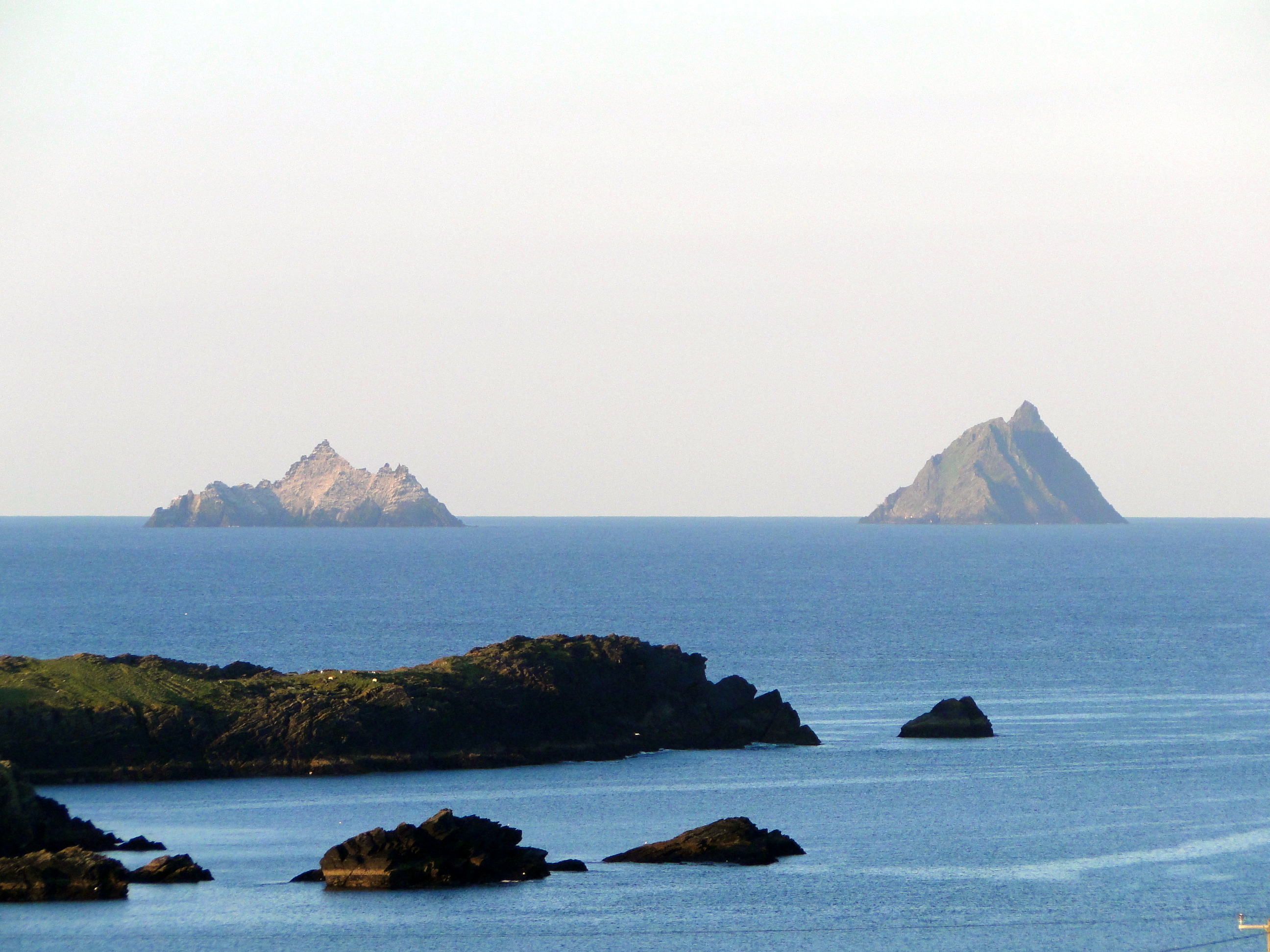
Skellig Islands
Thirteen kilometres off the Iveragh Peninsula in County Kerry, the Atlantic breaks against two fragments of rock that look like they were never meant for human use. The Skellig Islands -- historically called "the Skellocks" -- are steep, wind-scoured, and barely accessible. And yet monks lived on the larger one for six hundred years, nearly 30,000 pairs of gannets breed on the smaller one, and in 2015 a film crew turned the ruins of that monastery into the last refuge of a Jedi knight. These islands have always attracted extremists: people and birds willing to endure anything for the right piece of ground.
The Greater Rock
Skellig Michael, the larger island, rises to twin peaks over 230 metres above sea level. Its Irish name, Sceilig Mhichil, invokes the Archangel Michael -- one of the few beings, the old reasoning went, capable of alighting on such a remote pinnacle. A Christian monastery founded sometime in the sixth century clings to a ledge at 160 metres, a cluster of corbelled beehive huts and oratories built entirely without mortar. The monks who lived here endured Viking raids, Atlantic storms, and an isolation so complete that their nearest neighbours were seabirds. UNESCO designated Skellig Michael a World Heritage Site in 1996, recognizing it as an exceptional example of early religious settlement preserved by its own inaccessibility.
The White Island
Little Skellig, roughly 1.5 kilometres to the east-northeast, is closed to humans entirely. It belongs to the gannets. With approximately 35,000 breeding pairs, it hosts Ireland's largest northern gannet colony and the second-largest gannet colony in the world. From a boat, the island appears to be covered in snow -- until the snow moves. Every ledge, every cranny, every viable surface is occupied by nesting birds. The guano-white rock teems with life: gannets plunge-diving into the sea, returning with fish, squabbling over territory. Landing is neither permitted nor physically possible on Little Skellig's sheer cliff faces, which rise 134 metres from the ocean.
Wings Over Open Water
Together the two islands form a 364-hectare Important Bird Area designated by BirdLife International, one of Ireland's most critical seabird habitats for both population size and species diversity. The breeding roster is extraordinary: European storm petrels, northern fulmars, Manx shearwaters, black-legged kittiwakes, common guillemots, razorbills, and over 4,000 Atlantic puffins on Great Skellig alone. Red-billed choughs and peregrine falcons patrol the cliffs. Below the surface, the surrounding waters support grey seals, basking sharks, minke whales, dolphins, and occasional leatherback sea turtles. Divers who brave the crossing find underwater cliffs dropping 60 metres through water so clear that the Atlantic feels like a different ocean entirely.
From Monks to Movie Stars
The Skelligs have always attracted storytellers. Werner Herzog filmed scenes for Heart of Glass here in 1976, drawn by the islands' apocalyptic grandeur. But it was Star Wars that brought them global recognition. The final scene of The Force Awakens, shot in July 2015, revealed the monastery ruins as an ancient Jedi temple -- the place where Luke Skywalker had hidden from the galaxy. Additional filming for The Last Jedi followed in September 2015. The production was not without controversy: BirdWatch Ireland raised concerns after helicopter downdraft during the 2014 nesting season swept black-legged kittiwake chicks from their nests and into the sea, where gulls devoured them. The tension between preservation and access is the central story of the Skelligs, as old as the monks who first carved steps into the rock.
At the Edge of Everything
The Skellig Islands sit near the western extremity of Europe, a position that has defined their character across millennia. They were formed from Devonian sandstone and shale between 360 and 375 million years ago, the same geological upheaval that created MacGillycuddy's Reeks on the Kerry mainland. Rising sea levels eventually severed them from the coast, leaving two pyramidal fragments exposed to the full force of the North Atlantic. Even the video game world has taken notice: in The Witcher 3, the fictional archipelago of Skellige, whose inhabitants speak with Irish accents, draws openly on these islands. Whether in stone, feather, or pixel, the Skelligs keep finding new ways to lodge themselves in the imagination.
From the Air
The Skellig Islands are located at approximately 51.77N, 10.53W, about 13 km west of Bolus Head on the Iveragh Peninsula. From the air, the two islands appear as sharp rocky pyramids surrounded by open Atlantic. Kerry Airport (EIKY) is approximately 60 km to the northeast. Cork Airport (EICK) is about 130 km east. At lower altitudes in clear weather, the white coating of gannets on Little Skellig is visible as a distinctive bright patch. The Ring of Kerry coastline and Valentia Island provide good visual references for navigation.