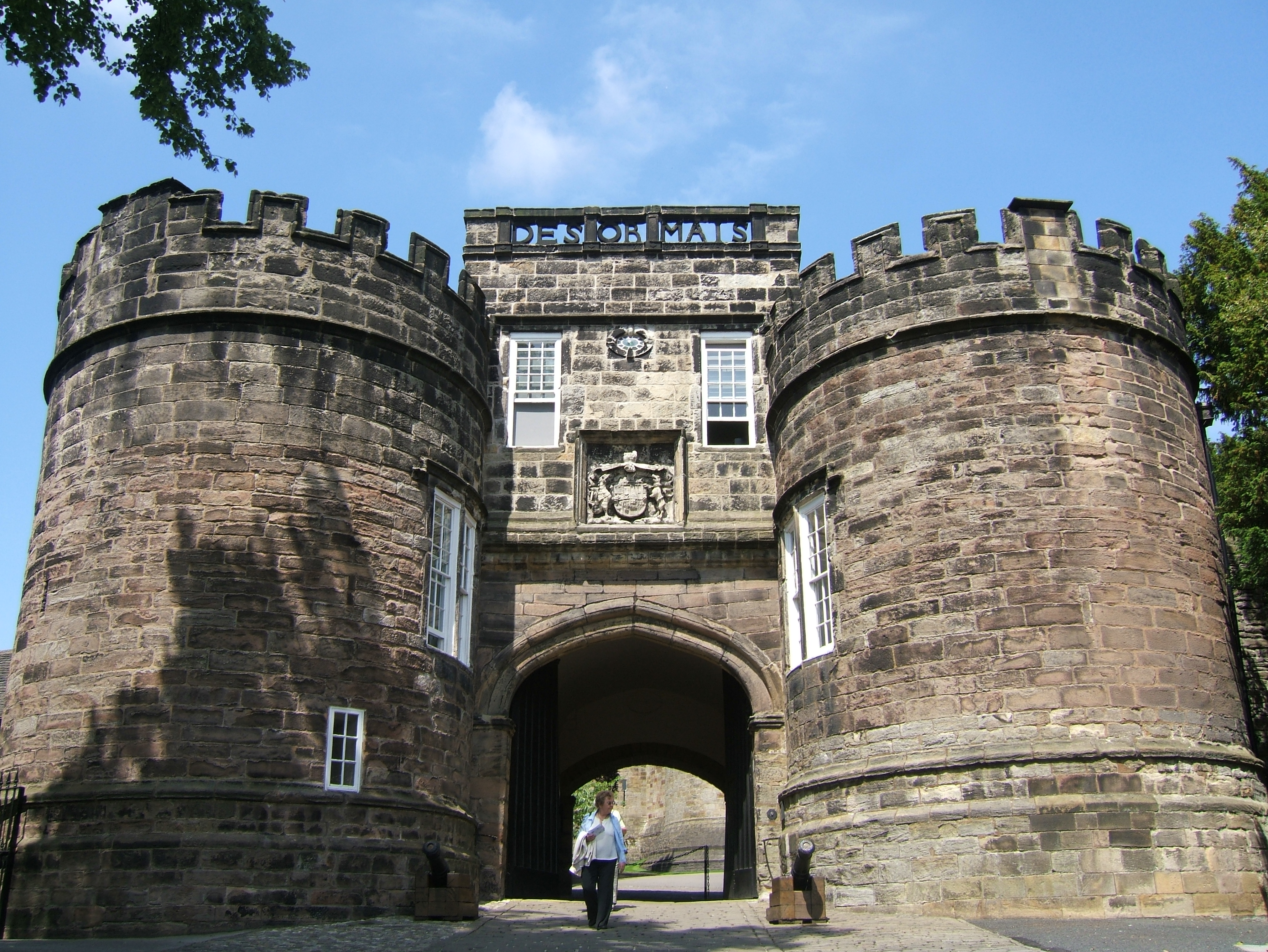
Skipton Castle
A yew tree grows in the courtyard of Skipton Castle. Lady Anne Clifford planted it in 1659 to mark the castle's restoration after the English Civil War, and it has been growing there ever since -- a living monument to a woman who rebuilt what Cromwell's forces tried to destroy. The castle itself is older by centuries, founded in 1090 by the Norman baron Robert de Romille at the north end of what is now Skipton's High Street. It is one of the most complete medieval castles in England, with its roof fully intact, a rarity that owes everything to Lady Anne's stubborn determination.
From Earth to Stone
Robert de Romille built the original castle as a motte and bailey -- earth and timber -- to secure his estates in the Yorkshire Dales. Shortly after 1102, Henry I extended his lands to encompass all of upper Wharfedale and Airedale, and the castle was rebuilt in stone to withstand Scottish raids. The cliffs dropping to Eller Beck gave the position natural strength. When the Romille line died out, Edward II granted the castle to Robert Clifford in 1310, naming him Lord Clifford of Skipton and Guardian of Craven. Clifford immediately began improving the fortifications, but he was killed at the Battle of Bannockburn in 1314, barely finishing the work. The castle he had strengthened held firm when the Scots raided Skipton during the Great Raid of 1322.
The Last Royalist Holdout
During the English Civil War, Skipton became the last Royalist stronghold in northern England. For three years, Parliamentary forces besieged the castle. According to local legend, the garrison hung sheep fleeces over the walls to absorb the impact of cannon fire -- an image that found its way into Skipton's coat of arms. The siege ended on 21 December 1645 with a negotiated surrender. Cromwell ordered the castle slighted, its roofs stripped to render it uninhabitable. The six fortified drum towers, the great hall, the withdrawing rooms, and the lord's bedchamber were left open to the Yorkshire weather. An ancient well may explain how the garrison held out for so long without relief.
Lady Anne's Restoration
Lady Anne Clifford was 55 when the Civil War ended, and she spent the last three decades of her life restoring the castles and churches of her family's northern estates. At Skipton, she repaired everything Cromwell had broken. The castle's roof was replaced -- the reason it stands fully covered today while many of its contemporaries are open ruins. She planted the yew tree in the Conduit Court, the Tudor courtyard at the castle's heart, to commemorate the restoration. Lady Anne was the last Clifford to own Skipton, dying in 1676 at the age of 86. The castle she saved is now the starting point of Lady Anne's Way, a 100-mile long-distance footpath that traces her legacy across northern England to Penrith.
Nine Centuries Standing
The Fattorini family purchased the castle in 1956, and it remains a private residence as well as a tourist attraction. Walking through the entrance that once held a drawbridge, up stairs added in the 16th century, visitors pass through rooms that span nearly a thousand years of continuous use. The original kitchen survives on the first floor alongside the great hall. The ground floor holds newer kitchens and cellars. The drum towers that once served military purposes now frame views across the Yorkshire Dales town that grew up around the castle. Skipton itself takes its character from the fortress at the head of its High Street, a market town that has been living in the shadow of Norman walls since William the Conqueror's followers first raised earth and timber on this spot above Eller Beck.
From the Air
Located at 53.96°N, 2.01°W at the north end of Skipton, North Yorkshire. The castle's drum towers and intact roof are visible from lower altitudes at the head of the town's main street. The Yorkshire Dales extend to the north and west. Nearest airport: Leeds Bradford (EGNM) approximately 18 nm southeast. The Leeds-Liverpool Canal passes through Skipton and provides a visual reference.