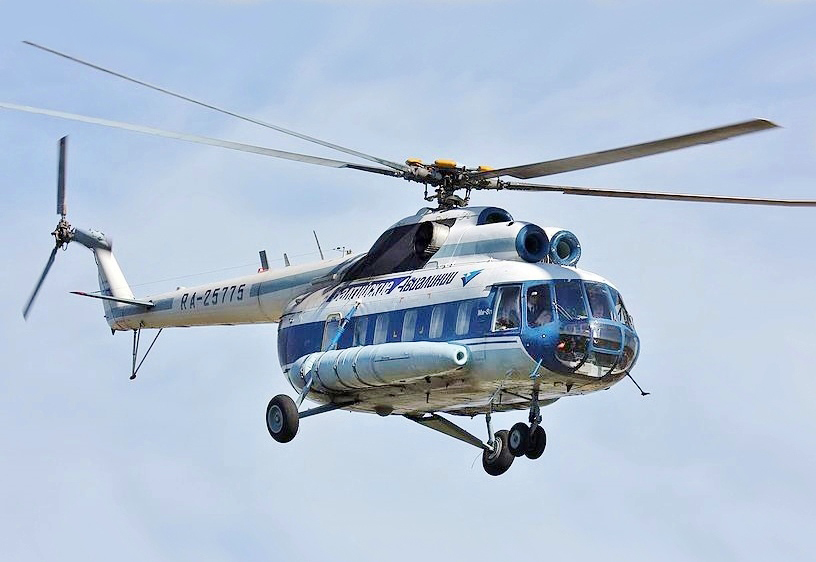
Skol Airlines Flight 9375
Forty-five kilometers short of its destination, with fuel running low and darkness absolute, the helicopter went down. On October 21, 2016, Skol Airlines Flight 9375, a Mil Mi-8 carrying 22 passengers and crew across the Yamal Peninsula, crashed in the tundra of Yamalo-Nenets. Nineteen people died. Three survived. The dead were mostly oil and gas workers, the kind of people who make routine flights across Arctic Siberia because the resources they extract cannot be reached any other way.
The Flight
The Mil Mi-8 is a Soviet-designed workhorse, one of the most widely produced helicopters in aviation history, a twin-turbine machine built for the kind of conditions Siberia routinely delivers. Flight 9375 departed from the Vankor area in the Krasnoyarsk region, bound for the Suzumskoye oil and gas field near Staryi Urengoi in Yamalo-Nenets. The passengers were predominantly oil and gas industry workers, people accustomed to helicopter transport across the vast distances between extraction sites. In this part of Russia, roads are scarce, railways incomplete, and helicopters serve as the primary link between field operations and the outside world. The flight was routine in every sense that matters until it was not.
Into the Dark
The crash occurred 45 kilometers northeast of the helicopter's destination. As fuel levels dropped, the crew attempted an emergency landing. It was night, and the Yamal Peninsula in October offers no light reference points: no city glow on the horizon, no highway headlights, no illuminated landmarks. The tundra is flat, featureless, and dark. The helicopter fell on its side. The position of the wreckage trapped those inside, preventing escape. Three passengers survived. All three crew members perished. Initial reports conflicted, some news outlets reporting 19 dead, others 21. The final confirmed toll was 19 killed out of 22 aboard.
The Investigation
The Interstate Aviation Committee released its final report on August 24, 2017. The conclusion was direct: the crew became disoriented while attempting the emergency landing. Low fuel had forced the decision to land, but the combination of darkness and the complete absence of visual references made spatial orientation impossible. The Mi-8 has instruments for such conditions, but spatial disorientation can overwhelm instrument readings when a pilot's inner ear and visual systems disagree with the gauges. In the Arctic, where flat terrain offers no horizon line and darkness can be total for months, the risk of disorientation during low-altitude maneuvering is acute. The report identified no mechanical failure. The helicopter was functioning. The environment was not survivable for the decisions that had to be made.
The Human Cost of Extraction
Russian President Vladimir Putin expressed condolences to the families. Yamalo-Nenets Governor Dmitry Kobylkin declared a full day of mourning, ordered flags to half-mast, and cancelled entertainment events across the region. The gestures were genuine but also familiar. Helicopter accidents in Russia's oil and gas regions are not rare. The Mi-8, for all its reliability, operates in conditions that push the margins of safe flight: extreme cold, low visibility, vast distances between fuel points, and landing zones that may be nothing more than a patch of tundra selected in desperation. The workers aboard Flight 9375 accepted these risks as part of their employment. They flew because the gas fields required their presence, and the gas fields exist because global energy demand reaches even into the Arctic dark.
A Mark on the Tundra
The crash site lies in open tundra at approximately 67.25 degrees north latitude. There is no memorial visible from the air, no permanent marker on the landscape. The tundra heals slowly in the Arctic, but it heals. Snow covers the ground for most of the year. In summer, the permafrost thaws just enough to support low scrub and moss. The nineteen people who died on Flight 9375 were part of a workforce that operates largely invisible to the consumers of the energy they help extract. Their commute was a helicopter ride across the darkness of the Yamal Peninsula, and on October 21, 2016, that commute ended 45 kilometers short of arrival.
From the Air
Crash site located at approximately 67.25°N, 74.67°E on the Yamal Peninsula in Yamalo-Nenets Autonomous Okrug. The area is flat tundra with no distinguishing features visible from altitude. Nearest airports include Novy Urengoy (USMU) to the south and Salekhard (USDD) to the west. The helicopter was en route from Vankor (Krasnoyarsk region) to Suzumskoye field near Staryi Urengoi. Extreme caution warranted for low-altitude operations in this region due to featureless terrain, lack of light references, and subarctic weather. Recommended overfly altitude: 5,000+ feet AGL.