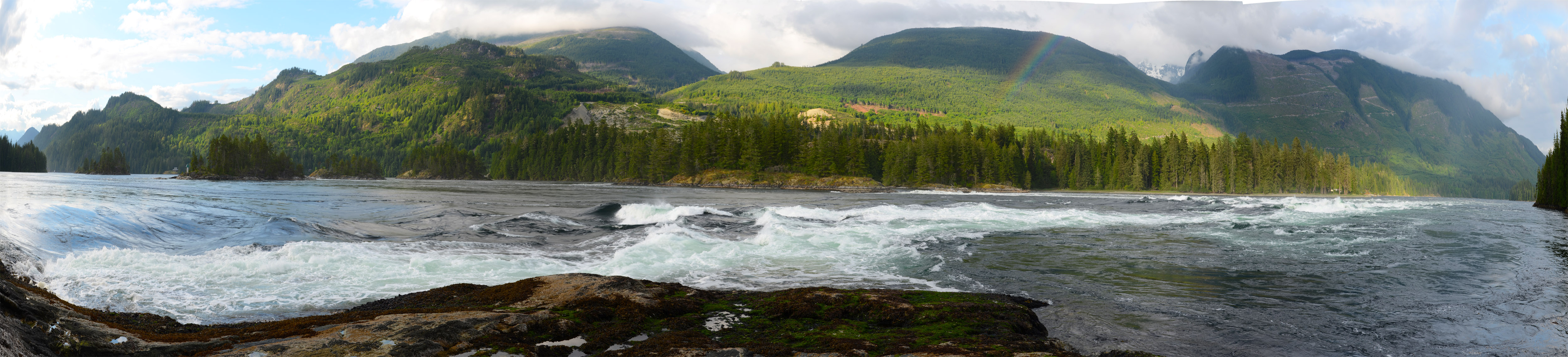
Skookumchuck Narrows
Twice a day, the ocean tries to pour itself through a gap that is simply too narrow to accommodate it. The result, at Skookumchuck Narrows on British Columbia's Sunshine Coast, is a spectacle that looks like whitewater rapids transported to the open sea: standing waves rear up, whirlpools spin and dissolve, and whitecaps shatter the surface even when there is not a breath of wind. The word skookumchuck comes from Chinook Jargon -- the old trade language of the Pacific Northwest coast -- and means exactly what you see here: strong water.
The Bottleneck
Sechelt Inlet is a deep fjord. So are its two tributaries, Salmon Inlet and Narrows Inlet. All of that tidal water -- every drop flowing in or out of three interconnected waterways -- must pass through the Skookumchuck Narrows and the Sechelt Rapids that lie within them. On a three-meter tide, that amounts to roughly 200 billion US gallons of seawater forcing through a passage far too constricted for the volume. The difference in water level between the two sides of the rapids can exceed two meters. Current speeds surge past 16 knots, with measurements recorded as high as 17.68 knots. To put that in perspective, most boats under sail struggle to reach those speeds. The water here moves faster than many vessels can.
A Name Carried Across the Coast
The Chinook Jargon that gave Skookumchuck its name was no single people's language but a pidgin -- a trade tongue assembled from Chinook, Nuu-chah-nulth, French, and English words, spoken up and down the Pacific Northwest coast wherever commerce required a common vocabulary. Skookumchuck became the generic term in maritime jargon for any set of strong tidal rapids, particularly at the mouth of an inlet. The word appears across British Columbia: an unrelated town called Skookumchuck sits several hundred kilometers east in the East Kootenay region, and Skookumchuck Hot Springs lies along the Lillooet River east of Whistler. Each place earned its name from the same observation -- water here is powerful -- but this narrows, at the gate of Sechelt Inlet, is the most dramatic bearer of the title.
Life in the Churn
The relentless tidal motion creates an ecosystem as dynamic as the water itself. Nutrients churn continuously through the water column, supporting a density of marine life that draws divers, kayakers, and wildlife watchers to the narrows throughout the year. The constant current means the water is almost never still -- even at the brief slack between tides, residual flow keeps things moving. This perpetual motion sustains everything from invertebrates clinging to the rocks to the larger marine mammals that patrol the passage. Skookumchuck Narrows Provincial Park provides land-based access to viewpoints above the rapids, and the best viewing times -- predictable down to the minute, because tides wait for no one -- draw crowds who stand on the bluffs watching the sea boil below.
A Whale Trapped Behind the Rapids
The narrows figure in the literary imagination of the coast through M. Wylie Blanchet, the BC writer best known for her memoir The Curve of Time. Her posthumously published second book, A Whale Named Henry, tells the story of a small whale that becomes trapped behind the rapids -- unable to navigate back through the violent passage that separates Sechelt Inlet from the open sea. The premise is entirely plausible. Anything that enters through the Skookumchuck during slack tide faces a very different negotiation on the way out, and the narrows have likely served as a natural barrier to marine life for as long as the fjord has existed. The currents do not discriminate between kayaks, sailboats, and whales.
From the Air
Located at 49.76°N, 123.92°W on BC's Sunshine Coast. From altitude, the narrows are visible as the constriction point where Sechelt Inlet meets Jervis Inlet -- look for turbulent white water during tidal flow, particularly dramatic on large tides. The narrow passage contrasts sharply with the broad, calm waters of the inlet behind it. Nearest airports: Sechelt-Gibsons Airport (CAA3) and Powell River Airport (CYPW, ~35 nm NW). Vancouver International (CYVR) is approximately 55 nm to the southeast. Best viewed at 2,000-4,000 feet AGL. The rapids are most visually striking during peak tidal exchange.