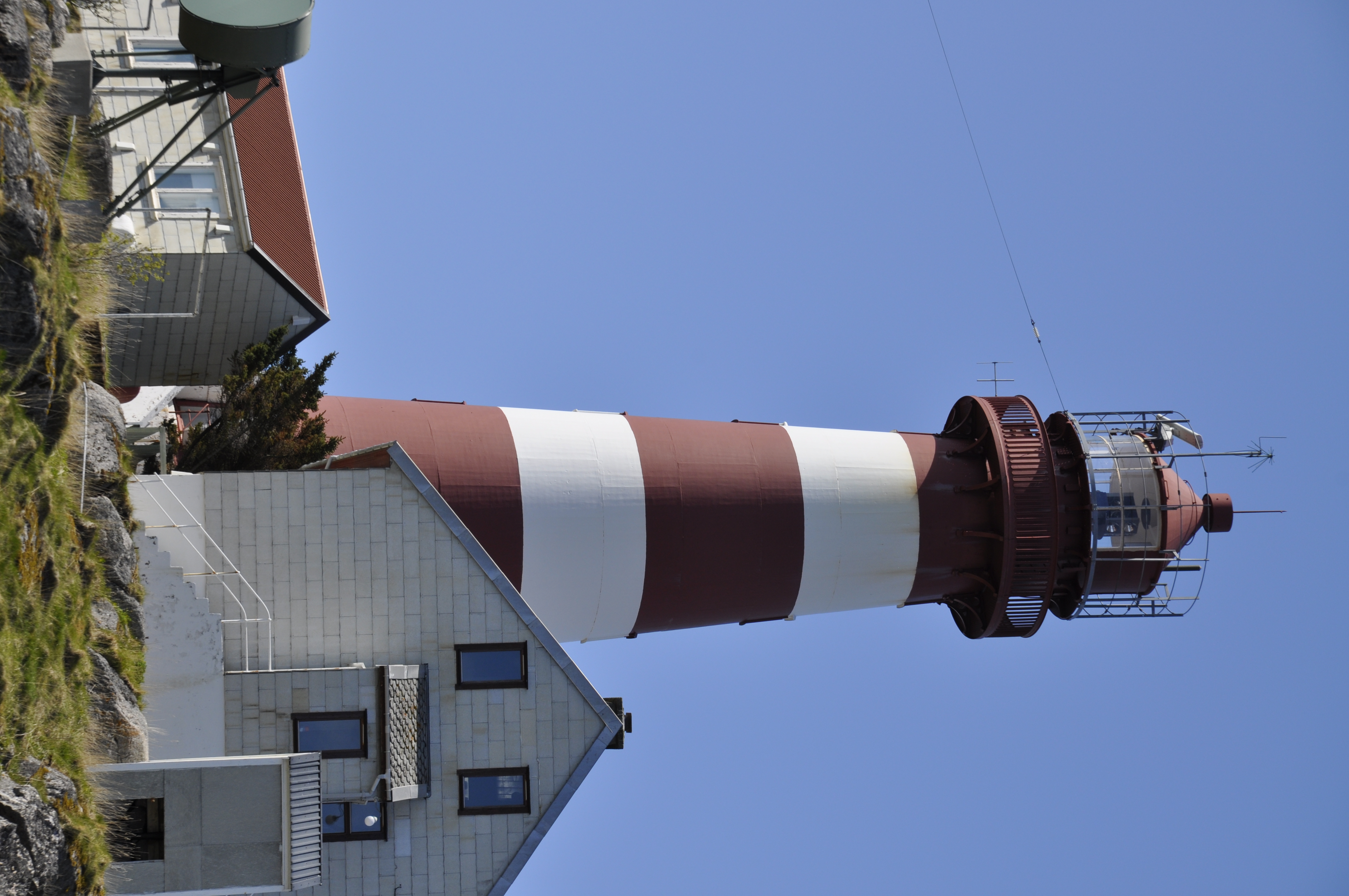
Skrova Lighthouse
Two white flashes every forty-five seconds. That is the signature of Skrova Lighthouse, a pattern that fishermen and coastal pilots have watched for since 1922, reading its rhythm against the darkness of the Arctic winter. The lighthouse stands on a bare skerry southwest of the island of Skrova, exposed to the full fetch of the Vestfjorden in Nordland county, Norway. It is not the most famous lighthouse on the Norwegian coast, nor the oldest. But at 2,298,000 candela, it is one of the most powerful -- a beacon built to cut through fog, snow squalls, and the long polar night that descends on the Lofoten archipelago each winter.
A Carpenter's Tower on the Edge of the Sea
Carl Wiig designed the lighthouse in 1920, and the Norwegian Lighthouse Administration contracted a team of carpenters from Volda, a town on the western coast far to the south, to build it. Construction on a wind-scoured skerry above the Arctic Circle was no small undertaking. Materials had to be ferried across open water, and work could only proceed during the brief windows when the sea allowed approach. The tower they built stands 24.5 meters tall, painted red with two horizontal white stripes -- a daymark visible to approaching vessels long before the light itself becomes necessary. The lantern sits at an elevation of 41 meters above sea level, its two white flashes repeating in a 45-second cycle. When the lighthouse was first lit in 1922, it joined a network of coastal lights that made navigation through the treacherous waters of the Lofoten fishery possible in the dark months.
Guardian of the Vestfjorden
The Vestfjorden is the wide body of water separating the Lofoten Islands from the Norwegian mainland, and it is where the great seasonal cod fishery has taken place for centuries. Skrova sits at the threshold of this water, near the eastern approach to the archipelago. For incoming fishing boats making the winter run to Lofoten, Skrova Lighthouse was the first confirmation of safe arrival -- the signal that the open sea crossing was behind them and the sheltered harbors of Svolvaer and Kabelvag lay ahead. The lighthouse served not only commercial fishermen but also coastal shipping traffic, including the Hurtigruten passenger vessels that have operated along the Norwegian coast since 1893. In these waters, where winter gales can reduce visibility to nothing and daylight vanishes entirely for weeks, a dependable light was not a convenience but a necessity.
The Keepers and the Machine
For more than eight decades, lighthouse keepers maintained the light at Skrova, living on the isolated skerry through conditions that most people would find unbearable. The keeper's duty was straightforward but relentless: tend the light, monitor the weather, report conditions. In 2005, the Norwegian Coastal Administration automated the lighthouse, ending the tradition of human attendance. The keepers departed, but the light continued its cycle without interruption. Automation brought efficiency, but it also silenced the human presence that had defined the skerry for generations. Recognition of the lighthouse's cultural significance came earlier, in 1999, when it was listed as a protected heritage site -- an acknowledgment that the tower, its daymark, and its setting formed a landscape worth preserving beyond mere navigational utility.
Light Against the Dark
Skrova Lighthouse belongs to a tradition of Norwegian coastal engineering that stretches back to the eighteenth century, when the first permanent lights were established along a coastline so convoluted it contains more than 100,000 kilometers of shore. Norway eventually built one of the densest lighthouse networks in the world, a chain of beacons marking every headland, reef, and harbor entrance from the Oslofjord to Finnmark. Most have been automated now, and many of the smaller ones decommissioned. But the major coastal lights endure, their beams still sweeping across water that radar and GPS have not made any less dangerous in a gale. At Skrova, the red tower on its bare rock remains exactly what Wiig and his Volda carpenters intended: a point of certainty in uncertain waters, two white flashes repeating through the night, forty-five seconds apart.
From the Air
Located at 68.15N, 14.65E on a small skerry southwest of Skrova island in the Lofoten archipelago, Nordland county, Norway. The red tower with white bands is visible against bare rock in the Vestfjorden. Nearest airport is Svolvaer/Helle (ENSH), approximately 8 km northwest. The lighthouse sits at the eastern entrance to the Lofoten fishing grounds. Best viewed at 1,500-3,000 ft for detail of the tower and its skerry setting. Austvagoya island rises to the north.