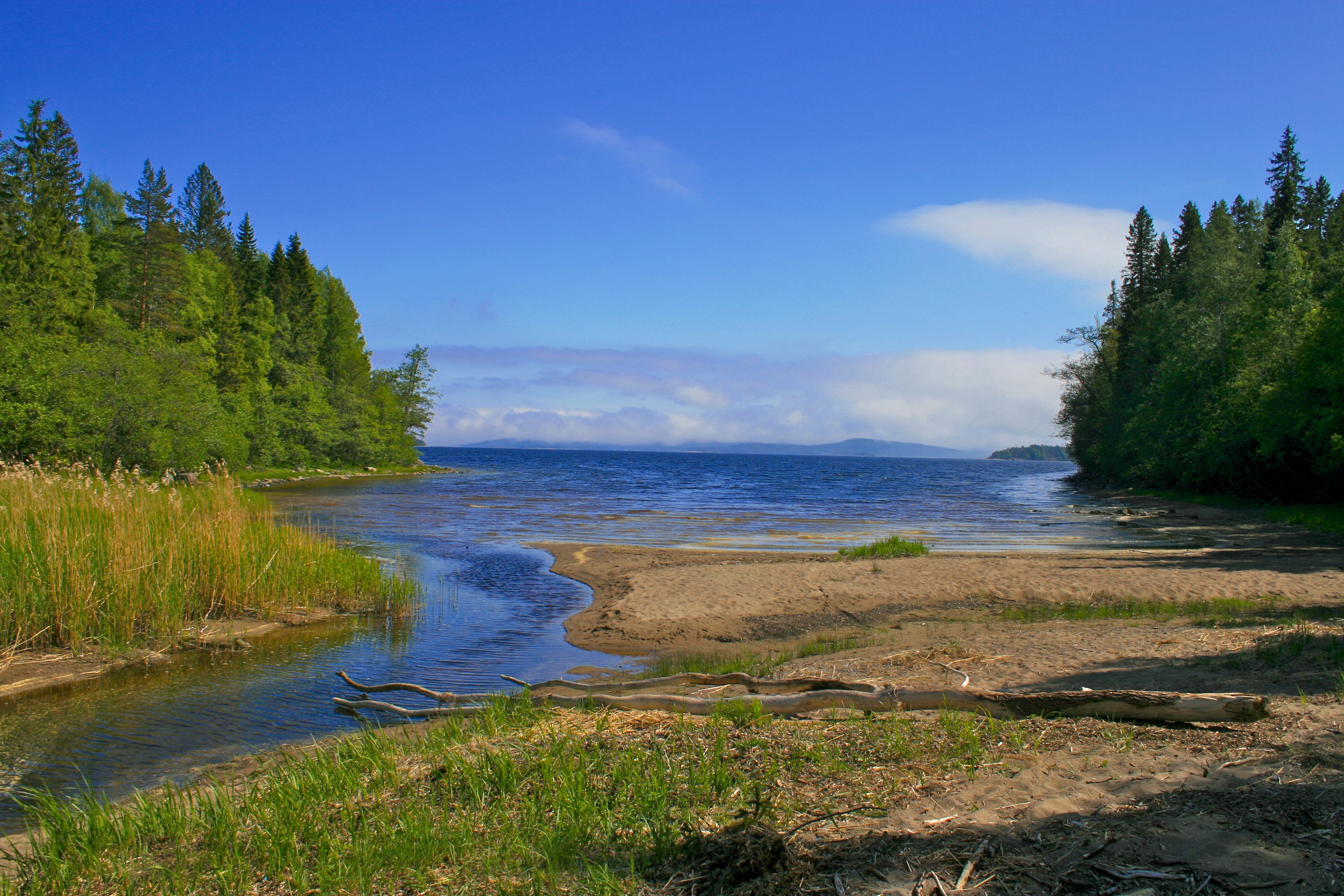
Skuleskogen National Park
According to local legend, brigands arrived in the Skule forest during the 7th century. Rejected by the surrounding villages, they retreated into a cave called Skulegrottan and terrorized anyone who dared cross through the dense woods. A young peasant eventually infiltrated their group by claiming the villagers had cast him out too. Centuries later, novelist Kerstin Ekman set her book The Brigands of the Forest of Skule in this same landscape, telling the story of an immortal troll named Skord whose curiosity about humans leads him through ages of adventure. The real Skuleskogen needs no fiction to be extraordinary. Established as a national park in 1984 on Sweden's High Coast, it is a place where the earth itself is still in motion -- rising from the sea at a pace visible within a human lifetime.
A Landscape Still Becoming
Skuleskogen sits on a coastline that refuses to hold still. When the glaciers of the last Ice Age retreated, they left behind land that had been compressed under kilometers of ice. That land is still rebounding, and the effects are written across the park's terrain. Mountain peaks that were once islands now stand well inland. The ancient coastline reveals itself through what are called vegetation caps -- patches of undisturbed plant life on summits that were never submerged after the glaciers melted. Because waves never eroded the moraines at these heights, soil accumulated and plants took hold, giving certain mountains the name Kalottberg, or "cap mountain." Former islands called Tarnattholmarna have become peninsulas. Sandy barriers now separate inland lagoons from the open sea. Thirty-six percent of the park is naked granite, scoured clean by ice and water, a reminder that this landscape is geologically young and still being shaped by forces that operate on timescales both vast and, by geological standards, surprisingly fast.
Where Taiga Meets the Sea
The park straddles a biological boundary. Skuleskogen marks the northern limit for several deciduous species -- small-leaved linden, common hazel, guelder rose, and Norway maple all reach the edge of their range here. But deciduous forest covers barely 42 hectares, just over one percent of the park's area. The overwhelming character is Scandinavian taiga: dense Norway spruce broken by Scots pine at higher elevations where the forest thins toward bare rock. No fire has swept through in two centuries, a departure from the natural cycle that once periodically cleared the understory. Beneath the conifer canopy, lingonberry and blueberry carpet the forest floor. On the exposed granite, dwarf pines grow slowly enough that some specimens are five hundred years old, their twisted forms a testament to patience in a landscape of thin soil and long winters. Streams feed lakes throughout the park -- Tarnattvattnen at nearly eight hectares and Stocksjon at six -- while 125 hectares of fens add boggy complexity to the terrain.
Lynx, Bear, and the Haunted Wood
Skuleskogen shelters the animals of northern Sweden's deep forest. Eurasian lynx and brown bear, both considered endangered in the country, move through the park alongside moose, red fox, European badger, and pine marten. Eurasian beavers work the waterways, and grey seals haul out along the coastal edges. The birdlife is equally rich: grey-headed woodpeckers drum in old-growth stands, common cranes stalk the fens, and hazel grouse rustle through the understory. The terrain's roughness is precisely what preserved it. Because the topography discouraged permanent settlement, no trace of habitation has been found within the park boundaries, though Stone Age sites exist ten kilometers to the northwest at Bjastamon. A trail called the Kustlandsvagen once threaded through the forest, roughly following what is now European route E4, and for centuries it served as the only road north through this part of Sweden. Four summer pasture cottages operated within what is now the park, the last of which -- Naskebodarna -- remained active until the end of World War II.
Walking the High Coast
The Hoga Kustenleden, the long-distance trail that traces Sweden's High Coast, passes through Skuleskogen for 8.7 kilometers from north to south. The park has three entrances and five shelters -- converted from private homes that predated the park's creation -- at Norrsvedjebodarna, Tarnattvattnen, Tarnettholmarna, Tarnettsundet, and Naskebodarna. Most trails concentrate in the eastern third of the park, which is designated as the high-activity zone. The remaining sixty-five percent is kept as a low-activity core where infrastructure is deliberately sparse. In winter, skiers take over the trails, and the park's terrain is steep enough to permit alpine descents. Kayakers explore the coastline, swimmers seek out the warmer waters of the Salsviken lagoon, and cyclists ride the coastal path. The park's protection began in 1968, when an environmental inventory flagged its natural value. In 1974, parts were classified as a temporary nature reserve, and the full national park was established a decade later, expanded again in 2009 with additional land from the surrounding reserve.
From the Air
Located at 63.11N, 18.48E on Sweden's High Coast (Hoga Kusten), a UNESCO World Heritage Site in Vasternorrland County. The park occupies a rugged stretch of coastline along the Gulf of Bothnia. The dramatic elevation changes from sea level to mountain summits are visible from the air, as are the former islands now connected to the mainland by post-glacial rebound. Nearest airport is Ornskoldsvik Airport (ESNO), approximately 30 km to the north. The visitor center Naturum Hoga Kusten is located at Skuleberget just outside the park. Best viewed at 3,000-6,000 feet where the contrast between forest, rock, and coast is most dramatic.