Sky Tower
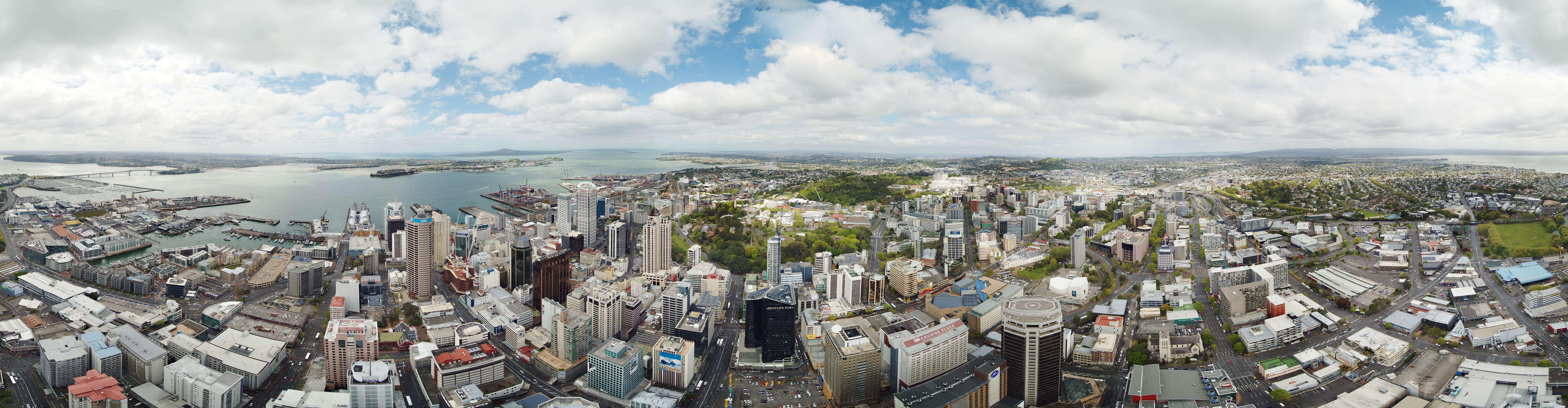
When early sketches circulated in the 1990s, Aucklanders compared the design to a sewer pipe. Architect Gordon Moller heard the jokes, but he also heard silence from the critics once the Sky Tower opened on 3 August 1997 and immediately redefined the city's silhouette. At 328 metres, this reinforced-concrete needle stood as the tallest freestanding structure in the Southern Hemisphere for over a quarter century. Today it remains the anchor point of Auckland's skyline, visible from ferry decks, volcanic summits, and flight paths across the Hauraki Gulf.
A Sewer Pipe That Scraped the Sky
The tower almost never stood where it does. Its first proposed site was on Upper Symonds Street in Eden Terrace, beside a shopping centre, but viewshaft restrictions killed the plan. An earlier design would have clad the shaft in stainless steel, which was dropped for cost reasons. What remained was a high-performance concrete core engineered to withstand an 8.0 magnitude earthquake within 20 kilometres. Fletcher Construction built it in two years and nine months, raising the structure with a crane bolted directly to the tower itself because no helicopter could bear the weight. Removing that crane required building a second crane, which dismantled the first before being broken into pieces small enough to fit inside the elevator. The solution was pure New Zealand ingenuity: practical, slightly absurd, and effective.
Higher Than the Fireworks
Five public levels stack the upper floors like a vertical village. Level 51 holds the main observation deck, where thick glass floor panels let visitors stare 186 metres straight down to the pavement. One floor up, Orbit 360 Dining is New Zealand's only revolving restaurant, completing a full rotation every hour. At the very top, the Skydeck sits just below the main antenna, offering views that stretch to the horizon in every direction. For those who find standing behind glass too sedate, SkyJump offers a 192-metre controlled freefall from the observation deck, with guide cables preventing wind gusts from swinging jumpers into the tower. The 2025 New Year's fireworks display, shot at 360 degrees from three platforms on the tower, was the highest firework show in the Southern Hemisphere.
The Spine of Auckland's Airwaves
What tourists see as a landmark, broadcasters see as infrastructure. The aerial at the top of the Sky Tower hosts the largest FM combiner in the world, feeding radio signals across the Auckland region. The Auckland Peering Exchange, a critical internet traffic hub, sits on Level 48. Two VHF analogue television channels once broadcast from the tower before being switched off in the early hours of 1 December 2013, part of New Zealand's digital transition. The tower's dual identity as both attraction and telecommunications facility was baked into the original brief from SkyCity Entertainment Group, which wanted a structure that would draw crowds and carry signals in equal measure.
A Canvas 328 Metres Tall
After dark, the Sky Tower becomes Auckland's largest piece of public art. Energy-efficient LEDs, which replaced the original metal halide floodlights in stages between 2009 and 2019, can produce millions of colour combinations via a DMX controller, using 66 percent less energy than the original system. The tower has glowed blue and white for New Zealand's vaccination milestones, blue and yellow in solidarity with Ukraine, and bright blue to honour slain Constable Matthew Hunt. During the winter of 2008, SkyCity switched the lights off entirely to conserve electricity during a national power shortage, leaving only the flashing red aviation lights. It was reilluminated on 4 August that year to support New Zealand's athletes at the Beijing Olympics. Each colour choice turns the tower into a barometer of what the city cares about at any given moment.
Climbing the Vertical Marathon
Every year, firefighters from across New Zealand race up 1,108 of the Sky Tower's 1,267 steps in full gear for the Leukemia and Blood Foundation's Stair Challenge. Participants call it a vertical marathon, and the analogy holds: the ascent is relentless, the air thins with effort if not altitude, and the finish line comes with a panoramic reward that no road marathon can match. The event captures something essential about how Aucklanders relate to their tower. It is not a monument to be admired from a distance. People jump off it, dine atop it, climb inside its antenna mast, and race up its stairwells. It exists to be used, not just seen.
From the Air
Located at 36.848°S, 174.762°E in central Auckland CBD. At 328 m, the tower is unmistakable on approach to Auckland Airport (NZAA). Visible from well beyond 50 nm in clear conditions. The tower sits near the waterfront between Waitematā Harbour and the volcanic cones to the south. Recommended viewing altitude: 2,000-3,000 ft for dramatic skyline perspective. Nearby airports: Auckland International (NZAA), Ardmore (NZAR), Whenuapai (NZWP).