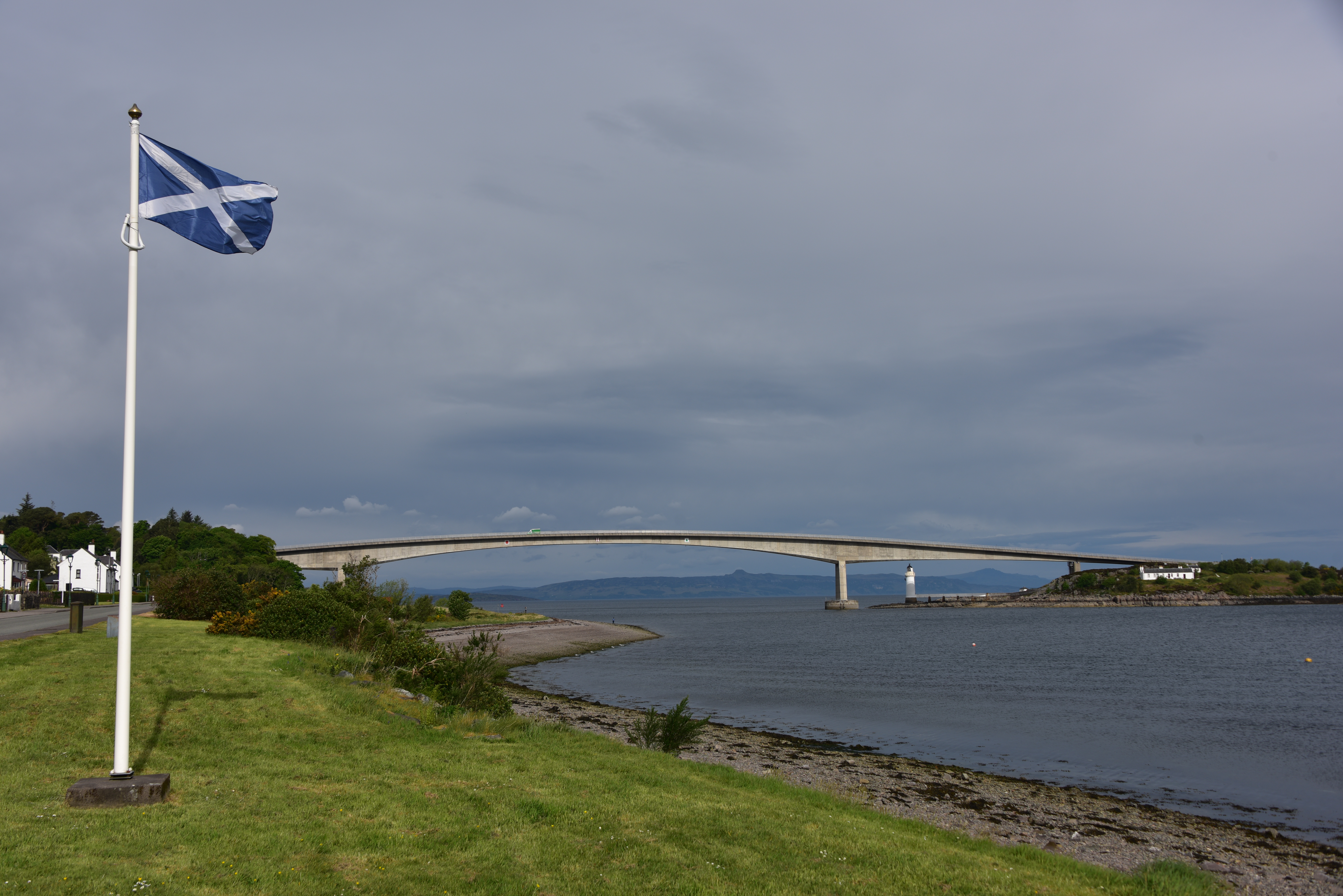
Skye Bridge
By 2004, crossing the Skye Bridge cost visitors 11.40 pounds for a round trip -- fourteen times the price of the Forth Road Bridge, a crossing more than twice as long. Protesters called it the most expensive road in Europe. Around 500 people were arrested for refusing to pay, 130 convicted, and one man briefly imprisoned. The bridge that was supposed to end Skye's isolation instead became the most contentious piece of infrastructure in modern Scotland, a test case for the Private Finance Initiative, and a demonstration of what happens when a community decides that a public road should not have a private toll.
Four Centuries by Ferry
For roughly four hundred years, getting to Skye meant taking the ferry. The crossing between Kyle of Lochalsh on the mainland and Kyleakin on the island's east coast spanned barely 500 metres, but it was the narrowest point in a much wider barrier of water and weather. A ferry service operated from around 1600, eventually run by Caledonian MacBrayne. By 1971, two 28-car ferries carried more than 300,000 vehicles annually, and the queues in summer stretched the patience of tourists and locals alike. The engineering to bridge the gap was straightforward -- the crossing was shorter and shallower than the Forth Bridge, completed in 1890. But Skye's remoteness and small population made the economics difficult to justify.
A Bridge Built on Private Finance
In 1989, the Conservative government announced plans for a toll bridge, the first major project funded by the Private Finance Initiative. The contract went to Miller-Dywidag, a consortium backed by the Bank of America, who designed a single-span concrete arch using the tiny island of Eilean Ban as a stepping stone. The caissons supporting the main span were cast as hollow cylinders in the old Kishorn Dry Dock -- originally built for the oil industry but having produced only one rig -- then floated into position and sunk onto the loch bed. Construction began in 1992. The bridge opened on 16 October 1995, the ferry ceased running, and the toll booths opened for what would become a decade of bitter conflict.
The Toll Revolt
The anger was not abstract. Islanders who had been waved onto the ferry free of charge by sympathetic ferry workers now faced mandatory payment every time they crossed. The campaign group SKAT organized mass protests and a sustained non-payment campaign. Toll collectors reported routine abuse from motorists. Among those charged was Clodagh Mackenzie, an elderly woman whose land had been compulsorily purchased for the bridge's arrival on Skye; her charges were dropped without explanation. Those convicted had to make a 140-mile round trip to Dingwall Sheriff Court, crossing the bridge again -- and many refused to pay again, earning a fresh criminal charge. Campaigner Robbie the Pict argued that the legal paperwork authorizing the tolls had never been properly completed. The local procurator fiscal, David Hingston, later admitted he had been denied access to government documents on the case, telling the BBC: "As a fiscal I was stuck with that evidence but as a private individual I found it stunning."
Free at Last
Political pressure mounted through the late 1990s and early 2000s. After the creation of the Scottish Parliament, the Liberal Democrats made toll abolition a coalition priority. On 21 December 2004, Scottish Transport Minister Nicol Stephen announced that the bridge had been purchased for approximately 27 million pounds, and toll collection ceased immediately. In its decade of operation, 33.3 million pounds in tolls had been collected -- considerably more than the bridge's construction cost. The crossing now carries traffic freely as part of the A87, and the Gaelic-language documentary An Drochaid preserves the story of the fight. Today drivers cross between Kyle of Lochalsh and Kyleakin in under a minute, most with no idea of the battle that was waged so they could do so without charge.
From the Air
Located at 57.28N, 5.74W, the Skye Bridge is clearly visible from the air spanning the narrow strait between Kyle of Lochalsh and Kyleakin, with the small island of Eilean Ban visible beneath the span. Nearest airport is Broadford airstrip on Skye; nearest ICAO airport is Inverness (EGPE). Best viewed at 1,500-3,000 feet. The bridge forms part of the A87, and the old ferry slipways are still visible on both shores.