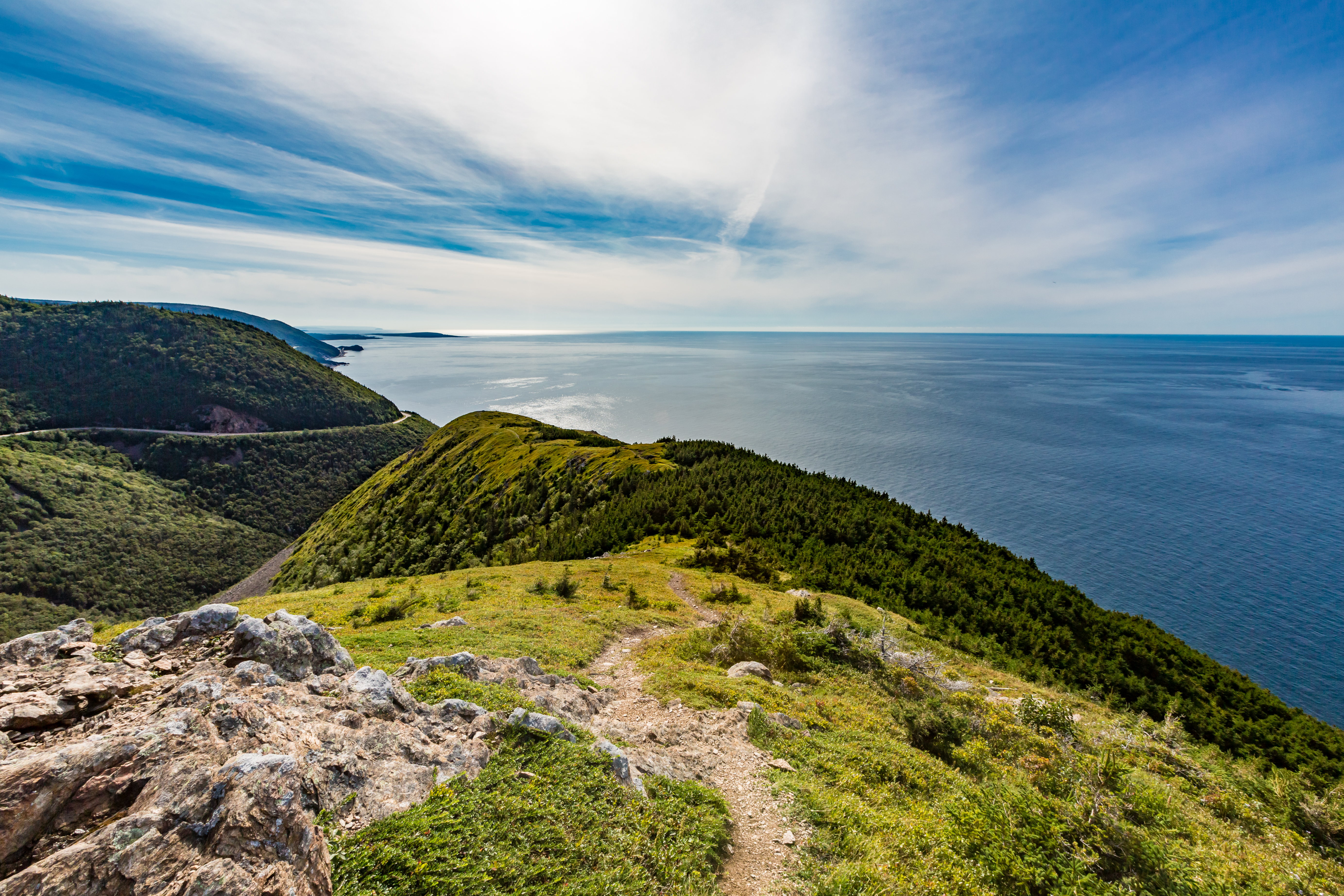
Skyline Trail (Cape Breton Highlands National Park)
On October 27, 2009, another hiker on the Skyline Trail photographed two coyotes behaving aggressively. Six minutes later, those coyotes attacked 19-year-old Taylor Mitchell, a rising Canadian folk singer hiking alone on the same path. She died that night from her injuries -- the first documented case of coyotes killing an adult in North American history. The trail, a seven-kilometer loop near French Mountain's summit in Cape Breton Highlands National Park, had been known for its spectacular views of the Cabot Trail winding along the coast below. After Mitchell's death, it became known for something else entirely: the reminder that the beauty of wild places and their danger are not separate qualities but the same one.
The Edge of the Highlands
The Skyline Trail begins on the western side of the Cabot Trail near the summit of French Mountain in Cape Breton Highlands National Park, Nova Scotia. The seven-kilometer loop divides neatly into two halves. The first section is well-maintained and virtually wheelchair accessible, a gentle path through boreal forest. The second half crosses stony ground and meadows, an easy but wilder hike. At the midpoint, a boardwalk of 275 steps descends toward the coast, delivering the view that draws thousands of hikers each year: the Cabot Trail ribboning along the cliff face below, the Gulf of St. Lawrence stretching to the horizon, and on clear days, the faint outline of distant shores. Interpretive panels along the route explain the ecology and geology, but most hikers come for the visual drama of standing on a headland where boreal forest gives way to open sky.
Where the Wild Things Are
The trail's wildlife is abundant and varied. Moose browse in the meadows and forest edges, sometimes blocking the path entirely. Black bears move through the underbrush. Offshore, the waters host a remarkable congregation of marine mammals: minke whales, humpback whales, fin whales, sei whales, pilot whales, harbour porpoises, Atlantic white-sided dolphins, harbour seals, harp seals, and grey seals. Northern gannets patrol the coastal waters from above. It is one of the richest wildlife viewing corridors in Atlantic Canada, a place where terrestrial and marine ecosystems meet at a dramatic cliff edge. But the animal that changed the trail's story was one most hikers would barely notice -- the eastern coyote, a hybrid species larger and more aggressive than its western relatives, which had colonized Cape Breton decades earlier and found in the park's boreal landscape an environment with abundant prey and limited human pressure.
Taylor Mitchell
Taylor Mitchell was 19 years old and building a promising career as a folk singer when she decided to hike the Skyline Trail alone on October 27, 2009. The attack came without the kind of warning most hikers would recognize. Another visitor had photographed two bold coyotes on the trail just minutes before. Mitchell was found with severe injuries and taken to Sacred Heart Community Health Centre in Cheticamp, then airlifted by helicopter ambulance to Halifax's Queen Elizabeth II Health Sciences Centre, where she died after midnight from extreme blood loss. DNA testing confirmed the identity of the coyotes responsible, and park resource managers and provincial wildlife officials killed the offending animals within six days. The attack was unprecedented -- no documented case of coyotes killing an adult had been recorded anywhere in North America. An earlier non-fatal attack on the trail, in July 2003, had injured a seventeen-year-old American girl hiking with her parents, but it had not prompted the kind of reassessment that Mitchell's death demanded.
What Changed
Mitchell's death triggered a five-year research project funded by Parks Canada, NSERC, and academic collaborators to understand what had driven the coyotes to such extreme behavior. Warning signs now greet hikers at every trailhead, educating visitors on how to respond in coyote habitat. The measures did not prevent another incident: on August 9, 2010, a coyote bit a sixteen-year-old girl twice on the head while she camped with her parents in Ingonish, on the park's eastern end. She required stitches and rabies treatment. Meanwhile, the park faces a parallel ecological challenge. Moose populations have so heavily browsed the boreal forest that Parks Canada launched a restoration project in 2015, building two-hectare enclosures on the trail to protect young trees. Over 57,000 trees have been planted in and around these exclosures. The Skyline Trail now embodies a tension that defines modern conservation: how to keep wild places genuinely wild while making them safe enough for the public that funds their protection.
From the Air
Located at 46.74N, 60.88W on the western coast of Cape Breton Highlands National Park, Nova Scotia. From the air, the trail is visible as a path emerging from boreal forest onto an exposed headland overlooking the Gulf of St. Lawrence. The Cabot Trail highway is visible winding along the cliffs below. The nearest airports are Port Hawkesbury Airport (CYPD) to the south and J.A. Douglas McCurdy Sydney Airport (CYQY) to the east. The park's highland plateau and dramatic western coastline are unmistakable from altitude. Weather can shift rapidly; fog and high winds are common along this exposed coast.