Slab City: The Last Free Place in America
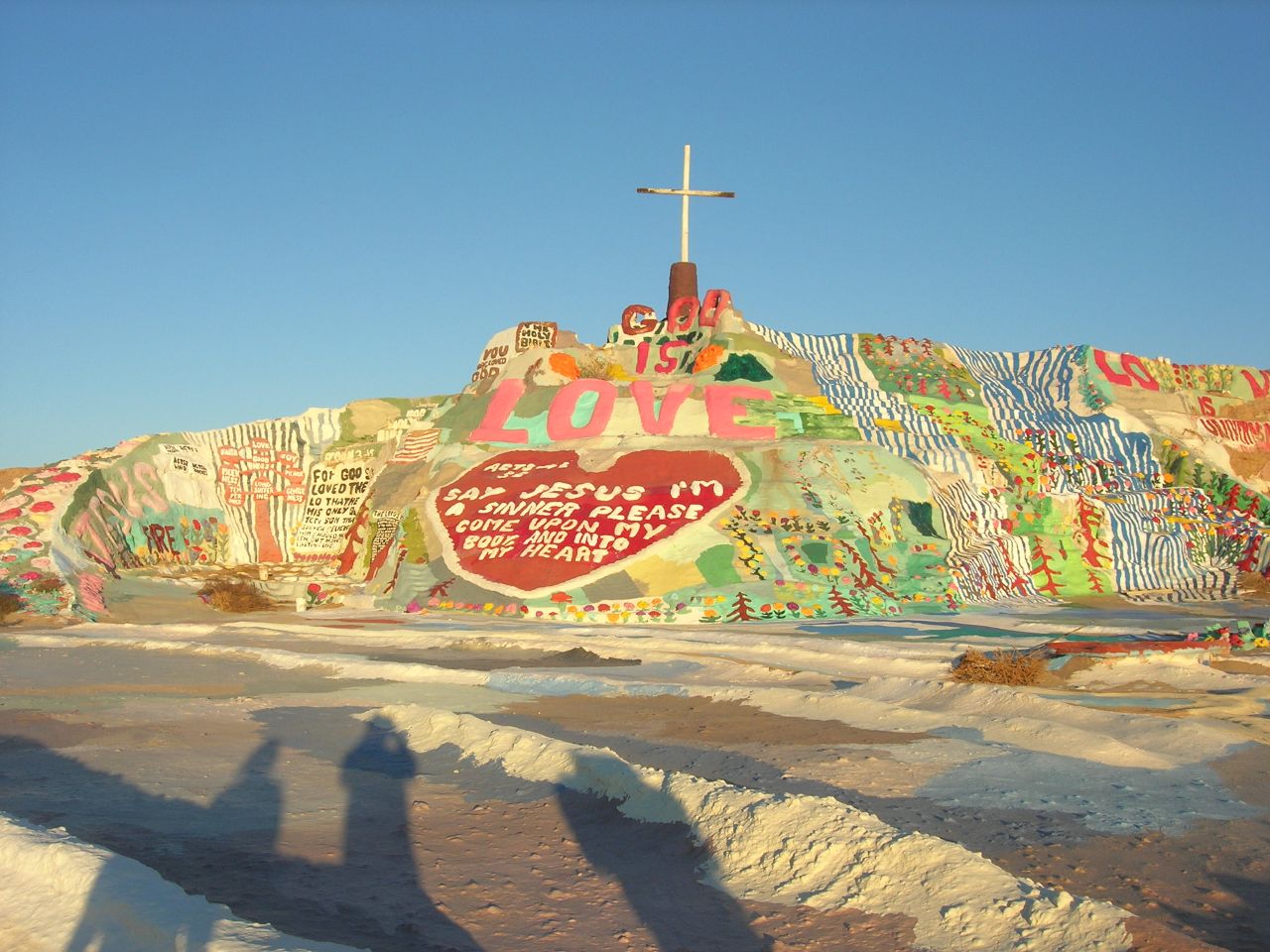
Three hours east of San Diego, past the last outposts of civilization, the concrete slabs of an abandoned Marine base host America's largest squatter community. Slab City has no mayor, no police, no running water, no electricity grid, and no rent. What it has is freedom - the kind that attracts artists, outlaws, drifters, and refugees from the American dream. Winter brings snowbirds escaping the cold; summer brings heat that kills the unprepared. At the entrance stands Salvation Mountain, a hillside painted in a fever dream of color by folk artist Leonard Knight, who spent 28 years covering the desert in religious proclamation. Slab City is the end of the road - literally the last stop before nothing. For some, that's exactly the point.
The Ruins
Camp Dunlap was a World War II Marine Corps base, built for desert training, abandoned after the war. The military took the buildings but left the concrete slabs - foundations for barracks, streets going nowhere, infrastructure waiting for reuse. By the 1960s, people had started camping on the slabs: retirees, drifters, anyone who wanted free land. The community grew organically, governed by nothing except informal norms. Today, winter population swells to perhaps 4,000; summer drops to a few hundred hardy souls who can survive triple-digit heat with no air conditioning. The land is technically state-owned; eviction has been discussed and deferred for decades.
Salvation Mountain
Leonard Knight arrived at Slab City in 1984 with a hot-air balloon and a message: 'God Is Love.' When the balloon failed, he started painting a hillside instead. For 28 years, until his death in 2014, Knight covered Salvation Mountain in paint, adobe, straw, and whatever materials he could scavenge - layer upon layer of color proclaiming 'Jesus I'm a sinner please come upon my body and into my heart.' The mountain is his masterpiece: three stories of psychedelic folk art, a desert chapel built by one man's obsession. It's now a National Treasure recognized by Congress, maintained by volunteers, visited by tourists who find a dead man's vision still radiating in the California sun.
The Society
Slab City operates on principles that would terrify city planners. No formal governance. No utilities. No sanitation beyond what individuals arrange. Some residents live in RVs, some in tents, some in structures built from salvage. There's a library (donated books), a bar (The Range), a church (several), and an open-air performance venue (East Jesus, an art installation). Solar panels provide power; water is trucked in or scavenged. The community includes veterans, retirees on fixed incomes, artists, addicts, people fleeing pasts they don't discuss. Violence occurs; theft occurs; beauty occurs. Slab City is not utopia - it's freedom, with all the risks that implies.
The Summer
Summer in Slab City is survival. Temperatures exceed 110°F routinely, sometimes 120°F. Most winter residents leave by May; those who stay are either too poor to move or too committed to leave. The heat kills - every summer brings at least one death. Water becomes precious; shade becomes shelter; night becomes the only bearable time. The few who endure summer earn a different status: they're the core, the permanent residents, the ones who've chosen this life rather than passing through. Summer strips Slab City to its essence: radical freedom, radical hardship, the desert testing everyone who claims to love it.
Visiting Slab City
Slab City is located off Highway 111, east of Niland, California, near the Salton Sea. It's public land; no permission is needed to enter. Salvation Mountain is at the entrance - the first thing you see, unmissable. The community beyond is informal; explore respectfully. The Range hosts Saturday night music. East Jesus is an art installation welcoming visitors during daytime. Facilities are nonexistent - bring water, food, and fuel. Don't expect cell service. Summer is dangerous; winter is pleasant. This is not a tourist attraction; it's someone's home. Treat it accordingly. The Salton Sea and Bombay Beach are nearby. The nearest services are in Niland. Slab City is free - in every sense of the word.
From the Air
Located at 33.25°N, 115.45°W in California's Sonoran Desert. From altitude, Slab City appears as a scattered collection of vehicles, structures, and debris on an old military base grid - the concrete slabs that gave it its name are visible as geometric patterns. Salvation Mountain is unmistakable: a brightly colored hillside at the community's entrance. The Salton Sea lies to the west; the Chocolate Mountains restrict access to the east. Niland, the nearest actual town, is a few miles northwest. The terrain is flat, brown, and hostile - nothing grows here without water. Slab City is an improbable community in an impossible landscape, visible from altitude as a cluster of human activity where nothing human should survive.