Slab City: The Last Free Place in America
The slabs are all that remain. Camp Dunlap was a World War II Marine base that the military abandoned in 1961, bulldozing the buildings but leaving the concrete foundations. Squatters moved in almost immediately, building shanties, parking RVs, creating a community beyond the grid. Slab City now hosts several hundred permanent residents and thousands of winter 'snowbirds' - retirees, drifters, artists, veterans, addicts, seekers, and anyone else who can't or won't afford conventional housing. There's no rent, no property tax, no water service, no electricity grid, no law except what residents enforce themselves. It's squalid and free and weirdly utopian, the last place in America where you can simply exist without paying anyone for the privilege.
The Origins
Camp Dunlap trained Marines for desert warfare from 1942 to 1961. When the military left, they removed everything except the concrete slabs - building foundations that proved too expensive to excavate. Squatters appeared within years, initially seasonal visitors drawn by free camping and winter warmth. By the 1980s, a permanent community had formed: retirees on fixed incomes, homeless veterans, artists attracted by the freedom and emptiness. The state of California owns the land but has never developed or enforced property rights on it. Slab City exists in a legal gray zone, tolerated rather than approved.
The Community
Slab City has no official population - estimates range from 150 in summer to 4,000 in winter. The community has informal neighborhoods: Poverty Flats, East Jesus (an art installation), The Range (a music venue), Salvation Mountain (a folk art landmark). Residents generate electricity with solar panels and generators; water is trucked in or collected from a natural hot spring. Sanitation is improvised. There's no police presence, though the sheriff occasionally visits; conflicts are resolved by community consensus or not at all. Crime exists - theft, drugs, occasionally violence - but so does cooperation, mutual aid, and the freedom that brought people here.
Salvation Mountain
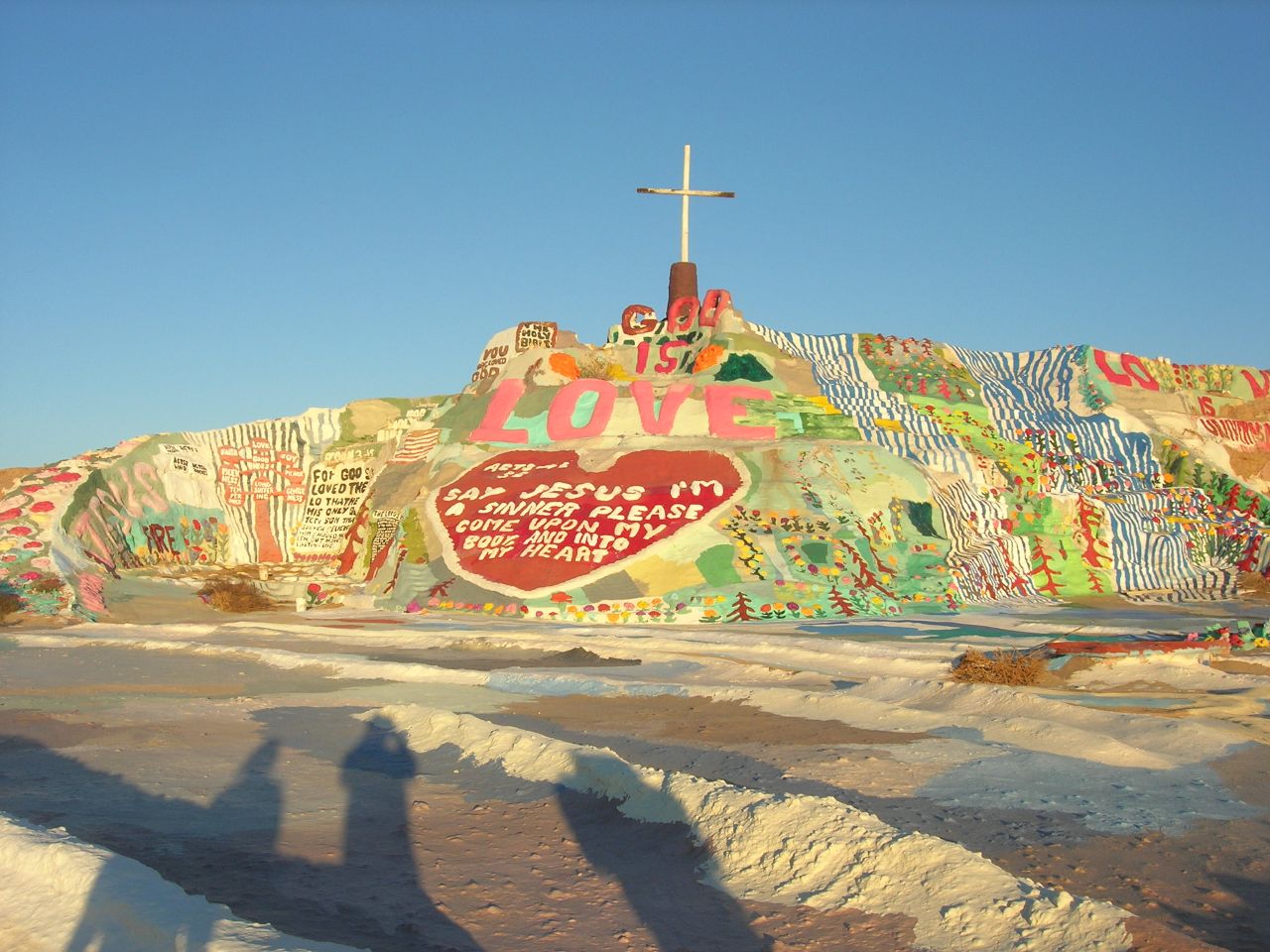
Leonard Knight spent 28 years building Salvation Mountain, a folk art installation at Slab City's entrance. Using donated paint and adobe, Knight covered a desert hillside with religious messages and colorful imagery - 'God Is Love' written large enough to read from a mile away. The mountain rises three stories, covers half an acre, and required over 100,000 gallons of paint. Knight, who died in 2014, lived in a truck at the site, welcoming all visitors with enthusiasm. The Salvation Mountain Preservation Committee maintains the structure now. It's naive art, genuine faith, and Slab City's most photographed attraction - the first thing visitors see, the symbol of what the place represents.
The Future
Slab City's future is uncertain. The state occasionally proposes developing or selling the land; residents have no legal claim to protect them. Climate change makes the already brutal summer heat more dangerous - daytime temperatures exceed 120°F. The Salton Sea, visible to the west, is shrinking and becoming more toxic, raising concerns about air quality. But the community persists, welcoming new arrivals, losing others to death or departure, maintaining its strange existence on concrete slabs in the desert. As long as the land remains officially unused, Slab City endures - the last free place, or something close to it.
Visiting Slab City
Slab City is located off Route 111, roughly 150 miles east of San Diego and 60 miles north of the Mexican border. There are no services - bring water, fuel, food, and common sense. Salvation Mountain is open to visitors; respectful exploration of other areas is generally tolerated, though asking permission before photographing residents is courteous. The Range hosts open mic nights on Saturday evenings. East Jesus offers tours of its sculpture garden. Summer visits are dangerous due to extreme heat; winter is the community's busy season. Overnight camping is possible but facilities are nonexistent. Slab City is not a tourist attraction - it's a community that tolerates visitors. Act accordingly.
From the Air
Located at 33.26°N, 115.47°W in the Sonoran Desert, Imperial County, California. From altitude, Slab City appears as a scattering of structures and vehicles on the eastern shore of the Salton Sea - distinct from the surrounding desert but less organized than conventional settlements. Salvation Mountain is visible as a colorful mound at the community's entrance. The Salton Sea gleams to the west, shrinking and increasingly saline. The Chocolate Mountains rise to the east. The isolation is apparent: the nearest town of any size is Niland, a few miles north. The slabs that gave the place its name are invisible from altitude - just the improvised community that grew on top of them.