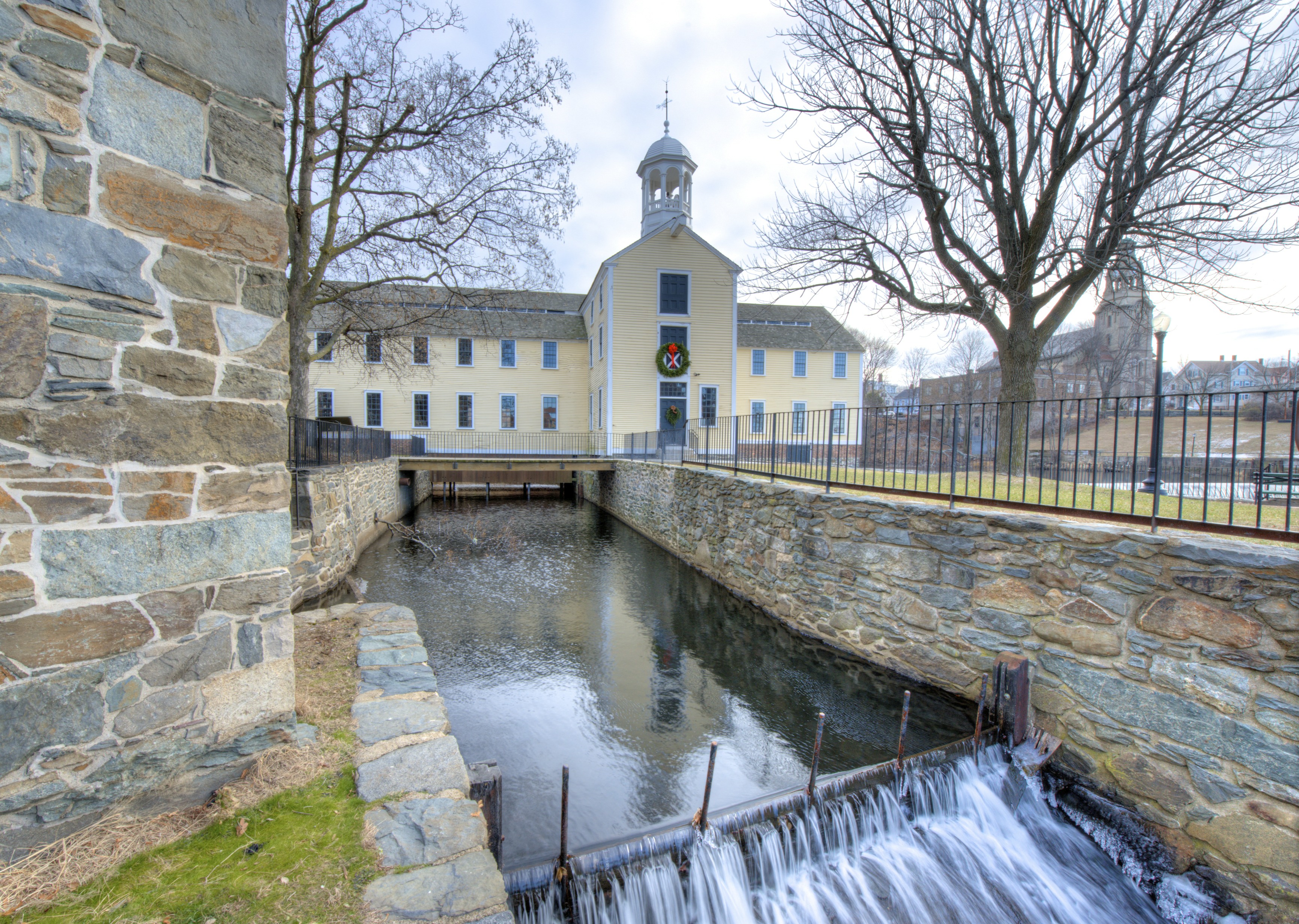
Slater Mill
The British Crown considered the knowledge inside Samuel Slater's head to be a state secret. In 1789, British law explicitly forbade textile workers from emigrating, and the export of machinery designs carried severe penalties. Slater, a 21-year-old apprentice who had memorized the workings of Richard Arkwright's cotton spinning machines, disguised himself as a farm laborer and boarded a ship for New York. He carried no plans, no drawings, no models - only the mental blueprint of the machines that were making England rich. Within four years, he had reconstructed those machines from memory on the banks of the Blackstone River in Pawtucket, Rhode Island, and America's Industrial Revolution had begun.
The Smuggler of Secrets
Samuel Slater learned the textile trade under Jedediah Strutt in Belper, England, one of the pioneers of mechanized cotton spinning. Strutt's mills used Richard Arkwright's water-powered spinning system, a technology that had transformed England's economy and that Parliament fiercely guarded. Slater, recognizing that American merchants were desperate for this technology, committed the designs to memory and sailed for America in 1789. He arrived in New York, where he learned that Moses Brown, a prominent Providence merchant, was seeking someone who could build Arkwright-style machines. Brown had already tried and failed to create working spinning equipment. Slater wrote to Brown offering his services. Brown's reply was blunt: if Slater could do what he claimed, Brown could provide the financing. Slater traveled to Pawtucket to begin.
Water, Cotton, and Children
By 1793, Slater and his workers had completed a dam, waterway, waterwheel, and the full complement of carding, drawing, and spinning machines needed to turn raw cotton into yarn using water power. The mill on the Blackstone River was small but functional - the first successful implementation of the Arkwright system in America. Slater's labor model was as revolutionary as his machines. He hired children and entire families, establishing what became known as the 'Rhode Island System.' Families moved to mill villages where children as young as seven worked the machines while parents performed other tasks. This system spread throughout the Blackstone Valley and defined early American manufacturing. It was efficient, profitable, and by modern standards deeply troubling - a reminder that industrialization always carries human costs.
America's First Factory Strike
The Slater Mill and its surrounding area became the stage for another American first: the first factory strike. In 1824, young women workers walked off the job, protesting conditions in what is recognized as the earliest factory labor action in the United States. The Rhode Island System that Slater pioneered, with its dependence on family labor and company-controlled villages, created tensions that would echo through American labor history for the next two centuries. Slater's model was eventually eclipsed by Francis Cabot Lowell's Waltham System, which recruited single young women to work in larger, more centralized mills. But the pattern of industrial conflict that began at Pawtucket - workers pushing back against the conditions that made their employers wealthy - would prove far more enduring than any particular manufacturing method.
First on the Register
On November 13, 1966, Slater Mill became the very first property listed on the National Register of Historic Places, simultaneously designated a National Historic Landmark. That distinction speaks to the site's importance in the national story: this is where factory production came to America. The mill complex today includes the original 1793 Slater Mill, the 1810 Wilkinson Mill with its working machine shop, and the Sylvanus Brown House, a 1758 dwelling moved to the site in the 1960s. The complex sits on five acres straddling the Blackstone River, with the original dam still channeling water past the buildings. In 2021, the National Park Service acquired the key buildings of the Old Slater Mill Historic District, incorporating them into a new national park that recognizes the Blackstone River Valley's role as the cradle of American industry.
Where the River Runs Through History
The Blackstone River flows 48 miles from Worcester, Massachusetts, to Narragansett Bay, dropping 438 feet along the way. That gradient made it one of the most intensively dammed rivers in America during the 19th century, powering mill after mill along its banks. Slater Mill sits near the river's mouth in Pawtucket, just north of Providence. The site is compact enough to walk in an afternoon: the wooden Slater Mill with its distinctive cupola, the stone Wilkinson Mill beside it, and the dam whose falling water once turned the wheels that turned the spindles that spun the cotton that built an industrial nation. Inside, working reproductions of Slater's machines demonstrate the Arkwright process. The spinning frames clatter and hum, the water wheel turns, and visitors can see exactly how thread emerges from raw fiber - the simple mechanical miracle that changed everything.
From the Air
Located at 41.878°N, 71.383°W in Pawtucket, Rhode Island, on the Blackstone River just north of downtown Providence. From altitude, the mill complex is visible along the river near the Main Street bridge, with the dam creating a visible line across the water. The Blackstone River is a useful navigation reference as it winds south toward Narragansett Bay. Providence's State House dome (white marble) is visible approximately 2 miles to the south. T.F. Green Airport (KPVD) is roughly 10 nautical miles south in Warwick. North Central State Airport (KSFZ) is 6 nautical miles to the northwest. Best viewed at 1,500-2,500 feet AGL where the river, dam, and mill buildings are clearly distinguishable.