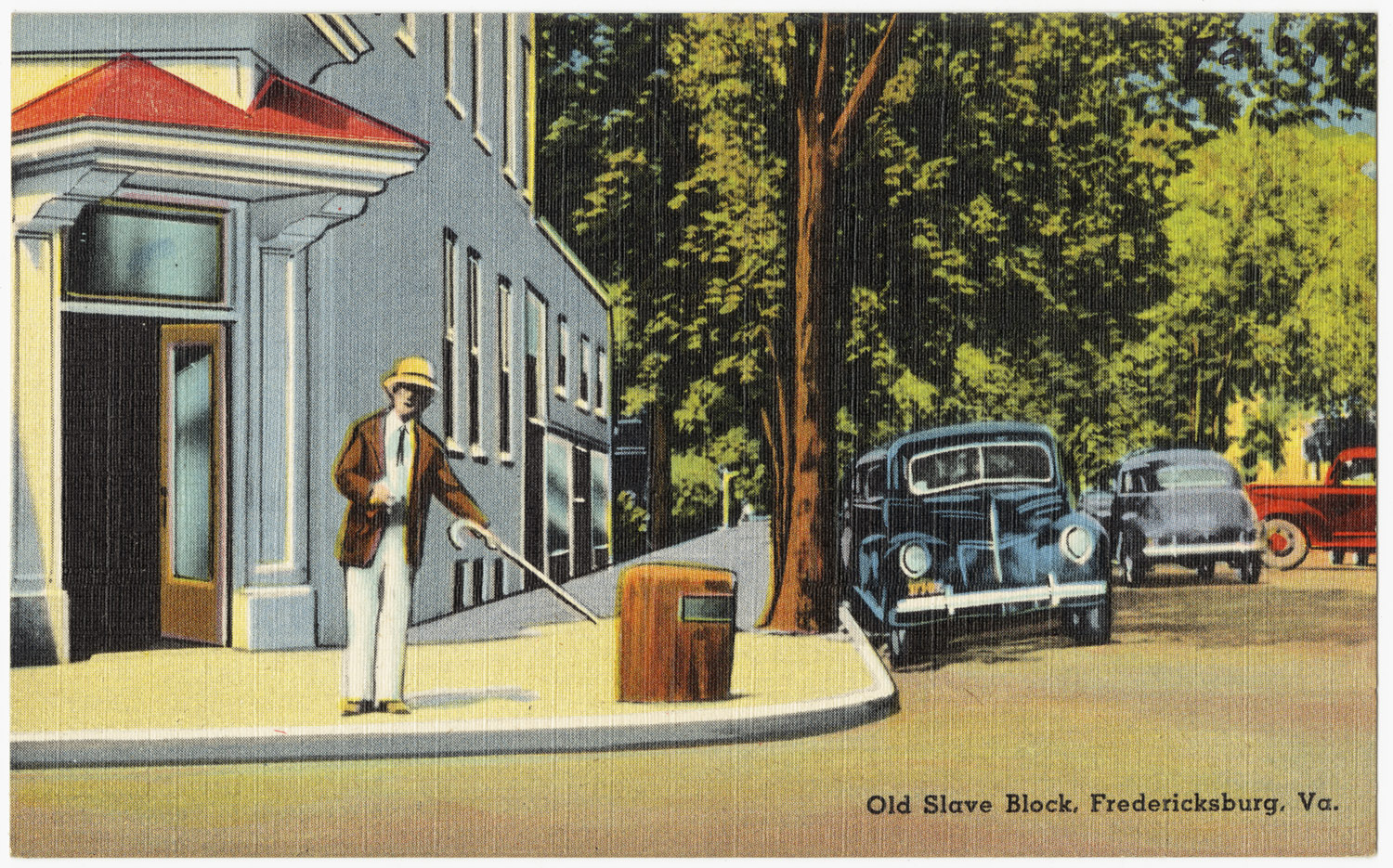
Slave Auction Block, Fredericksburg
For 177 years, an 800-pound block of Aquia sandstone sat on the corner of William and Charles Streets in Fredericksburg, Virginia. It was the same type of stone used to build the White House and the United States Capitol. But this stone served a different purpose. Placed outside the United States Hotel in 1843 as a carriage step -- a mounting block to help passengers climb into horse-drawn carriages -- it became something far darker. In front of that hotel, enslaved men, women, and children were stood upon the stone so buyers could get a better look at what they were purchasing. The last recorded sale happened in 1862. The block remained on its corner for another 158 years.
Commerce in Human Beings
The United States Hotel opened in 1843 at the busy intersection of William and Charles Streets in downtown Fredericksburg. When the hotel changed hands in 1851, it was renamed the Planter's Hotel -- a name that spoke plainly to its clientele. Between 1846 and 1862, at least twenty slave auctions took place in front of the hotel, many selling well over forty individuals at a time and generating tens of thousands of dollars. The earliest documented sale appeared in the November 20, 1846 edition of the Richmond Enquirer, which advertised the auction of 40 enslaved people. These were not hidden transactions. They happened at a prominent street corner in a busy town, in full public view. The stone block, standing about three and a half feet tall, elevated the people being sold so the crowd of buyers could inspect them. It was commerce conducted in plain daylight, at the center of civic life.
Witnesses Who Remembered
Two formerly enslaved men provided testimony that anchored the stone's history to living memory. Albert Crutchfield appeared in a 1920s postcard photograph standing near the block. When he died in 1931, his obituary noted that he "recalled his sale on the block distinctly." George Washington Triplett was documented in a 1903 photograph by historian James T. Knox, who described him as the last man "sold on the slave rock." Their words and images transformed the stone from an ambiguous artifact into a verified site of human trafficking. Local historians S.J. Quinn and John Goolrick recorded accounts of the auctions in their published works, and auctioneer N.B. Kinsey produced newspaper advertisements and other documentary evidence confirming the stone's role in the slave trade.
A Century of Debate
The argument over what to do with the block began almost as soon as the auctions ended. As early as 1924, the Fredericksburg Chamber of Commerce argued that removing the stone would improve the community's image. Kinsey pushed back, producing documentary proof that the block was historically significant -- a genuine artifact of the slave trade, not just an old stepping stone. The matter was dropped, then revived, then dropped again for decades. Through the Jim Crow era, the Civil Rights movement, and into the 21st century, the block sat on its corner. Some saw it as a necessary reminder. Others saw a trophy of oppression displayed in a public space. By 2017, the Fredericksburg City Council had begun formally planning its removal. On June 11, 2019, the council voted to relocate the block. A legal challenge followed, but the Virginia Supreme Court cleared the way in February 2020.
From Street Corner to Museum
On the morning of June 5, 2020 -- days after the murder of George Floyd triggered nationwide protests over racial injustice -- workers excavated the 800-pound stone and moved it to storage. The council's decision had preceded Floyd's death by a full year, but the timing of the physical removal gave the event an added weight. In November 2022, the Fredericksburg Area Museum placed the block in a prominent position as part of an exhibit titled "A Monumental Weight." The stone now sits in a context designed to educate rather than normalize. Visitors can learn about the auctions, the people who were sold, and the witnesses who remembered. The corner of William and Charles Streets, empty for the first time since 1843, is now the site of a planned permanent memorial. The design, led by EO Studio, will encompass all four corners of the intersection -- transforming a place of commerce in human lives into a place of remembrance.
From the Air
The Slave Auction Block's original location at William and Charles Streets sits at 38.303N, 77.462W in the heart of Fredericksburg's compact historic downtown. Shannon Airport (KEZF) is 2 miles south. Stafford Regional Airport (KRMN) is 8 miles north. The intersection is not individually visible from altitude, but the Fredericksburg Historic District is identifiable as the dense grid of streets along the south bank of the Rappahannock River. The Fredericksburg Area Museum, where the block is now displayed, is nearby on Princess Anne Street.