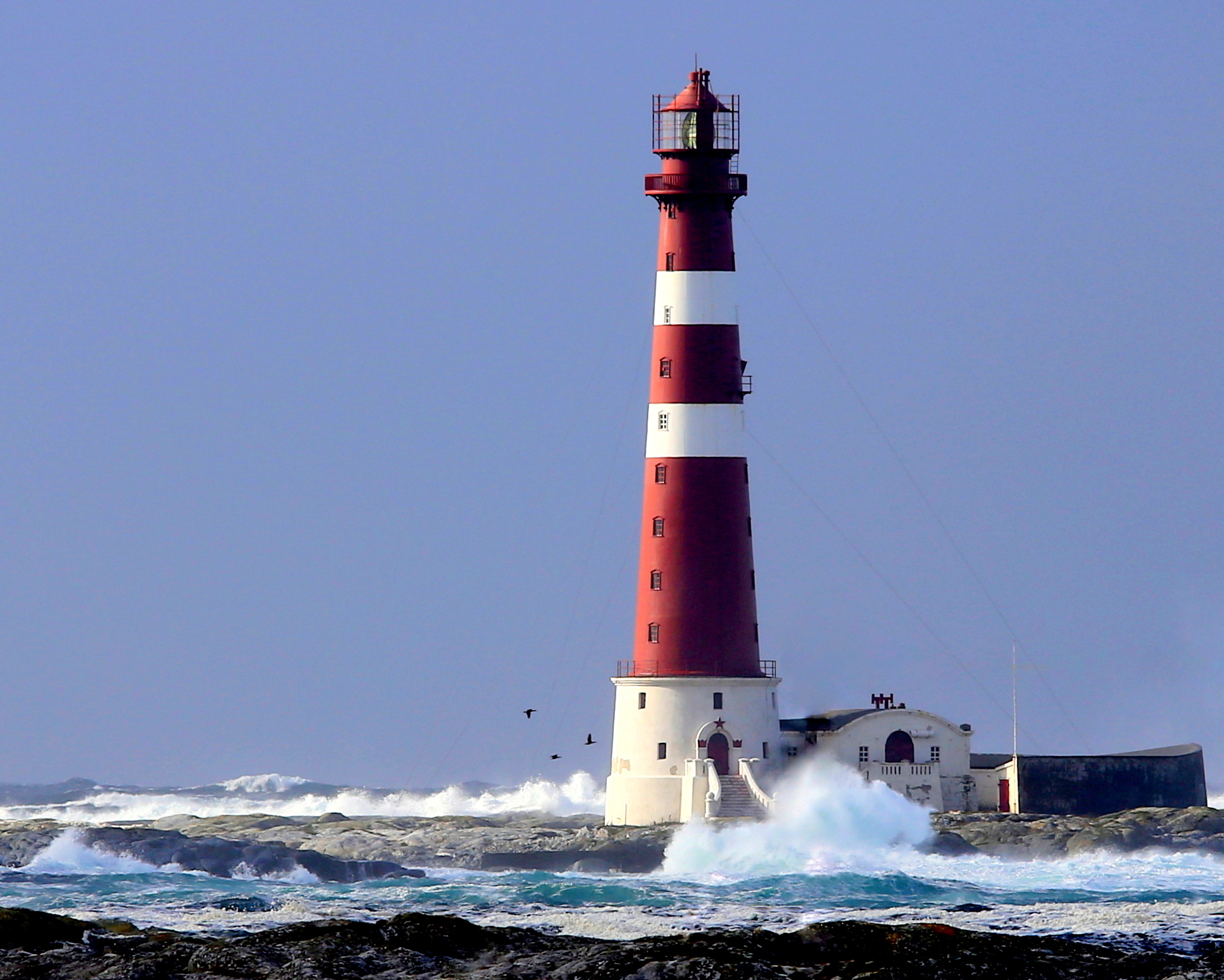
Sletringen Lighthouse
For two months each summer, Sletringen Lighthouse goes dark. Not because anything is broken -- because the sky at 63 degrees north never gets dark enough to need it. From late May through mid-July, the white nights wash the Norwegian coast in a perpetual silvery twilight, and the tallest lighthouse in Scandinavia simply has nothing to do. But when the light returns to duty on July 21, its first-order Fresnel lens throws a double flash every fifteen seconds across the open Atlantic, visible for nautical miles in every direction. Standing 45 meters tall on a rocky islet off the village of Titran, Sletringen is both a working navigational aid and a monument to the relentless relationship between Norwegians and the sea.
Iron Against the Atlantic
The tower went up in 1899, when the fishing grounds off Froya were among the most productive -- and most dangerous -- in Norway. The island's western tip faces the open Norwegian Sea with nothing between it and Iceland, and the waters around Titran had claimed boats and crews for centuries. Building a lighthouse here was an engineering challenge: the cylindrical cast-iron tower had to withstand gales that regularly exceed hurricane force. The designers answered with mass and simplicity. Red-painted iron with a white base and two horizontal white stripes, the tower rises from a two-story keeper's house built directly into its base. The main light sits 46 meters above sea level, high enough to be seen from far out at sea. Partway up, a secondary isophase light at 31.5 meters provides a closer-range signal, visible from one side of the tower only -- a directional marker for vessels navigating the coastal approaches.
The Lens That Survived a Century
Since 1923, Sletringen has used a first-order Fresnel lens -- the largest class of lighthouse optic, originally designed by French physicist Augustin-Jean Fresnel in the 1820s. These massive glass assemblies bend and focus light with such efficiency that a relatively modest lamp can project a beam visible at enormous distances. The main light flashes white twice every fifteen seconds, a rhythm that mariners along this coast have memorized for generations. The secondary light operates differently: an isophase pattern, two seconds on and two seconds off, a steady pulse rather than a flash. Together they give approaching ships two distinct signals at different heights, allowing navigators to confirm their position with precision. The keeper's house fell silent in 1993, when the lighthouse was automated. Fifteen years later, in 2008, the light lost power entirely -- an outage that lasted for some time before repairs restored the beam to its century-old duty.
Titran and the Fishing Coast
The village of Titran, just inshore of the lighthouse, sits at the westernmost point of Froya, the large island that anchors this stretch of the Trondelag coast. Froya Municipality has long depended on the sea, and the lighthouse was built as much for its fishermen as for passing merchant vessels. The waters off this coast are rich but unforgiving -- cold, deep, and exposed to North Atlantic weather systems that can turn violent within hours. The lighthouse's foghorn, still operational, sounds its warning when visibility drops, adding an auditory dimension to the visual one. From the air, Sletringen is unmistakable: a red needle on a grey rock, surrounded by white surf where the Atlantic meets the Norwegian coast. The keeper's house, the tower, the foghorn installation -- they form a compact outpost that has guided mariners through these waters for over 125 years.
Between Darkness and Light
What makes Sletringen unusual among the world's great lighthouses is its seasonal rhythm. Most lighthouses operate year-round, their beams sweeping through darkness every night. Sletringen observes a different calendar, one dictated by latitude. Though Froya sits south of the Arctic Circle, the summer nights here never fully darken -- the phenomenon Norwegians call hvite netter, white nights. So from May 16 to July 21, the light is extinguished. The tower stands in the endless twilight, a silent column against skies that shift from pale gold to soft blue and back without ever reaching black. Then, as autumn approaches and the nights grow long again, the Fresnel lens resumes its ancient work: flash, flash, pause. Flash, flash, pause. A fifteen-second rhythm that will continue through the dark months of the Norwegian winter, when the opposite extreme takes hold and the sun barely clears the horizon at all.
From the Air
Located at 63.67N, 8.26E on the western tip of Froya island in Trondelag, Norway. Best viewed at 2,000-3,000 ft to see the red tower against the rocky coastline and open Norwegian Sea. The nearest airport is Orland Main Air Station (ENOL), approximately 40 nm to the northeast. Trondheim Airport Vaernes (ENVA) is about 75 nm northeast. Expect strong coastal winds and frequent low cloud. The lighthouse is unmistakable from the air -- look for the tall red tower on a small islet just off the village of Titran at Froya's westernmost point.