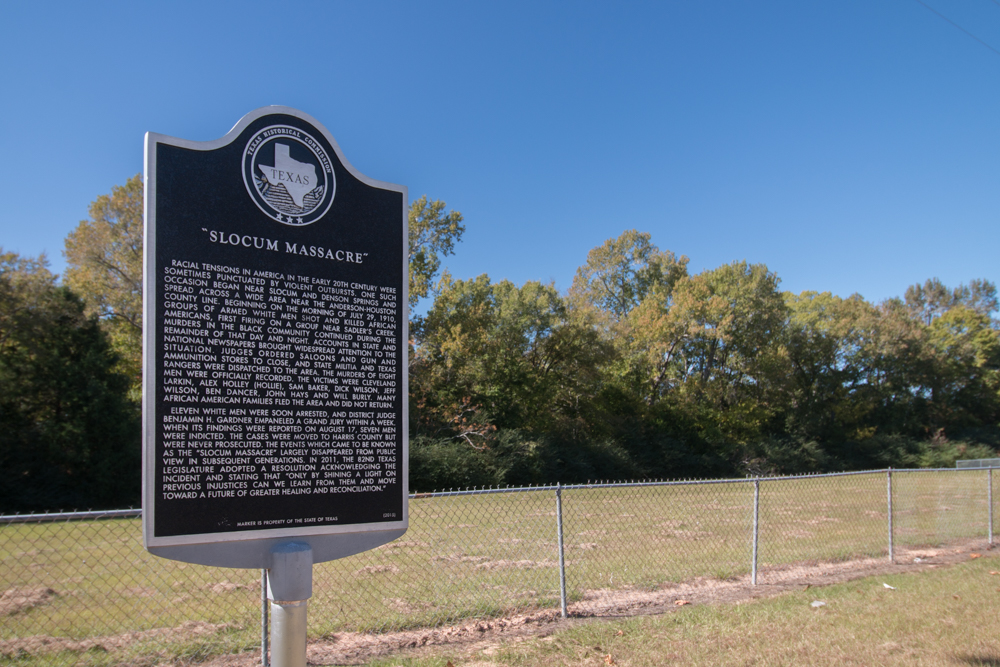
Slocum Massacre
Sheriff William H. Black arrived in Slocum, Texas, and found a community gripped by terror. "Men were going about killing Negroes as fast as they could find them," he reported, "and, so far as I was able to ascertain, without any real cause." It was July 29, 1910, in Anderson County, a stretch of piney East Texas farmland where Black and white families had lived as uneasy neighbors since the end of the Civil War. On that day and the next, armed white men carried out a massacre of African American residents -- one fueled not by any genuine threat, but by rumor, alcohol, and the violent architecture of racial oppression. Only seven deaths were officially confirmed, but newspapers reported as many as 22 killed, and some historians estimate the true toll may have reached one hundred.
Roots in Red Clay
The ground was already soaked in injustice long before the killing started. East Texas had been plantation country before the Civil War, with several counties holding enslaved Black majorities. After emancipation, the old power structure fought to reassert itself. In the post-Reconstruction era, white Democrats regained control of county and state governments and passed laws that systematically disenfranchised African Americans. By 1910, at least 335 lynchings had occurred in Texas, 261 of the victims Black. African American farmers were pushed onto overworked plots as tenant farmers and sharecroppers, keeping their acreage deliberately small to avoid provoking jealous white neighbors. The combination of exhausted soil and tiny farms trapped Black families in cycles of debt. To try to advance economically was to invite danger.
Rumors That Killed
Two minor incidents became the pretexts for mass murder. Marsh Holley, a Black businessman, had a disagreement with Reddin Alford, a disabled white farmer, over a promissory note. Holley thought nothing of it, but whites twisted the story into a tale of a Black man cheating and threatening a helpless white man. Separately, Black farmer Abe Wilson was sent to notify residents about road maintenance. White farmer Jim Spurger took offense at the idea of a Black man performing a civic duty, and rumors soon claimed Wilson was supervising a white road crew. These distortions merged with a larger fabrication: that Black residents were planning an armed uprising. White men from Anderson County and beyond answered the call to arms, stocking up on guns and ammunition. District Judge Benjamin Howard Gardner, sensing catastrophe, ordered all saloons, gun stores, and hardware stores closed. He was too late. The weapons had already been distributed.
The Killing Fields
On July 29, 1910, the mobs set out to hunt. White families hid their women and children in schools and churches, then fanned across the countryside. When Sheriff Black and Sheriff Lacy arrived from surrounding jurisdictions, they found every white male armed and the entire community paralyzed by fear. The investigation confirmed what should have been obvious: Black residents had not organized any uprising, had not armed themselves, had not threatened anyone. Whites had attacked people who offered no resistance. Among the victims were members of the Holley family. Wilustus "Lusk" Holley survived by witnessing his brother Alex's murder and then playing dead. He later fled to Fort Worth. Eleven suspects were eventually arrested on murder charges, but all were released on bail of $1,500 or less. None were convicted.
The Century of Silence
The massacre's aftermath was shaped by erasure. Newspapers across Texas, including the Palestine Daily Herald and the Fort Worth Star-Telegram, initially framed the violence as a race riot provoked by Black residents. Only The New York Times ran a headline that pointed toward the truth: "Score of Negroes Killed by Whites." The African American population of Slocum collapsed as survivors fled for their lives. Twenty years later, a landowner named Hayes offered the town land on the condition it erect a historical marker to the dead. The town refused. It took until January 16, 2016 -- more than a century after the killings -- for a historical marker to be dedicated, placed south of Slocum on FM 2022. Historian E. R. Bills published The 1910 Slocum Massacre: An Act of Genocide in East Texas in 2014, the first comprehensive account. In 2020, Bills and Hollie-Jawaid co-authored Ghosts of Slocum, an illustrated screenplay told through the voices of the victims.
Bearing Witness from Above
From the air, Slocum is barely a place at all -- a scattering of houses and fields in the rolling piney woods of East Texas, connected by two-lane farm roads. There is no skyline, no monument visible from altitude, nothing to suggest what happened here. That invisibility is part of the story. Oral histories collected by Bills preserve what the landscape cannot: Mable Willis remembering her parents opening their home to fleeing Black families; Elvie Ewell recounting how her father and uncles were warned and escaped; the Sadlers recalling how they stood armed alongside the Barnett family while the legendary marksman known as "Deaf and Dumb Gus" held the mob at bay from a barn. The marker on FM 2022 names several of the dead. It is a small thing set against a vast silence, but it insists that what happened in these quiet woods be remembered.
From the Air
Located at 31.631N, 95.462W in the piney woods of East Texas, Anderson County. Slocum is a small unincorporated community with no prominent landmarks visible from altitude -- mostly scattered houses, farms, and timber along FM roads. The historical marker is on FM 2022 south of Slocum. Nearby airports: KPSX (Palestine Municipal, 12 nm west), KJXI (Jacksonville, Cherokee County, 18 nm northeast). Best viewed at 2,000-3,000 ft AGL. The town of Palestine is the nearest recognizable landmark from the air.