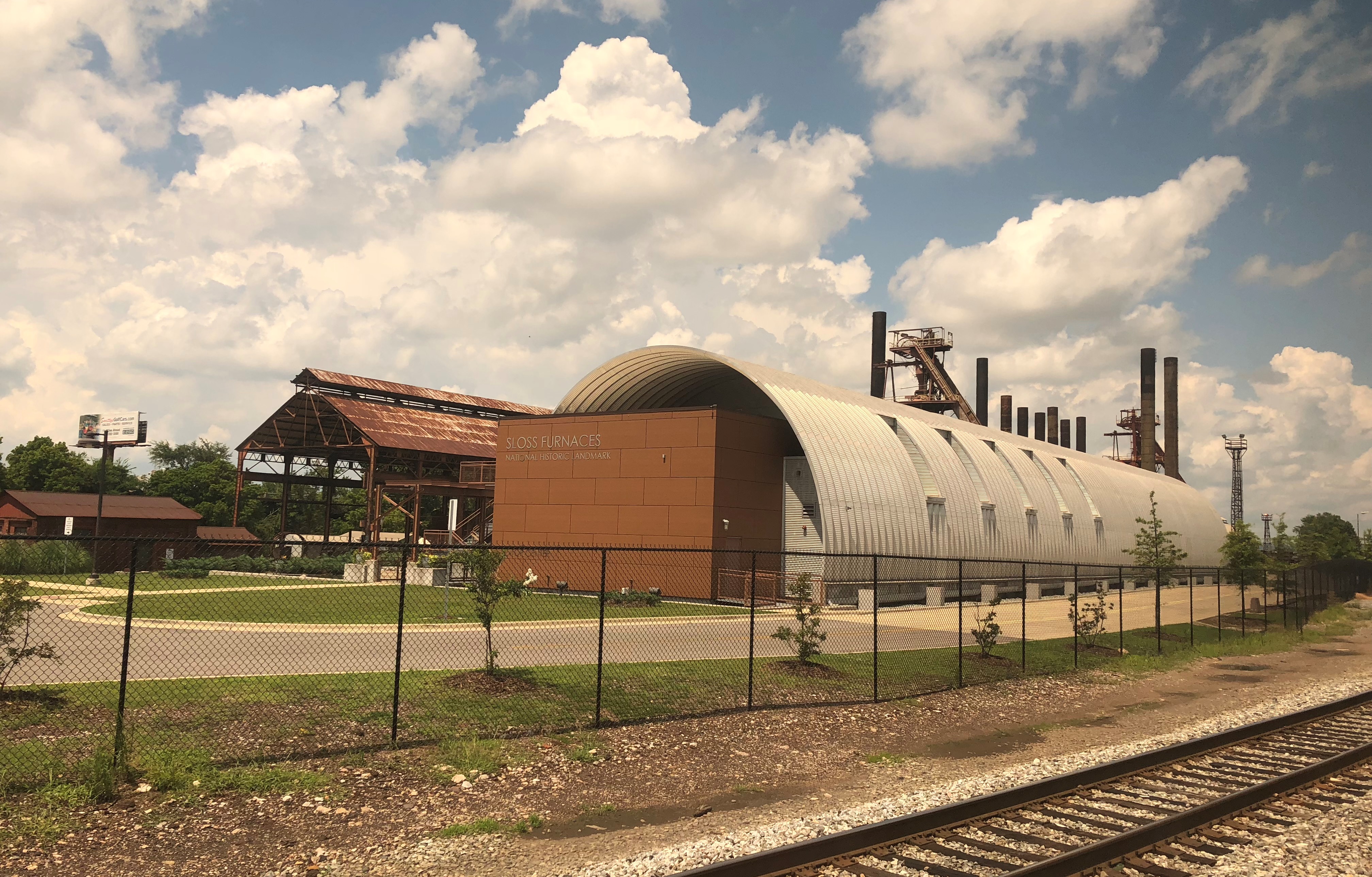
Sloss Furnaces: Where Iron Met Fire and Art Rose from the Ashes
Seventeen patents came out of a single ironworks in Birmingham, Alabama. Between 1909 and 1930, superintendent James Pickering Dovel turned Sloss Furnaces into his personal laboratory, redesigning gas cleaning systems, rethinking furnace linings, and rebuilding the No. 2 Furnace with innovations that earned national recognition. The furnaces he improved had been pouring iron since 1882, when Colonel James Withers Sloss -- one of Birmingham's founders -- lit the first blast on fifty acres of donated land in Jones Valley. By the time Dovel finished his work, Sloss-Sheffield Steel and Iron Company was the second-largest seller of pig iron in the district and among the largest in the world. The furnaces kept burning until 1971. They never made another ton of iron after that. But the fire never really went out.
A Colonel's Gamble on Fire and Ore
Colonel James Withers Sloss helped found Birmingham by promoting railroad development in Jones Valley, and in 1881 he bet his reputation on the city's mineral wealth by forming the Sloss Furnace Company. The Elyton Land Company donated fifty acres for industrial development, and engineer Harry Hargreaves -- a student of English inventor Thomas Whitwell -- designed two Whitwell-type blast furnaces standing sixty feet tall and eighteen feet in diameter. The first blast roared to life in April 1882. In its first year, the facility produced 24,000 tons of high-quality iron, and by 1883, Sloss iron had won a bronze medal at the Southern Exposition in Louisville, Kentucky. The iron was pure, the ore was local, and Birmingham had announced itself to the industrial world. Sloss retired in 1886 and sold the company to investors, who reorganized it in 1899 as the Sloss-Sheffield Steel and Iron Company.
Dovel's Workshop
When James Pickering Dovel became superintendent of construction in 1909, he inherited a functional but aging facility. Over the next twenty-one years, he transformed it. New blowers arrived in 1902, new boilers in 1906 and 1914, and between 1927 and 1929 the furnaces were completely rebuilt with modern equipment bearing Dovel's fingerprints. He developed gas cleaning equipment, modified furnace designs, and improved the linings that took the punishing heat of molten iron. Seventeen patents bear his name. The No. 2 Furnace, rebuilt in 1927, showcased so many of his inventions that it earned both Dovel and Sloss a national reputation for innovation. The company expanded aggressively into mining and quarrying operations across Jefferson County, and the community around the downtown furnace grew -- including forty-eight small cottages built for Black workers, a neighborhood known simply as 'the quarters.'
The Smoke Clears
By the 1950s, Birmingham's air was choking under the output of its iron and steel industry. The U.S. Pipe and Foundry Company acquired the Sloss Furnaces in 1952, then sold them to the Jim Walter Corporation in 1969. Federal legislation like the Clean Air Act was pushing older smelting works toward closure, and higher-yielding ores from other regions had already undercut local supply. Jim Walter shut the furnaces down in 1971 and donated the property to the Alabama State Fair Authority for possible museum development. The authority looked at the rusting towers, the massive Cowper stoves, the tangle of pipes and conveyors, and decided demolition made more sense. Local preservationists disagreed. They formed the Sloss Furnace Association and fought to save a site that sat at the very center of Birmingham's identity.
Iron Into Art
Birmingham voters decided the argument in 1977, approving a $3.3 million bond issue to preserve Sloss Furnaces. The money stabilized the main structures, built a visitors' center, and launched a metal arts program that would become the site's creative heartbeat. In 1981, the Department of the Interior designated Sloss a National Historic Landmark. Two years later, on Labor Day weekend 1983, it opened to the public as the nation's first and only twentieth-century blast furnace preserved as a museum. Admission is free. Today, the furnace site hosts metal arts classes, food festivals, fun runs, concerts, and weddings among the rusted towers. The hardcore punk festival Furnace Fest ran from 2000 to 2003 and returned in 2021, filling the industrial cathedral with sound. In 2022, the site hosted competitions for the World Games, including sport climbing and parkour -- athletes scaling walls where ironworkers once tended molten metal.
The Furnace Endures
A new 16,000-square-foot Visitors' and Education Center broke ground in 2012 and opened on the southwest corner of the property, funded jointly by the City of Birmingham and the Sloss Foundation. The complex houses educational exhibits, administrative offices, and event space. A steam locomotive, SLSF 4018, was relocated from Birmingham's Fair Park to Sloss in 2009, adding another chapter to the site's industrial collection. The preservation story itself became a documentary -- Alabama Public Television's 'Sloss: Industry to Art.' From the air, the furnaces appear as a dense cluster of industrial geometry along the rail corridor that Birmingham's original city plan set aside for exactly this purpose. The blast furnaces have not fired since 1971, but the site remains alive with the clang of hammer on metal, the roar of festival crowds, and the quiet footsteps of visitors walking through the bones of the industry that built a city.
From the Air
Located at 33.52°N, 86.79°W in central Birmingham, Alabama, along the east-west rail corridor. From altitude, Sloss Furnaces appears as a dense cluster of industrial structures -- blast furnace towers, Cowper stoves, and connected piping -- set along railroad tracks just east of downtown. Best viewed at 2,000-3,000 feet AGL for industrial detail. Birmingham-Shuttlesworth International Airport (KBHM) lies approximately 5 nautical miles northeast. The site sits in Jones Valley between Red Mountain to the south and the northern ridges.