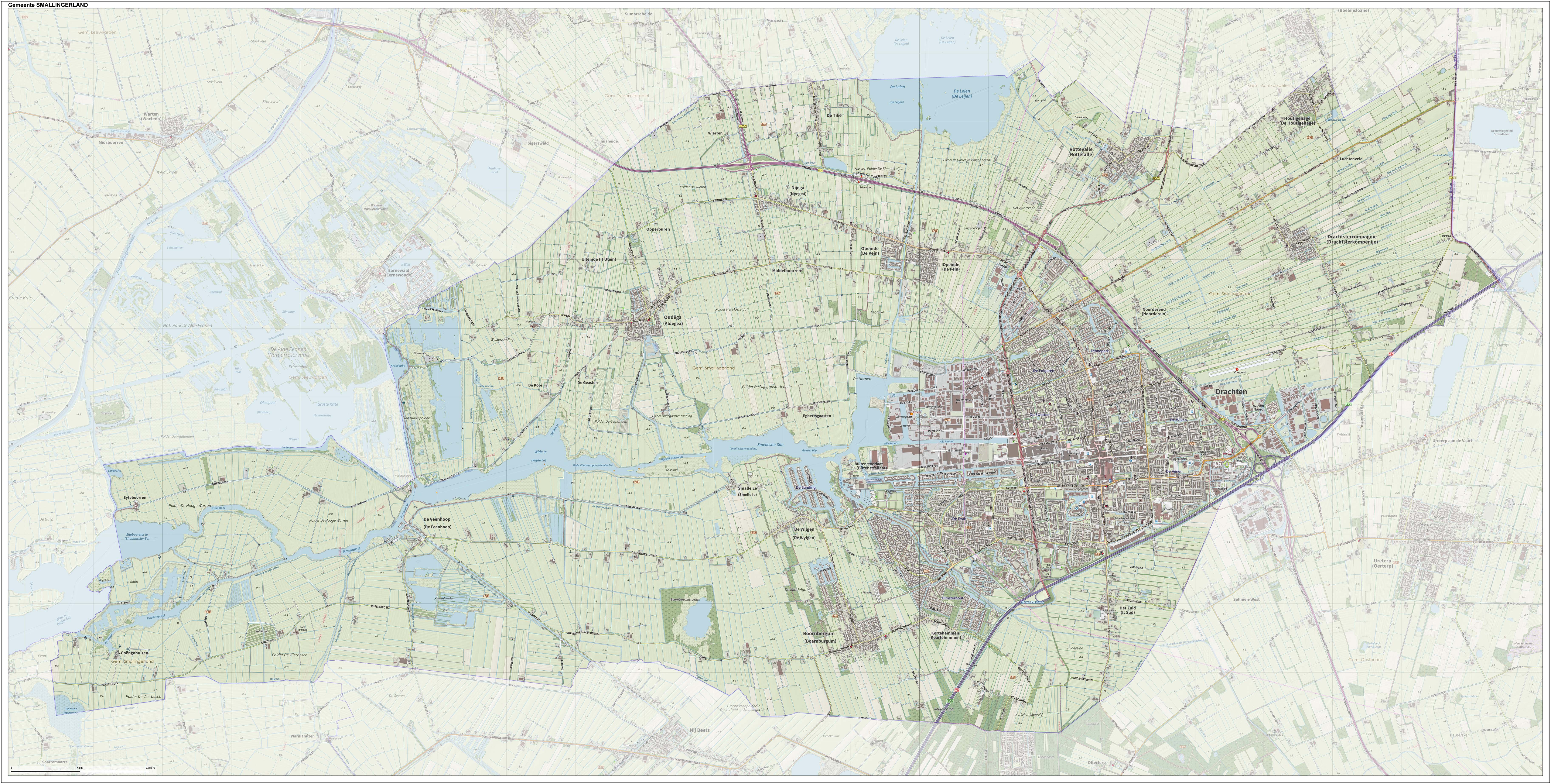
Smallingerland
Passchier Hendriks Bolleman went broke trying to dig up Drachten. He was a businessman from The Hague, one of the Holland Associates who in 1641 bet that the peat under the wet hamlets of Drachten North and Drachten South would heat the rapidly growing cities of the Dutch Golden Age. Eight hundred workers spent a year cutting the Drachtstervaart canal so the peat could be barged out. The peat was disappointing. The math did not work. Bolleman lost his money. But the canal he had paid for kept doing what canals do: it brought ships, and the ships brought shipyards, and the shipyards brought rope-makers and carpenters and forges, and within a century the small church and scattered farmhouses that had been Drachten were a town. Today Smallingerland's main town holds 44,000 people. Bolleman's ruin built it.
Older Than Drachten
Before Drachten was anything, Smalle Ee was the place that mattered here. A monastery stood there, and by the 14th century its annual fair was important enough to be spoken of in the same breath as the fairs of Leeuwarden and Dokkum, the most consequential cities in Friesland. Oudega, another hamlet in the same district, had a stone church before the year 1100. The whole shape of central Friesland in the medieval period turned on these older settlements, and Smallingerland still carries the name of that lost monastic hamlet at its center: a 'land of the people of Smalle Ee.' Today Smalle Ee has 57 residents. Opeinde, the largest village in the municipality after Drachten, has 1,731. Drachten itself, the upstart that arrived late and won everything, runs the modern district.
Skutsjes and Shipyards
The Drachtstervaart that bankrupted Bolleman became a working artery. In 1746 the first proper shipyard opened on the Langewijk, building flat-bottomed wooden cargo boats. A second yard followed on the Drachtstervaart itself in 1902, and after 1895 the yards began making iron hulls as well as timber ones. The boats they built had a particular Frisian shape: the skutsje, a low-sided cargo sailer designed to slip through the shallow canals and lakes of the north with maximum hold and minimum draft. Many of those skutsjes are still afloat. Every summer they race in the skutsjesilen, a series of regattas held across Friesland's lakes in which fourteen historic boats compete town against town. Some of the skutsjes racing today were launched from Drachten yards more than a hundred years ago, hulls maintained generation by generation because the racing communities will not let them die.
People from Drachten
Drachten and the surrounding villages have produced an unusually diverse run of people for a town of their size. Pier Pander, born here in 1864, became a sculptor and designer of medals whose work is held in major Dutch collections. S.H. de Roos, born in 1877, became one of the most influential Dutch typeface designers of the 20th century, the man who designed the typefaces that filled Dutch books for decades. Fedde Schurer, born in 1898, was a teacher, journalist, and Frisian-language activist who fought to make Frisian a recognized language of education and public life. The mathematician Hendrik Kloosterman, born in nearby Rottevalle in 1900, gave his name to the Kloosterman sums in number theory. More recently, Cisca Wijmenga, born in Drachten in 1964, became one of the Netherlands' leading geneticists and rector of Groningen University. A peat-bog town, it turns out, can grow a remarkable variety of minds.
The Bog Beneath
The landscape Bolleman tried to mine is still readable, particularly around Drachtstercompagnie, where the dark stripes of old peat workings stand against the green of reclaimed pasture. The name Drachten itself probably comes from the old Frisian word darch, meaning peaty soil, and the soil is still that: spongy, acidic, holding the dampness even in dry summers. Smallingerland fronts the Friesland lake district to its west, where canals fan out toward the lakes around De Veenhoop and Goengahuizen, and water shapes the leisure economy now as completely as it shaped the industrial one three centuries ago. The skutsjes race here. The kayakers paddle here. The bird-watchers walk the dikes. Bolleman's canal carries pleasure boats now, which is not what he sold it as, but the town it built does not seem to mind.
From the Air
Coordinates 53.10N, 6.10E. Smallingerland is best appreciated from 3,000-5,000 ft AGL, where the grid of Drachten's modern town center contrasts with the looping water of the old Drachtstervaart and the lake country to the west. Drachten airfield (EHDR) sits on the western edge of town; Groningen Eelde (EHGG) is 25 km northeast. The patterns of old peat exploitation are most visible in low-angle light around Drachtstercompagnie to the east.