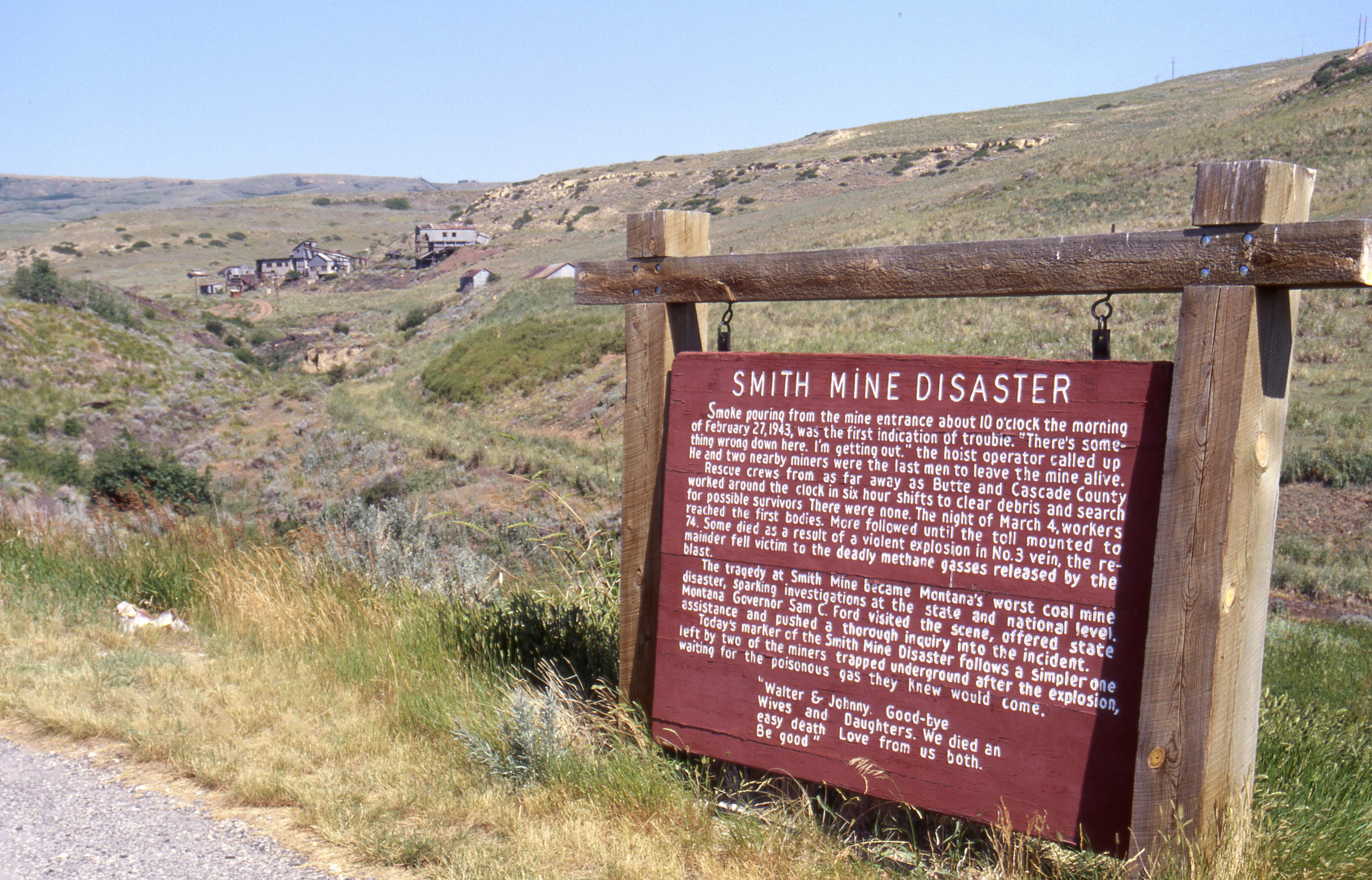
Smith Mine Disaster
The explosion was powerful enough to knock a 20-ton locomotive off its tracks a quarter mile from the blast origin. Yet at the mouth of Smith Mine No. 3, on the morning of February 27, 1943, nobody heard a thing. The devastation unfolded in silence above ground while 74 men died in the darkness below. It was a Saturday, which meant a short crew. Of the 77 miners who descended into the coal tunnels near Bearcreek, Montana that morning, only three would walk out alive. One rescue worker died shortly afterward, bringing the final toll to 74 souls lost in what remains the worst coal mining disaster in Montana history.
9:37 A.M.
At approximately 9:37 in the morning, methane gas that had accumulated in the mine found an ignition source. The United States Bureau of Mines investigation would later reveal troubling details: men were allowed to smoke underground, and blasting fuses were lit with matches. Any spark could have triggered the catastrophe. The Bureau's report determined that 30 men died instantly in the explosion itself. The remainder perished from injuries or suffocation as carbon monoxide and methane filled the tunnels. The blast occurred so deep underground that the surface remained oblivious to the horror unfolding below. Families went about their Saturday morning routines, unaware that their worlds had already ended.
The Darkness Underground
Smith Mine No. 3 sat between the small towns of Bearcreek and Washoe in Carbon County, near the Beartooth Mountains. The mine had operated for years, extracting coal from seams beneath the Montana prairie. That Saturday, the reduced weekend crew reported for work as usual. When the explosion ripped through the tunnels, those who survived the initial blast faced a race against time as toxic gases flooded the workings. Rescue crews mobilized, but the mine's depth and the spread of lethal gases made recovery operations dangerous and slow. All 74 bodies were eventually recovered from the tunnels. The mine never reopened. Its dark passages remain sealed, a tomb in all but name.
The Reckoning
Investigators pieced together the sequence of events. Methane, the deadly firedamp that has killed miners for centuries, had built up in the workings. Ventilation systems existed but proved inadequate against the invisible accumulation. The cause of ignition was never definitively established, though the evidence pointed toward human error compounded by lax safety practices. Men smoking in a methane-filled environment. Matches struck to light blasting fuses. Any of these could have provided the spark. The disaster ranked as the 43rd worst coal mining accident in American history according to the National Institute for Occupational Safety and Health, a grim position on a list that includes the 1907 Monongah catastrophe in West Virginia that killed 362.
What Remains
A highway plaque now stands near the sealed mine entrance, marking the spot where dozens of families lost fathers, husbands, brothers, and sons. Memorials rise in the cemeteries of Bearcreek and nearby Red Lodge, the Carbon County seat. The Smith Mine Historic District was listed on the National Register of Historic Places in 2009, preserving the site and its somber history. The disaster devastated the tight-knit communities that depended on the mine. Bearcreek never fully recovered from the loss of so many working-age men in a single morning. The population dwindled as families moved away and the mine stayed closed. The town survives today as a shadow of its former self, population measured in dozens rather than hundreds.
Silent Ground
The landscape around the former Smith Mine looks peaceful now. Rolling prairie stretches toward the Beartooth Range, and little visible evidence remains of the industrial operation that once employed much of the local population. But the memory persists. Every February 27th, the anniversary passes over Carbon County, and those who know the history remember the morning when an explosion that nobody heard changed everything. The three survivors carried their stories for the rest of their lives. The sealed mine keeps its secrets. The memorials stand in their cemeteries, listing the names of 74 men who went to work on a Saturday morning and never came home. Montana's worst coal mining disaster left no physical scar on the land, only an absence where families used to be.
From the Air
Located at 45.16N, 109.19W in Carbon County, Montana, between the small communities of Bearcreek and Red Lodge. The site lies in the foothills approaching the Beartooth Mountains to the southwest. Nearest significant airport is Billings Logan International (KBIL) approximately 60 miles north. From altitude, the area appears as open rangeland with scattered small settlements. The former mine site is not visually prominent but lies along the highway corridor between Bearcreek and Red Lodge.