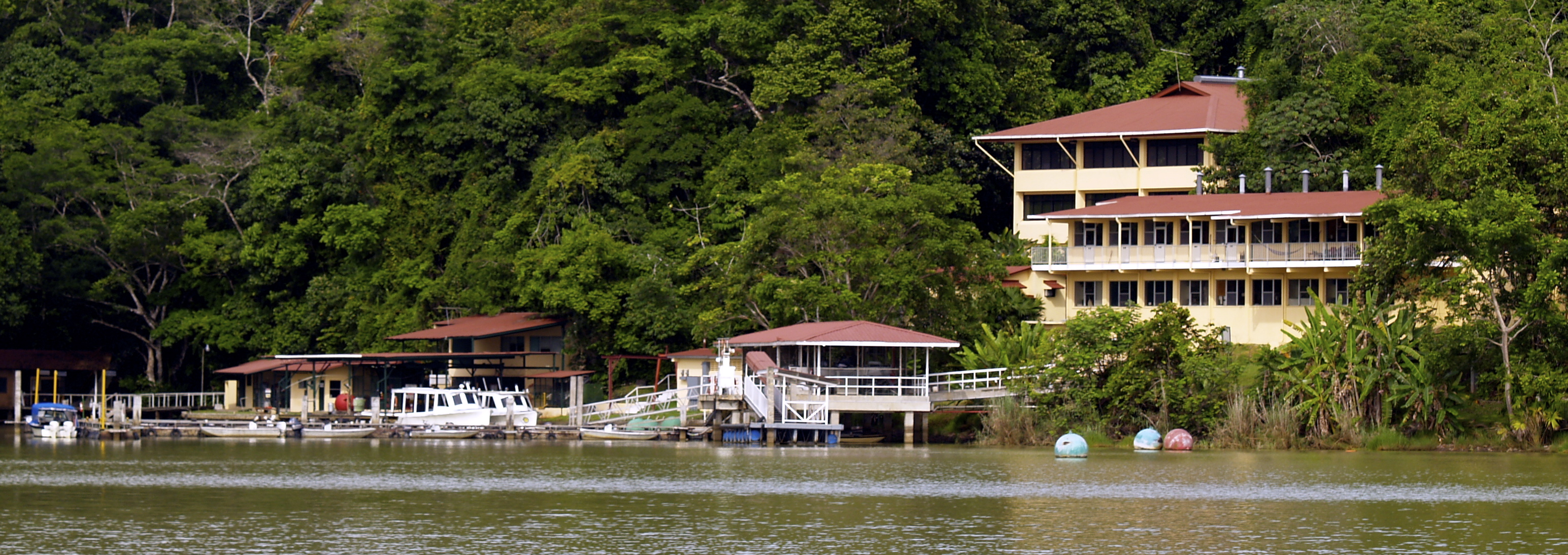
Smithsonian Tropical Research Institute
When engineers dammed the Chagres River to create Gatun Lake for the Panama Canal, they accidentally created something else: Barro Colorado Island, a hilltop suddenly surrounded by rising water. By 1923, the governor of the Canal Zone had declared the 16-square-kilometer island a biological reserve -- one of the earliest in the Americas. What began as a field station on that accidental island grew into the Smithsonian Tropical Research Institute, the only bureau of the Smithsonian Institution based outside the United States, and today one of the world's foremost centers for tropical research. More than 1,200 visiting scientists pass through its facilities every year, drawn by nearly a century of unbroken data collection in a protected setting that exists nowhere else on Earth.
Science Follows the Shovel
Smithsonian scientists first arrived in Panama while the canal was still under construction, between 1904 and 1914. In 1910, Secretary Charles Doolittle Walcott struck an agreement with Panamanian diplomat Federico Boyd to conduct a biological inventory of the new Canal Zone, a survey later extended to cover all of Panama. The work bore fruit quickly. By 1940, when Barro Colorado was designated the Canal Zone Biological Area, more than 300 scientific publications had already described the island's biota. The Government Reorganization Act of 1946 folded the reserve into the Smithsonian, and in 1966 the institution formally created STRI. Today, the institute maintains an average of 350 ongoing research projects and publishes more than 400 peer-reviewed articles annually.
An Island Laboratory
Barro Colorado Island sits in the middle of Gatun Lake, blanketed in tropical forest with a nearly intact mammal fauna -- a rarity in Central America. The Barro Colorado Nature Monument extends beyond the island itself to include 40 square kilometers of surrounding mainland peninsulas, covered by forests in various stages of succession that serve as sites for manipulative field experiments. The monument adjoins Panama's 220-square-kilometer Soberania National Park. Protocols developed on BCI in the early 1980s for monitoring forest plots became the standard for what is now the Smithsonian's Forest Global Earth Observatory network, which tracks more than seven million individual trees representing nearly 13,000 species across 78 plots worldwide. The island is open to public day visits, though advance reservations are required.
From Canopy Cranes to Coral Reefs
STRI's reach extends well beyond Barro Colorado. Its headquarters occupy the Earl S. Tupper Research, Library and Conference Center in Ancon, Panama City. From there, the institute operates a canopy access crane in Parque Natural Metropolitano, with a sister crane at San Lorenzo National Park on the Caribbean slope. The Naos Marine and Molecular Laboratories sit on the Amador Causeway at the Pacific entrance to the canal, equipped with a dock, wet lab, and scientific diving office. On the Caribbean side, the Bocas del Toro Research Station on Isla Colon provides access to mangrove, seagrass, and coral reef ecosystems. In western Panama, the Fortuna Field Station opens montane forests to study. And on the island of Coibita in Coiba National Park, a small station gives researchers access to the 500-square-kilometer Coiba Island and the coral reefs of the Eastern Tropical Pacific.
A Century of Continuity
What makes STRI unusual among research institutions is the depth of its temporal record. Nearly a century of continuous observation at Barro Colorado -- documenting which trees grow, which animals thrive, how rainfall and temperature shift year by year -- has created an unparalleled baseline against which changes can be measured. Since 1965, the institute has supported some 5,500 fellows and interns at every academic level, from undergraduates to senior researchers. Universities including Princeton, Harvard, Yale, Cambridge, and Dartmouth send students to STRI's field courses each year. The institute also runs intensive courses for Panamanian and Central American undergraduates, ensuring that the country whose geography made the science possible shares in its practice. The canal builders came to reshape a continent. The scientists who followed came to understand one.
From the Air
Headquarters located at 8.962N, 79.553W in Ancon, Panama City, near the eastern approach to the Panama Canal. Barro Colorado Island is visible in Gatun Lake approximately 25 nm northwest, best viewed from 3,000-5,000 feet AGL. The Amador Causeway marine labs are at the Pacific entrance to the canal. Nearest airport: Albrook 'Marcos A. Gelabert' International Airport (MPMG), approximately 1 nm south. Tocumen International Airport (MPTO) is 15 nm east.