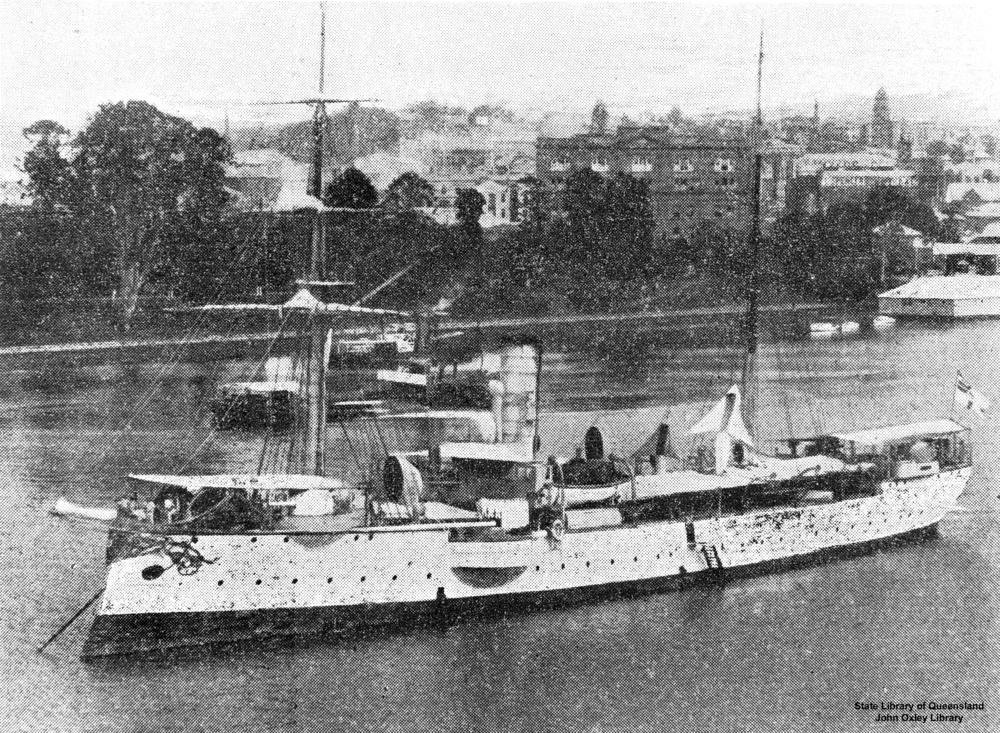
SMS Cormoran (1892)
The SMS Cormoran had the kind of career that only an imperial navy in the age of gunboat diplomacy could produce. Launched in Danzig in 1892, this unprotected cruiser spent two decades crisscrossing the globe -- from Mozambique to Muscat, from the Yangtze River to the Samoan Islands, from Melbourne to the Bismarck Archipelago. She ran aground on a Pacific reef, survived a hurricane off Hong Kong, rescued 300 Armenians from persecution in Ottoman Turkey, and helped seize the Chinese territory that would become Germany's most celebrated colony. In the end, she died where her most consequential mission had begun: in the harbor of Qingdao, scuttled on the night of September 28-29, 1914, to deny her to the Japanese forces closing in.
Built for Empire
Cormoran was the fifth of six ships in a class of unprotected cruisers designed for overseas patrol duty. At 82.6 meters long, with a crew of 9 officers and 152 enlisted men, she was modestly sized but heavily armed for her tonnage: eight 10.5cm quick-firing guns, five Hotchkiss revolver cannon, and two torpedo tubes. Her triple-expansion steam engines could push her to 15.5 knots, with a range of roughly 2,950 nautical miles at cruising speed. She was built at the Imperial Shipyard in Danzig, and Kaiser Wilhelm II himself attended her launching on May 17, 1892. Her intended mission was straightforward: show the flag, protect German interests, and suppress colonial unrest in the far-flung possessions of a late-arriving imperial power.
A Career of Unlikely Encounters
Cormoran's service record reads like an atlas of imperial ambition. She towed a damaged Portuguese cruiser in Mozambique, visited the Sultan of Oman in Muscat, and steamed up the Shatt al-Arab to pay calls on German and Turkish officials in Basra. In November 1897, she provided the inshore fire support for Admiral Otto von Diederichs's seizure of Jiaozhou Bay, steaming into the inner harbor at dawn while 717 German sailors marched on the Chinese garrison. During the Spanish-American War in 1898, the American cruiser prevented her from entering Cavite in the Philippines. In March 1899, she ran hard aground on Whirlwind Reef in the Pacific. Her commander, Hugo Emsmann, sent a steam pinnace and dinghy on a 162-nautical-mile journey to find help. The crew cut away both masts, shifted the stern guns forward, and jettisoned coal and ammunition until the ship floated free. An inspection in Sydney revealed only minor hull damage.
From Armenia to Apia
In June 1909, while passing through the Mediterranean, Cormoran was diverted to Asia Minor, where violence against Armenians was escalating. She joined other German warships and took aboard some 300 Armenian refugees to protect them from persecution. After delivering them to safety, she resumed her voyage to the Pacific, stopping in Jeddah for boiler repairs before reaching German Samoa. In December 1910, she joined four other warships to suppress the Sokehs Rebellion on Ponape, landing shore parties alongside police troops from German New Guinea. She represented Germany at the opening of Australia's first Parliament in Melbourne in 1901 and conducted surveying cruises that charted coastlines across the German Pacific colonies. By 1913, she was reclassified as a gunboat, her age catching up with her reputation.
Scuttled at Tsingtao
Cormoran arrived in Qingdao for repairs on May 30, 1914, as the political crisis in Europe deepened. When war broke out in August, she was still in the dockyard, unfit for action. Her crew was transferred to the captured Russian steamer Ryazan, which was commissioned as the auxiliary cruiser SMS Cormoran II. The old Cormoran's guns were removed and placed in shore batteries to defend the colony against the approaching Japanese siege force. On the night of September 28-29, 1914, the staff of the Imperial Dockyard opened her seacocks and scuttled the cruiser in the harbor to prevent her from being captured. She sank in the same bay she had helped seize seventeen years earlier. The guns that once lined her deck continued to fire from their shore positions until the colony surrendered on November 7. Cormoran's final contribution to German arms was made from the land, not the sea.
From the Air
Located at 36.050N, 120.267E in the waters of Jiaozhou Bay near Qingdao. The cruiser was scuttled in the harbor area during the Siege of Tsingtao in 1914. The wreck site lies within the bay visible from altitude. Nearest airport is Qingdao Jiaodong International Airport (ZSQD). The harbor entrance and bay are visible from 5,000-10,000 feet.