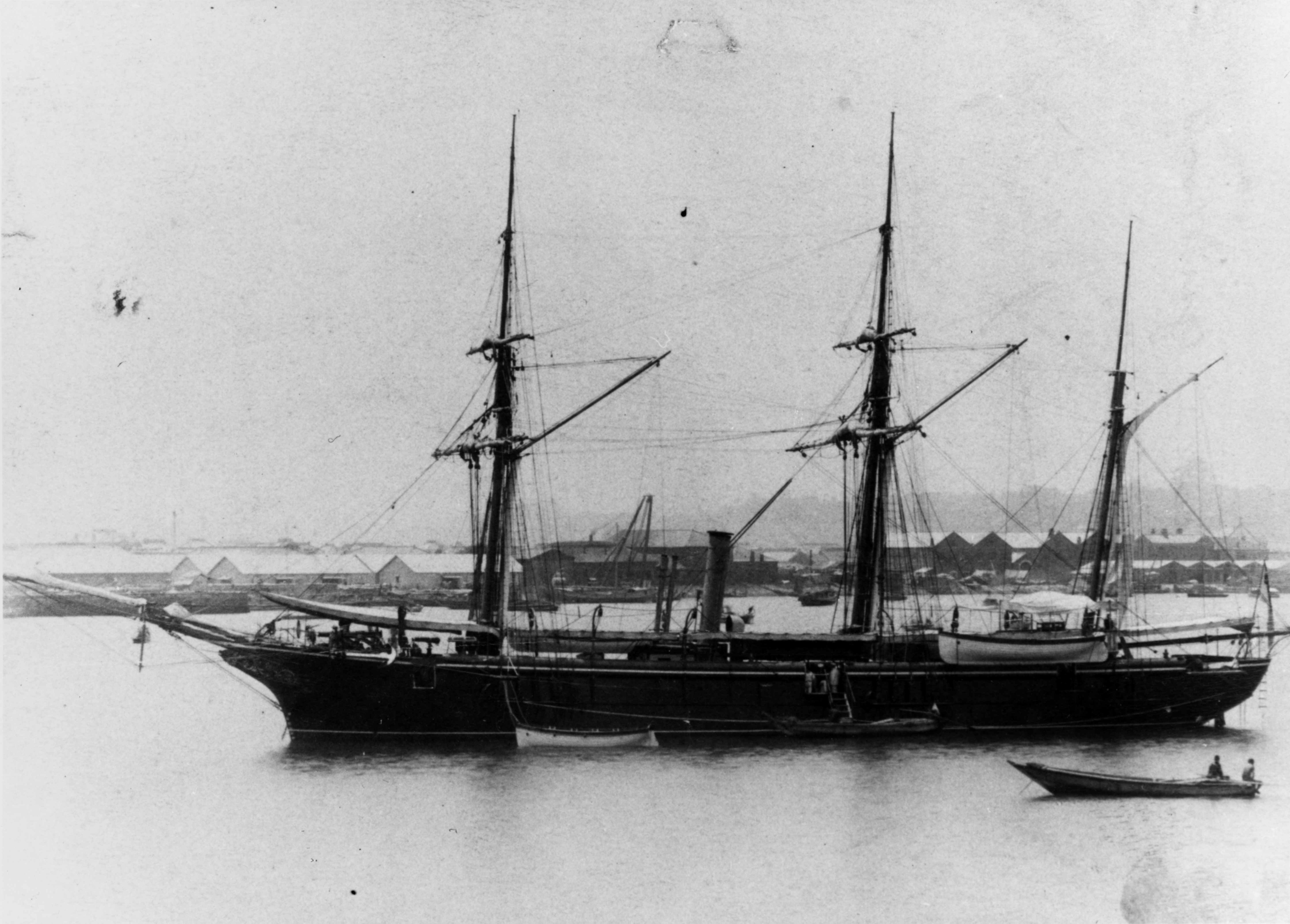
SMS Iltis (1878)
Named after the polecat, SMS Iltis was a gunboat that weighed less than 500 tons and could barely make nine knots. She was not built to fight fleet actions or project imperial power on a grand scale. She was built to show up -- at treaty ports where German merchants needed protection, at islands where rival empires planted flags, at coastlines where pirates raided commerce. For sixteen years, from 1880 to 1896, this small ship with a barque sailing rig and a crew of eighty-five men was often the only German warship in the vast waters of East Asia.
The Polecat Goes East
Iltis was laid down at the Imperial Shipyard in Danzig in June 1877 and launched on 18 September 1878. She was 47.2 meters long, armed with a pair of medium-caliber built-up guns and three Hotchkiss revolvers, and fitted with recycled engines from an older class of gunboat. On 1 July 1880, she left Germany for East Asia, arriving in September to begin a deployment that would stretch, with one break for overhaul, across the rest of her existence. Her first assignment was replacing her older sister on the China station, and within months she was hunting pirates in Mirs Bay near Hong Kong alongside Chinese gunboats and a German screw corvette.
Pirates, Flags, and the Pope
Iltis spent the 1880s in constant motion across a staggering range of waters. She surveyed the Paracel Islands, searching for a suitable coaling station. She recovered stolen cargo from pirates in the Pescadores. She guarded German nationals in Guangzhou during anti-European riots triggered by French colonial expansion in Indochina. In one of her more unusual assignments, she was dispatched to the Caroline Islands in 1885 to plant the German flag at Yap, asserting a claim against Spain. Her crew raised the flag on 25 August; the next day, her captain demanded the Spanish flag be lowered. Spain protested, and the dispute went all the way to Pope Leo XIII, who mediated a settlement returning the islands to Spanish control. Iltis, having helped start an international incident, sailed on to her next task.
Witness to War
When the First Sino-Japanese War broke out in 1894, Iltis and the gunboat Wolf were the only German vessels in East Asian waters. Iltis sent twenty-three men ashore at Incheon to guard the German embassy in Korea. After the Battle of Pungdo on 25 July, she rescued some two hundred Chinese soldiers and sailors who had survived the sinking of their transport ship. She then sailed to Port Arthur for hull cleaning -- marine biofouling had severely degraded her speed -- before returning to observe the main fleet engagement at the Battle of the Yalu River on 17 September 1894. A German gunboat watching two Asian empires destroy each other's fleets with European-designed warships: the irony was not lost on the officers who recorded the event.
Broken by the Storm
On 23 July 1896, Iltis departed Yantai bound for Qingdao under orders from Rear Admiral Alfred von Tirpitz, who wanted to survey the port as a potential permanent naval base. The morning was calm, winds at a gentle 2 on the Beaufort scale. By afternoon, rain and hail had closed in. As Iltis rounded the Shandong Peninsula near Rongcheng and turned south, the wind rose sharply to force 7 or 8. Her screw lifted out of the water in heavy seas. In pitch darkness, blown far closer to shore than her captain realized, Iltis struck a reef. The sea broke her hull in two between the engine room and crew compartment. The bow capsized; a breaker flipped the stern section upside down and slammed it onto the reef beside the bow. Seventy-one of her crew died. Eleven survivors clung to the wreck for two days before a lighthouse crew could reach them. Three others swam to shore.
Monuments Lost and Found
The Germans erected a memorial near the lighthouse where their sailors had perished. During World War I, it was destroyed. A second monument, raised in Shanghai's International Settlement in 1898, was knocked down in November 1918 after Germany's defeat. Local Germans restored it at the German School in Shanghai in 1929, where it survived World War II but was dismantled during the Cultural Revolution. Iltis's bell fared no better -- displayed at Berlin's Museum for Oceanography, it vanished during the war, only to surface at a scrap dealer in the 1950s. It now rests at the military history museum in Rastatt. The polecat's long journey through East Asian waters ended on a reef, but pieces of the ship keep reappearing, as if the little gunboat refuses to be entirely forgotten.
From the Air
The wreck site is located at approximately 36.90N, 122.50E off the Shandong Peninsula near Rongcheng, China. The coastline here features rocky reefs and a lighthouse marking the dangerous stretch where Iltis went aground. Nearest airport: Weihai Dashuibo Airport (ZSWH), approximately 40 km northwest. Best viewed at 2,000-4,000 ft following the coast south from Rongcheng.