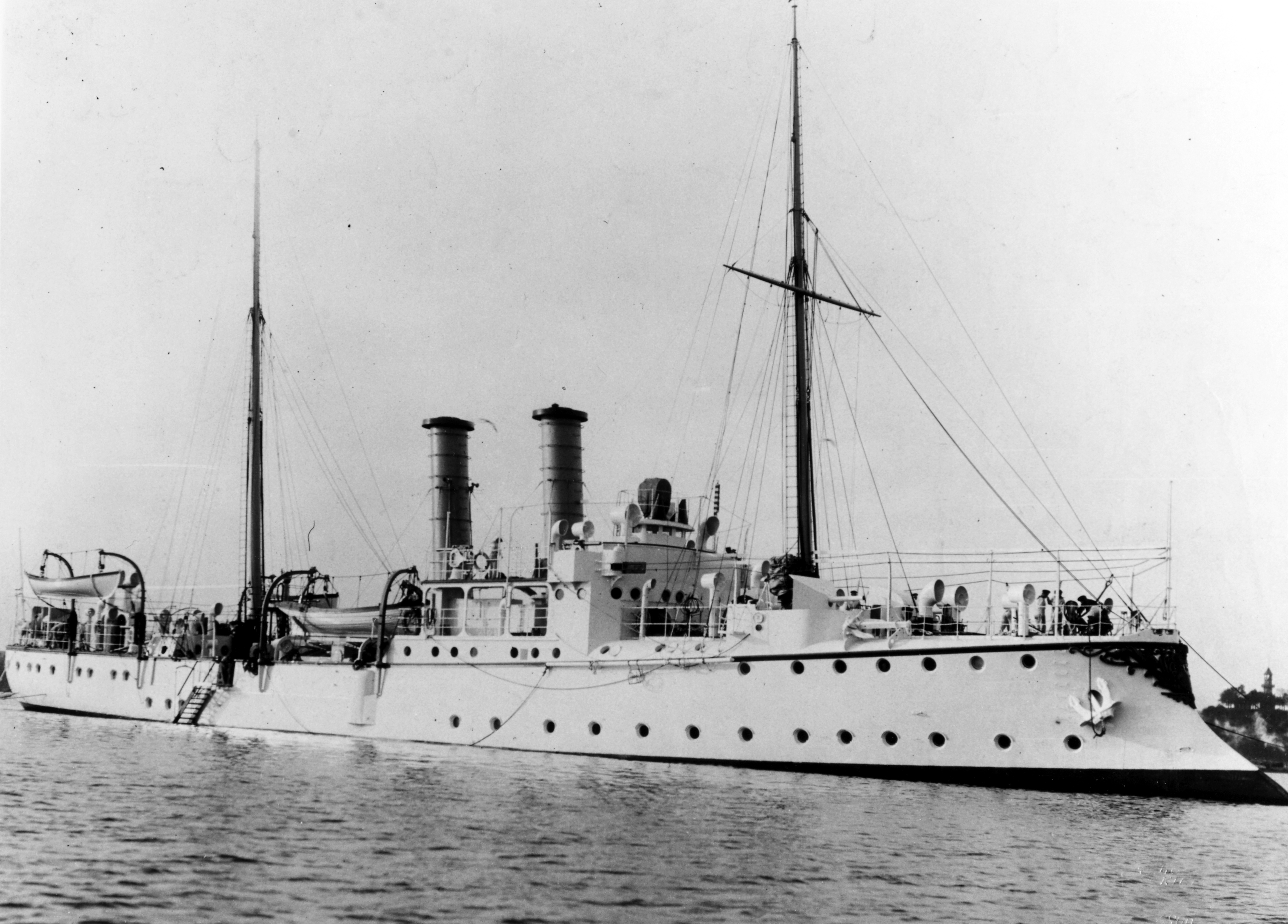
SMS Jaguar
Of the four Iltis-class gunboats stationed at Qingdao when war came in 1914, only one kept fighting. SMS Jaguar, named for the big cat and built at the Schichau-Werke shipyard in Danzig, had spent fifteen years steaming through East Asian waters -- raising flags on newly acquired Pacific islands, navigating the Yangtze during the Boxer Uprising, suppressing rebellions from the Carolines to Samoa. Her sisters were stripped of their guns and scuttled early. Jaguar alone remained armed, her crew firing some 2,200 shells against Japanese siege forces before sinking her themselves on the night of November 6-7, 1914.
Flag-Raiser of the Pacific
Jaguar's first mission set the tone for a career defined by distant orders and long voyages. Commissioned in April 1899, she left Kiel on June 1 bound for the East Asia Squadron in China. But en route, while coaling in Colombo, Ceylon, new orders arrived: sail first to the Caroline and Mariana Islands. Spain had sold these Pacific chains to Germany after the Spanish-American War, and someone needed to raise the German flag. Jaguar embarked the colonial governor of German New Guinea at Herbertshoe and spent two months island-hopping -- Pohnpei in October, Yap in November, Saipan by mid-November. She finally reached Qingdao on the last day of November 1899, having traveled halfway around the world before even beginning her assignment.
The Boxer Uprising and Fifteen Years of Patrol
By the summer of 1900, the Boxer Uprising had engulfed northern China, and Jaguar was ordered into the lower Yangtze to protect German nationals. While Kaiser Wilhelm II assembled a multinational expeditionary force under Marshal Alfred von Waldersee, Jaguar's captain oversaw the transfer of troops and supplies at Tanggu after the Battle of the Taku Forts. The small gunboat -- just 65.2 meters long, displacing 894 tons, with a crew of 130 -- spent the next fourteen years in an exhausting rotation of Chinese river patrols, Japanese port visits, and periodic emergencies. She sailed to Incheon during the Russo-Japanese War of 1904-1905, helped suppress unrest in the Caroline Islands in 1908, carried rebel leaders to exile in Jaluit Atoll after defeating an uprising in German Samoa in 1909, and guarded the German consulate in Fuzhou during China's Xinhai Revolution.
A Rock and a Race Against War
In February 1914, Jaguar struck a submerged rock in the Yangtze that punched a hole in her hull. Her crew patched the damage, but permanent repairs required dry-docking. She was sent to a British floating dry dock in Shanghai -- an arrangement that worked fine in peacetime but became untenable when the July Crisis spiraled into world war at month's end. On July 31, with her repairs unfinished, Jaguar was hurriedly refloated and her executive officer raced her back to Qingdao. The captain and a small detachment stayed behind in Shanghai to establish a German station. It was the last leg of a journey that had begun in Danzig seventeen years earlier.
Last Ship Standing
When Jaguar reached Qingdao on August 4, 1914, she found herself alone. Her three sister ships had already been disarmed, their guns and crews transferred to outfit an auxiliary cruiser for commerce raiding. Jaguar was placed under the colonial governor and modified for combat: her mainmast came down to prevent fouling her propellers if shattered, a spotting top went up on her foremast, and two of her 8.8-centimeter guns were removed to arm the auxiliary cruiser. With just two guns remaining, she fought through the Siege of Qingdao -- bombarding Japanese positions ashore, dueling with field artillery, even enduring air attacks from seaplanes launched by the Japanese carrier Wakamiya. A shell struck her bow on October 4 but caused only minor damage. With the garrison set to surrender on November 8, Jaguar's crew opened her seacocks the night before, sending her to the bottom of Jiaozhou Bay at a shallow depth. She lies there still, the last of the Qingdao gunboats to fight and the last to sink.
From the Air
SMS Jaguar was scuttled in Jiaozhou Bay near Qingdao at approximately 36.05N, 120.27E. The bay is visible from altitude, with the modern city of Qingdao sprawling along its eastern shore. Nearest airport: ZSQD (Qingdao Jiaodong International Airport). The old German colonial district is identifiable by its European-style architecture along the waterfront.