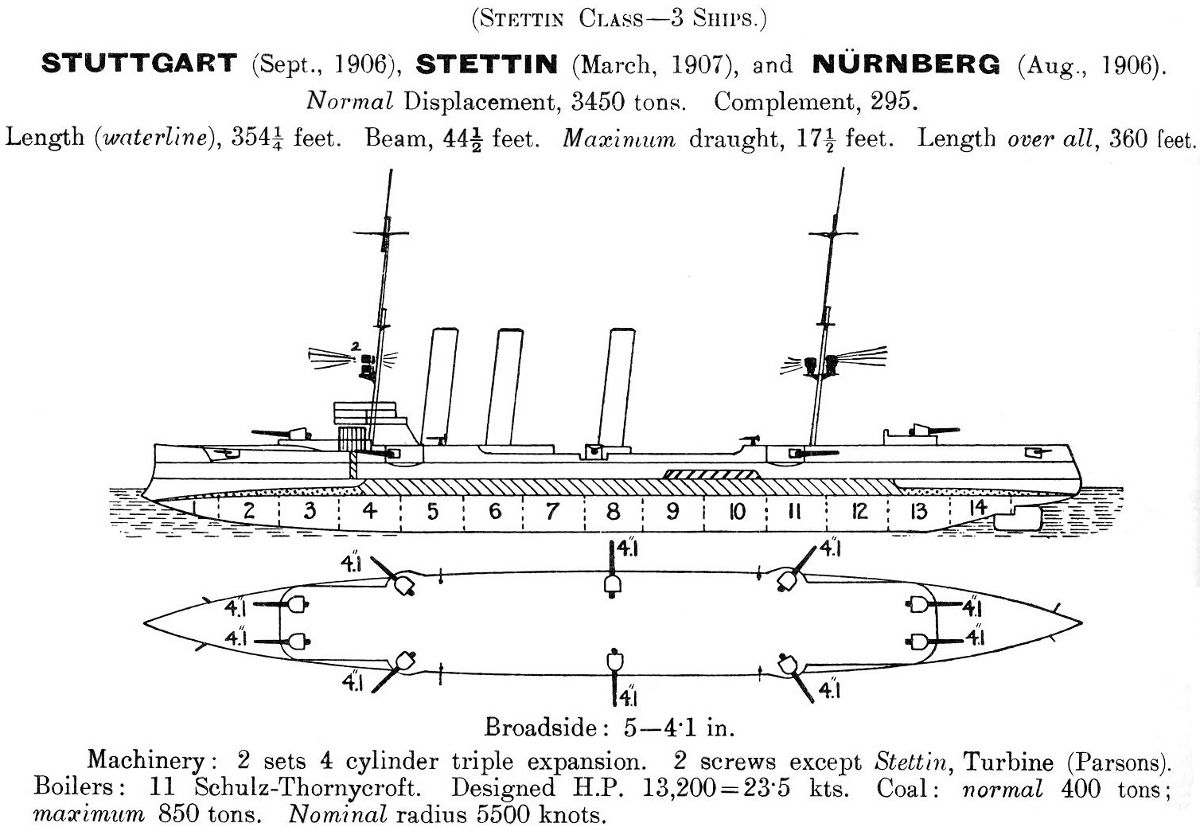
SMS Konigsberg (1905)
The locals called her Manowari na bomba tatu -- "the man of war with three pipes." When SMS Konigsberg arrived in Dar es Salaam in June 1914, her three tall funnels signaled something formidable to the people along the coast of German East Africa. They were not wrong. Within months, this light cruiser would sink a British warship, vanish into a river delta, survive nine months of aerial bombing and naval bombardment, and ultimately have her guns stripped from the wreck to fight a guerrilla war across a continent. Konigsberg's story reads less like naval history and more like an adventure novel -- except that every detail is documented in Admiralty reports and German war diaries.
The Kaiser's Escort
Built at the Imperial Dockyard in Kiel and launched on 12 December 1905, Konigsberg was the lead ship of her class of light cruisers. She was 115.3 meters long with a beam of 13.2 meters, carried a crew of 14 officers and 308 enlisted men, and could make 24.1 knots. Her main armament consisted of ten 10.5 cm guns -- respectable for a cruiser of her size, though not exceptional. What set Konigsberg apart in her early career was her diplomatic role. She spent years escorting Kaiser Wilhelm II's yacht to regattas, state visits, and meetings with foreign royalty. She carried the Kaiser to meet Czar Nicholas II at Nordkapp in 1907, Queen Wilhelmina of the Netherlands at Portsmouth, and King Oscar II of Sweden at Malmo. She even won the Kaiser's Schutzpreis, a shooting prize for excellent gunnery. It was a genteel existence that would end abruptly.
Flight from Dar es Salaam
Fregattenkapitan Max Looff took command on 1 April 1914 and sailed Konigsberg through the Mediterranean and Suez Canal to Dar es Salaam, arriving on 5 June. When news of the assassination of Archduke Franz Ferdinand reached East Africa in July, Looff abandoned his peacetime schedule and rushed back to port to replenish coal. He organized a coast-watcher network along the shore. On 27 July, the Admiralty Staff warned him that war was imminent. Three British cruisers from the Cape Squadron appeared, intending to bottle Konigsberg up in the harbor. Looff got his ship moving on 31 July, slipping past the slower British ships by using a rain squall and superior speed. For the next several weeks, Konigsberg roamed the western Indian Ocean, but coal shortages -- the British had purchased every available supply in Portuguese East Africa -- crippled her ability to raid commerce. She captured and sank only one merchant vessel, the freighter City of Winchester, off the coast of Oman on 6 August.
Forty-Five Minutes at Zanzibar
Konigsberg's most devastating action lasted less than an hour. Looff had hidden his ship in the Rufiji Delta to overhaul her engines, but before beginning repairs, intelligence reached him that HMS Pegasus, a British protected cruiser, was regularly coaling at Zanzibar on Sundays. On 19 September, Konigsberg slipped out of the Rufiji and appeared off Zanzibar harbor at dawn the next morning. At 05:10, she opened fire from roughly 7,000 meters. Within 45 minutes, Pegasus was burning, listing to port, and sinking. Her crew had raised a white flag, but it was invisible through the smoke. Thirty-eight of Pegasus's crew were killed and 55 wounded. Konigsberg suffered no damage and no casualties. After bombarding the wireless station and dumping sand-filled barrels into the harbor entrance to simulate mines, Looff spotted a picket ship on his way out and sank her with three shells. Then he returned to the Rufiji to begin the overhaul that would trap him there for the next nine months.
The Long Siege
Hiding in the mangrove-choked channels of the Rufiji Delta, Konigsberg's crew camouflaged the ship beneath cut branches until she blended into the forest. The British located her by late October but could not reach her -- their cruisers drew too much water for the shallow delta. What followed was one of the war's most frustrating sieges. Blockships, dummy mines, civilian seaplanes, Royal Naval Air Service aircraft (which disintegrated in the tropical heat), and even the 12-inch guns of the old battleship HMS Goliath all failed to destroy the hidden cruiser. Inside the delta, Konigsberg's crew endured malaria, dwindling food, and isolation. An elaborate resupply scheme using a captured British merchant ship disguised with Danish papers and a Danish-speaking crew was intercepted before it could reach them. By early 1915, Looff had transferred most of his crew to the land forces, keeping just 220 men aboard.
Scuttled but Not Silenced
The end came on 11 July 1915, when two British monitors -- Mersey and Severn, towed all the way from Malta -- navigated the delta and pounded Konigsberg for five hours. Her guns were knocked out in rapid succession. By 13:40, with ammunition nearly gone and heavy casualties among the gun crews, Looff ordered the ship scuttled with torpedo warheads detonated in the bow. She sank to the upper deck with her flags still flying. Nineteen men had been killed, forty-five wounded -- Looff among them. But Konigsberg's war was not over. Her crew salvaged all ten 105 mm guns, repaired them in Dar es Salaam, and mounted them on improvised carriages. Under Lieutenant Colonel Paul von Lettow-Vorbeck, these guns and their crews fought across East Africa until the last was knocked out in October 1917. The surviving sailors, organized as the Konigsberg-Abteilung, surrendered on 26 November 1917. After the war, they paraded through the Brandenburg Gate in Berlin. Three of the ship's guns survive today -- in Pretoria, Mombasa, and Jinja, Uganda. The wreck itself, bought for 200 pounds by the former captain of Pegasus in 1924, was salvaged intermittently until 1966, when it finally collapsed into the riverbed and disappeared.
From the Air
The wreck lies in the Rufiji River delta at approximately 7.87S, 39.24E, about 200 km south of Dar es Salaam along the Tanzanian coast. The delta is a broad, branching expanse of mangrove swamps visible from altitude. Mafia Island is offshore to the northeast. The nearest major airport is Julius Nyerere International Airport (HTDA) in Dar es Salaam. The wreck itself sank into the riverbed in 1966 and is not visible, but the distinctive mangrove delta and river channels that sheltered the cruiser remain clearly identifiable from the air.