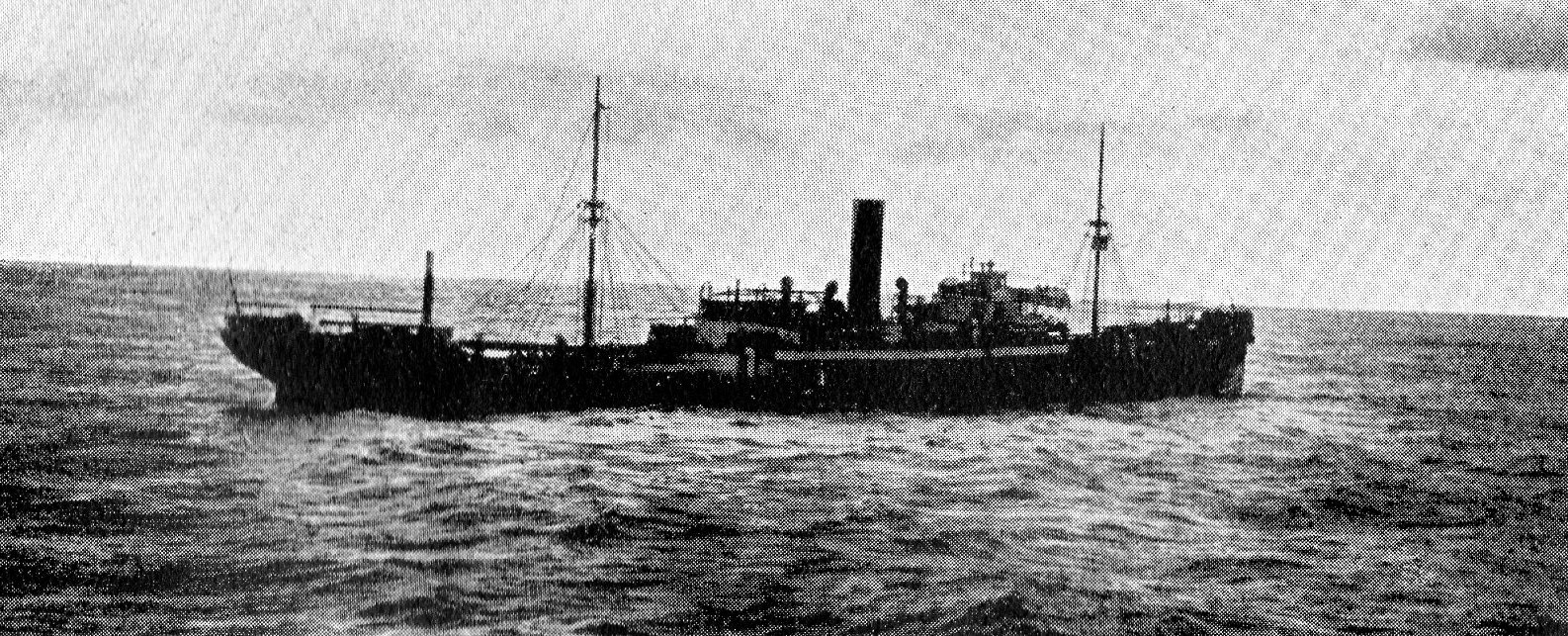
SMS Leopard (1917)
She was built in 1912 at Walker, Newcastle upon Tyne, launched on 3 May as yard number 178. Her name was Yarrowdale, a cargo steamer operated by Robert Mackill & Co of Glasgow, one of thousands of unremarkable freighters hauling goods across the Atlantic. Four years later she was captured by an enemy warship, converted into a weapon, renamed, disguised, and sent back to sea under a different flag. Weeks into her new career, she burned to the waterline in the Norwegian Sea and carried every man aboard to the bottom. SMS Leopard holds a singular distinction in naval history: she was the last commerce raider Germany ever sent out during the First World War.
Cargo and Capture
Yarrowdale was a single-screw steamer of 4,652 gross register tons, driven by a triple-expansion steam engine rated at 429 nominal horsepower, good for about 13 knots. On 11 December 1916, the German commerce raider Mowe intercepted her in the Atlantic. Mowe's captain, Nikolaus zu Dohna-Schlodien, was having a productive cruise, one that would ultimately account for 25 ships totaling 123,265 gross register tons. He recognized something in Yarrowdale beyond her cargo of vehicles, barbed wire, and ammunition: she had the size, speed, and nondescript profile that made a perfect disguise. Dohna-Schlodien transferred 469 prisoners aboard, including 89 American citizens, and dispatched her to Germany under a prize crew led by Acting Leutnant Reinhold Badewitz.
A Christmas Eve Bluff
Badewitz had an improbable stroke of luck. A strike by Liverpool boilermakers had shrunk the Northern Patrol from 23 vessels to six, and Yarrowdale slipped through the cordon on Christmas Eve 1916. When a Swedish officer boarded her during a gale in Swedish waters, Badewitz claimed she was a coaling ship. Below decks, the prisoners were kept silent with drawn pistols. The bluff held. Yarrowdale reached Germany on 5 January 1917, and the Kaiserliche Werft Kiel immediately began her transformation. She was renamed SMS Leopard on 9 January and armed with five 15-centimeter guns forward, four 8.8-centimeter guns, and two torpedo tubes, all concealed behind false doors and shutters. Seven watertight compartments were installed to resist flooding. She carried no armor, but her firepower could overwhelm any ship smaller than a modern cruiser.
Rena Norge Sails North
Leopard was disguised as Rena, a Norwegian freighter of similar size built in England in 1911. It was the second time Germany had used this identity for a raider; the first had been sunk before attacking any Allied shipping. Under Korvettenkapitan Hans von Laffert, with a complement of 319, Leopard passed through the Little Belt on 7 March 1917 and headed for the open sea. German intelligence had gleaned detailed information about the British Northern Patrol from decoded wireless signals, but on 10 March a warning arrived: the British had changed their cipher. Laffert was advised to turn back. He chose to continue.
Ninety Minutes of Fire
On 16 March, in the Norwegian Sea north of the Shetlands, the armoured cruiser HMS Achilles and armed boarding steamer HMS Dundee spotted Leopard. Achilles overtook her and ordered Dundee to send a boarding party. Six men rowed across and were never seen alive again. As Dundee's captain watched Leopard maneuvering to bring her hidden guns to bear, the ship's port gun ports swung open. Dundee fired first, hitting the gun deck and engine room with her two 4-inch guns while a 3-pounder raked the bridge. Leopard fired three salvoes at Dundee, all of which missed. She also launched three torpedoes, which passed harmlessly. Achilles joined the bombardment from range. For roughly ninety minutes, Leopard burned, her one surviving gun still firing, until she listed to port and sank. All 319 German officers and men died, along with the six British boarders.
A Bottle on the Waves
Soon after the sinking, a bottle was found containing a message reportedly thrown overboard during the engagement. It read: "In action with British cruiser. Fighting for the glory and honour of Germany. A last greeting to our relatives." That message is the only direct voice to survive from Leopard's crew. After her loss, Germany abandoned surface raiding altogether. Mowe, the ship that had captured Yarrowdale in the first place, returned to port on 22 March and was not sent out again. From that point forward, Germany waged its war at sea entirely with submarines. The spot where Leopard sank, at roughly 64.9 degrees north in the grey waters between Norway and the Shetlands, marks the place where an era of naval warfare quietly ended.
From the Air
Located at approximately 64.90N, 0.37E in the Norwegian Sea, north of the Shetland Islands. Open ocean with no land nearby. This is the approximate sinking location of SMS Leopard. Nearest airports: EGPB (Sumburgh, Shetland, approximately 170 nm south-southeast) and ENBO (Bodo, Norway, approximately 250 nm east-northeast). Expect frequent poor weather, heavy seas, and limited visibility characteristic of the Norwegian Sea.