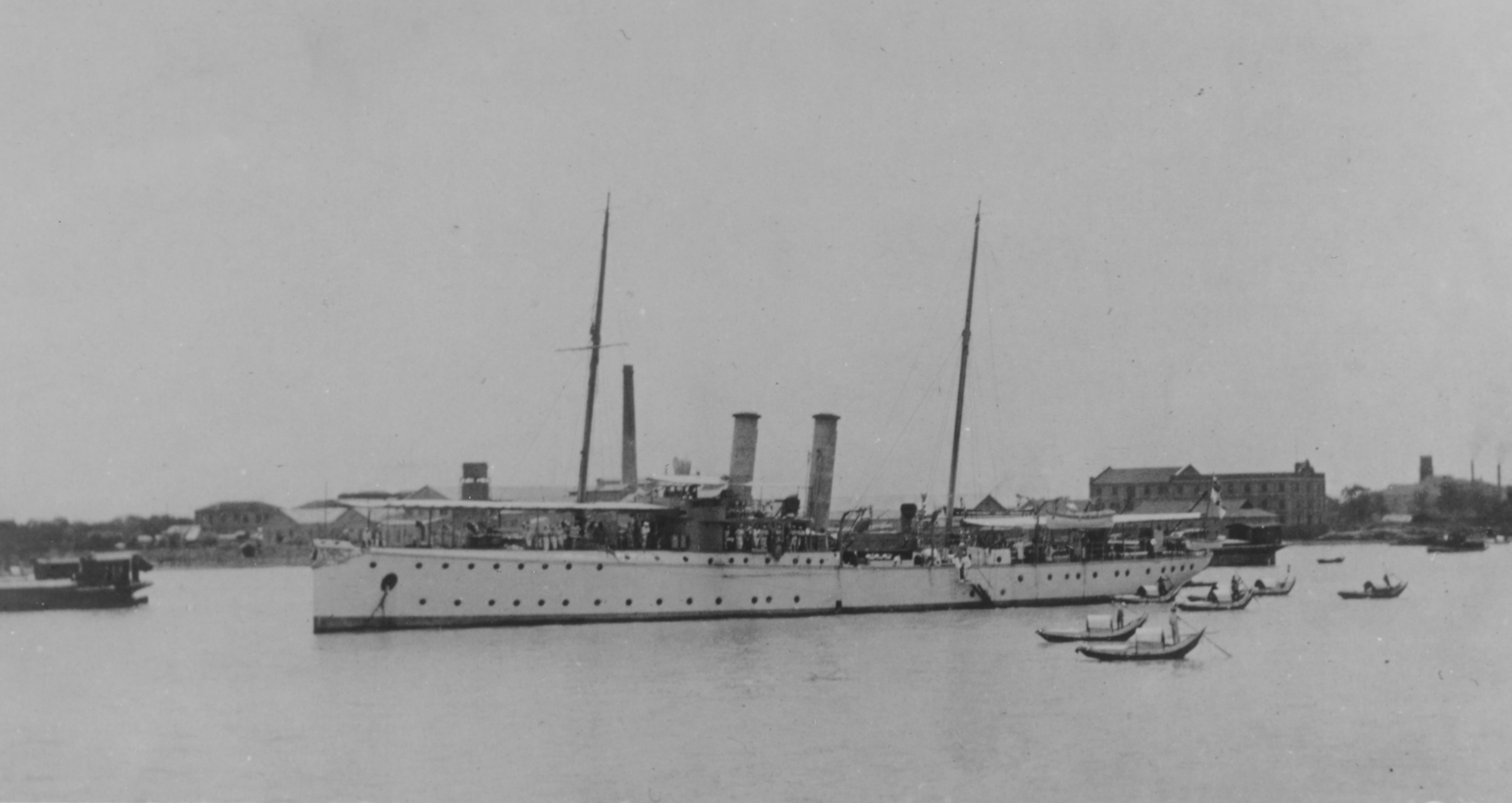
SMS Luchs
Her name was spelled wrong at her own christening. When SMS Luchs slid down the ways at the Imperial Shipyard in Danzig on October 18, 1899, the ceremony rendered her as Lux -- Latin for light, rather than the German word for lynx. By the time she was commissioned the following May, someone had caught the error. It was a fitting start for a warship that would spend her entire career slightly out of step with the action, always arriving at the edge of a crisis rather than its center, until the Siege of Qingdao in 1914 made her expendable.
Detoured to War
Luchs was originally assigned to the American Station, a relatively quiet posting that would have seen her patrolling the Caribbean and South American coasts. But the Boxer Uprising changed everything. On June 30, 1900, just weeks after commissioning, her orders were rewritten: sail for the Far East. She departed Kiel on July 7, rendezvous-ed with the main German fleet in Port Said, then suffered a machinery breakdown that stranded her in Aden for over a week. She finally reached Singapore at the end of August and was ordered to Guangzhou to secure German interests in southern China. Once there, she gave up men and weapons to a newly purchased river gunboat -- already being stripped of resources before her career had properly begun.
The Interment at Qingdao
If one moment defined Luchs's long service in East Asia, it came in August 1904 during the Russo-Japanese War. The badly damaged Russian battleship Tsesarevich and three destroyers limped into the German naval base at Qingdao after their defeat in the Battle of the Yellow Sea, seeking refuge. Germany was neutral, which meant the Russians had to be interned -- but the warships attempted to restock their coal supplies from British steamers, raising the possibility they might try to escape. The armored cruiser Furst Bismarck and a protected cruiser cleared for action, and Luchs and her sister ship reinforced them. It was a tense standoff: German guns trained on Russian ships in a German harbor during someone else's war. The Russians stayed put.
Bangkok to Hankou
Luchs's peacetime cruises read like a Victorian adventure novel's itinerary. She picked up squadron commanders in Bangkok for formal visits to the King of Siam. She navigated the Mekong River in French Indochina. In 1910, she toured Manila, Sumatra, and North Borneo alongside the armored cruiser Scharnhorst. When the East Asia Squadron commander died of typhus in Hong Kong in January 1911, Luchs's men formed part of the honor guard escorting his body to a steamship for the journey home. Through it all, the 65-meter gunboat kept returning to the Yangtze -- to Hankou especially, where the currents ran fast and German commerce needed watching.
Stripped and Sunk
When war broke out in late July 1914, Luchs was in the Shanghai shipyard undergoing maintenance. She raced back to Qingdao, but her fate had already been decided. Along with her sister Tiger, Luchs was disarmed: her 10.5-centimeter guns and much of her crew went to outfit the Norddeutscher Lloyd postal steamer Prinz Eitel Friedrich as a commerce-raiding auxiliary cruiser. Her captain, Korvettenkapitan Thierichens, left to command the new raider. Luchs herself was decommissioned and towed into the inner harbor, a hollow shell of a warship. On the night of September 28-29, as Japanese forces tightened the siege around Qingdao, shipyard workers set scuttling charges and sent her to the bottom. She sank the same night as her sister Iltis -- two lynx and a name, misspelled at the start, forgotten at the end.
From the Air
SMS Luchs was scuttled in the inner harbor of Qingdao at approximately 36.05N, 120.27E. Jiaozhou Bay is clearly visible from altitude, with the Qingdao waterfront identifiable by its mix of German colonial architecture and modern high-rises. Nearest airport: ZSQD (Qingdao Jiaodong International Airport). The old harbor area lies in the Shinan District along the southern shore.