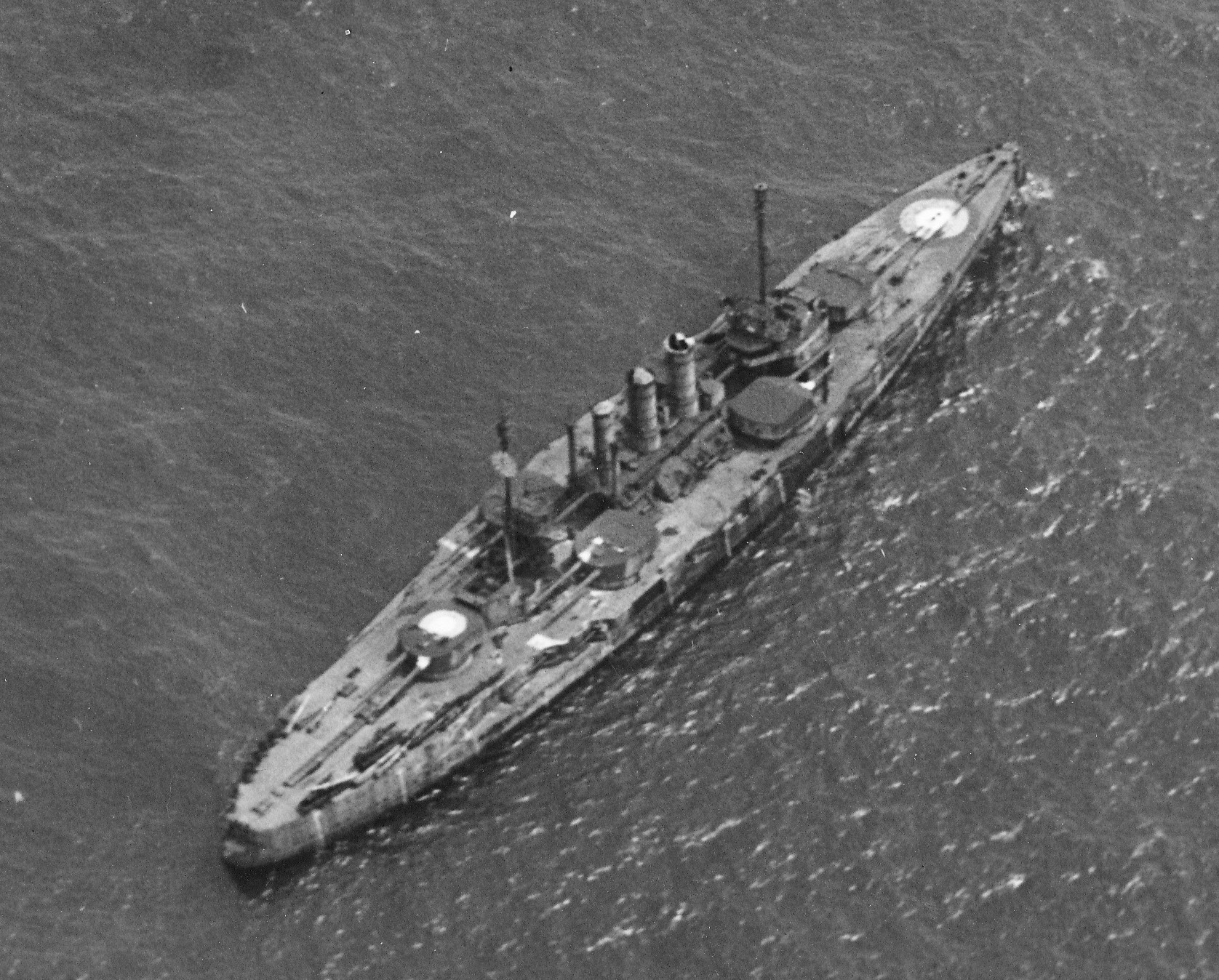
SMS Ostfriesland
At 12:40 on the afternoon of July 21, 1921, the German dreadnought Ostfriesland rolled over and sank in the Atlantic off Cape Henry, Virginia. She had endured two days of aerial bombing by the United States Army Air Service -- waves of aircraft dropping increasingly larger ordnance onto her stationary hull. The 2,000-pound bombs that finally killed her had not even been sanctioned by the Navy, which had set the rules for the test. General Billy Mitchell, who orchestrated the demonstration, became a national hero overnight. The Navy was furious. And the argument over what the sinking actually proved -- whether battleships were obsolete, whether air power was supreme -- consumed American military thinking for the next two decades, right up until Japanese aircraft settled the question permanently at Pearl Harbor.
Built for the Kaiser's Fleet
Ostfriesland was laid down on October 19, 1908, at the Imperial Dockyard in Wilhelmshaven, the second vessel of the Helgoland class of dreadnought battleships. Named for the coastal region of East Frisia in northwestern Germany, she was christened by the Princess of Innhausen and Knyphausen, a representative of the oldest East Frisian nobility. Commissioned into the High Seas Fleet on August 1, 1911, the ship carried twelve main battery guns in six twin turrets arranged in a hexagonal pattern, a crew of 42 officers and 1,071 enlisted men, and enough Krupp cemented armor to absorb considerable punishment. She was assigned to I Battle Squadron and quickly became the squadron flagship, flying the flag of Vice Admiral Hugo von Pohl. In peacetime, she won the Kaiser's artillery shooting prize for her squadron. Her career would span the entire arc of Imperial German naval ambition -- from the swagger of prewar fleet exercises to the mutiny that ended the empire.
Jutland and a Mine
Ostfriesland participated in every major fleet operation of World War I in the North Sea. She was present when the High Seas Fleet nearly stumbled into an isolated British squadron during the December 1914 raid on Scarborough, Hartlepool, and Whitby. She sortied during the Battle of Dogger Bank in January 1915 and joined the attempted sweep of the Gulf of Riga that August. But her defining moment came at Jutland on May 31, 1916 -- the largest naval battle of the war. Positioned ninth in the German battle line, directly behind the fleet flagship, Ostfriesland fired 111 rounds from her main battery and 101 shells from her secondary guns. She claimed hits on the British dreadnought Warspite. During the chaotic night fighting, she helped destroy the armored cruiser Black Prince, illuminating the vessel with spotlights and pouring salvos into it until two massive explosions killed all 857 crew. On the morning of June 1, steaming for home, Ostfriesland struck a British mine on her starboard side. The blast tore a hole in the hull and flooded the ship. When she turned away from what was thought to be a submarine, the damaged torpedo bulkhead gave way, causing a nearly five-degree list. She limped into Wilhelmshaven that evening under escort.
Mutiny and Surrender
By late October 1918, the war was lost but the High Seas Fleet's commanders planned one final sortie -- a suicidal charge against the British Grand Fleet intended to improve Germany's bargaining position at the peace table. The order to sail was given for October 30. War-weary sailors on Ostfriesland's sister ship Thuringen began the mutiny on the night of the 29th. The unrest spread. Crews on several battleships refused to raise anchor. Admirals Hipper and Scheer were forced to cancel the operation. Kaiser Wilhelm II, informed of the collapse of discipline, said simply: "I no longer have a navy." Ostfriesland was decommissioned on December 16 and converted to a barracks ship. Under the Treaty of Versailles, she and the remaining German dreadnoughts were surrendered to the Allies as war reparations. On April 1, 1920, Ostfriesland sailed for Rosyth, Britain. Ceded to the United States, she was commissioned briefly as USS Ostfriesland, then towed across the Atlantic, arriving at Sandy Hook on August 9. She decommissioned in New York on September 20, 1920, and was prepared for her final role: a target.
Mitchell's Bombs
The bombing tests of July 1921 were General Billy Mitchell's chance to prove that aircraft could sink capital ships. The Navy set strict rules: inspectors were to board the target between bombing runs, and bomb sizes were to increase incrementally. Mitchell's aviators hit Ostfriesland with 230-pound bombs on July 20, scoring eight hits out of thirty-three drops. Larger 600-pound bombs followed, five finding their mark. The topside damage was modest, but near-misses detonated underwater and cracked the hull, flooding compartments and creating a five-degree list. A storm halted operations that afternoon. The next morning, the fifth wave scored three hits with 1,000-pound bombs. Inspectors noted damage but found the ship still structurally sound. Then came the unauthorized escalation: at 12:19, six 2,000-pound bombs were dropped. None hit directly, but three detonated close enough to the hull to devastate the underwater structure. Eleven minutes later, Ostfriesland was gone. Mitchell had not allowed inspectors aboard between the final runs, violating the Navy's protocols. General Pershing signed a joint report declaring the battleship still the backbone of the fleet. Mitchell leaked his own account to the press. His supporters falsely branded Ostfriesland an unsinkable super-battleship. Senator William Borah declared battleships obsolete.
The Wreck Below the Waves
Ostfriesland lies on the Atlantic floor off the Virginia Capes, roughly 60 miles east of Cape Henry, a war grave that belongs to two navies and two eras. She was built in the final years of the Anglo-German naval arms race and sunk in the opening chapter of the air power debate. Mitchell's court-martial for insubordination came four years later, in 1925, after he accused senior military leaders of criminal negligence following the crash of the airship Shenandoah. He was convicted and left the service. History largely vindicated his central argument: aircraft carriers would dominate the next war. But the specific lesson of Ostfriesland was more nuanced than either side admitted in 1921. The near-misses that cracked her hull proved that underwater blast effects -- not direct hits on armored decks -- were what sank heavily protected ships. That insight would reshape naval architecture and antiship weapons for generations. The dreadnought that survived Jutland, a mine, and a mutiny could not survive the future.
From the Air
SMS Ostfriesland was sunk approximately 60 miles east of Cape Henry, Virginia, at roughly 37.15°N, 74.57°W, in open Atlantic waters. The wreck site is not visible from the surface. From the air, Cape Henry and the entrance to the Chesapeake Bay are the nearest significant landmarks, visible to the west. The Chesapeake Bay Bridge-Tunnel crosses the bay's mouth in the same general area. Virginia Beach's oceanfront stretches south of Cape Henry. Nearest airports: Norfolk International (KORF) approximately 25 nm west-southwest, and NAS Oceana (KNTU) about 20 nm southwest. The open ocean location is best appreciated at cruise altitude, where the distance from shore underscores the isolation of the bombing tests.