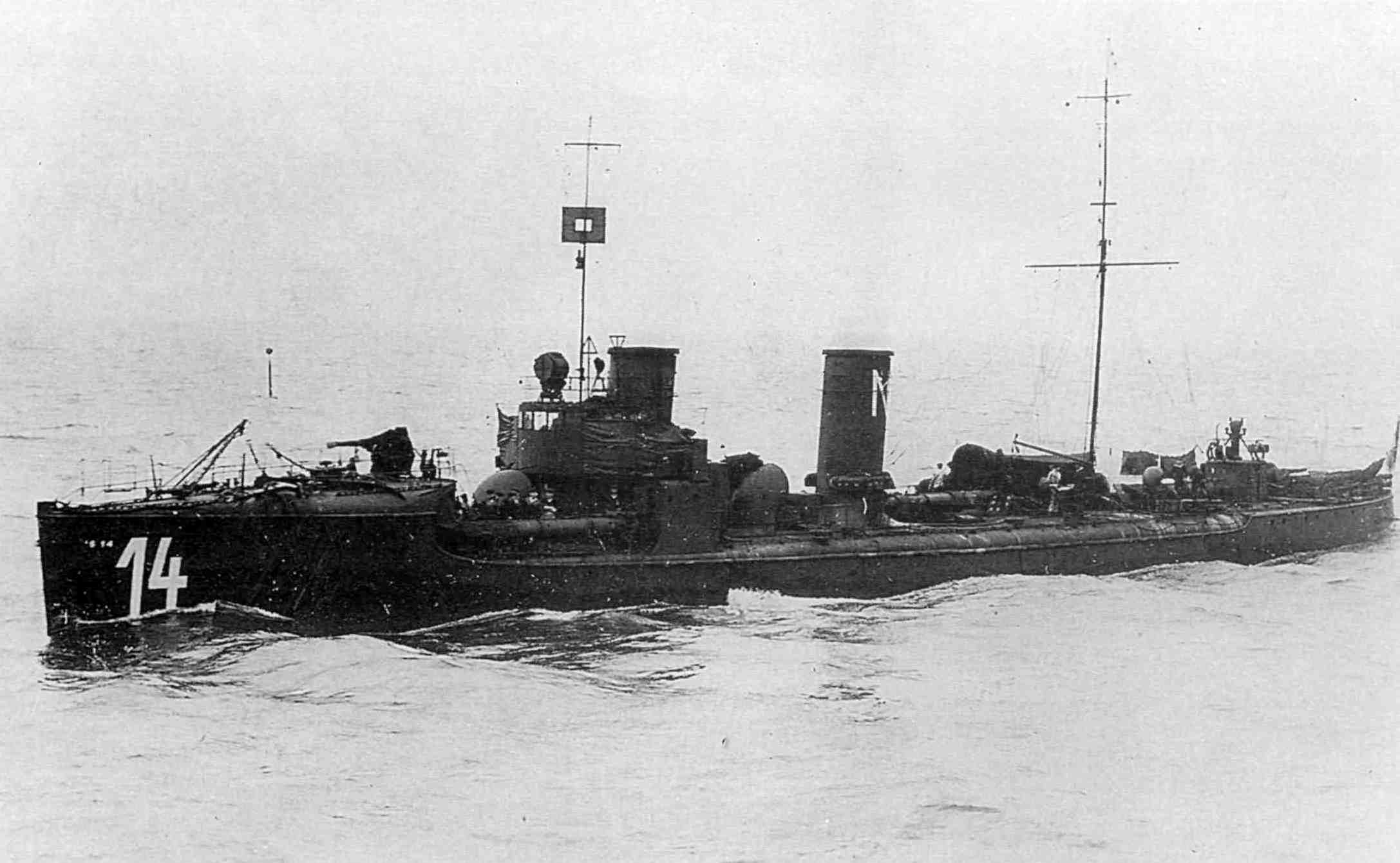
SMS S14 (1912)
On February 19, 1915, the German torpedo boat SMS S14 was lying in the Jade estuary off Wilhelmshaven when an explosion ripped through her hull. Eleven of her crew died. She sank where she lay. It is the kind of small disaster that almost no one outside her own flotilla has reason to remember - a single 570-ton ship lost not to enemy action but to something inside her, something that her crew was probably standing very close to when it gave way. The cause was never definitively published. She had been at sea four months earlier, taking part in the raids on Yarmouth and Scarborough, the operations that would help define the early naval war in the North Sea.
The Smaller Cousin
S14 was a V1-class torpedo boat, built by Schichau-Werke in Elbing as one of twelve similar boats ordered in the 1912 programme (S13 to S24). The Imperial German Navy had decided that torpedo boats were becoming too big to operate effectively as scouts and screens for the main battle line; this class was a step back toward something more nimble. They carried a small main armament - a pair of 8.8 cm guns, one on the forecastle and one aft - and four 50 cm torpedo tubes, two angled to fire ahead from beam positions and two on the centerline behind the funnels. They could carry up to eighteen mines as well, in case the situation called for laying rather than launching.
The 13th Half-Flotilla
On the outbreak of war in August 1914, S14 was part of the 13th Half-Flotilla of the 7th Torpedo Boat Flotilla, attached to the German High Seas Fleet. Her job was to screen heavier ships, run scouting patrols across the Bight, and prepare for the kind of close-in night action torpedo boats were designed for. On November 3, 1914, the 7th Flotilla supported the German raid on Yarmouth - a hit-and-run bombardment of the English east coast intended to provoke a British naval response. A month later, on December 3, the flotilla was at sea again for the raid on Scarborough, Hartlepool, and Whitby. Both operations killed civilians on the British coast and accomplished little of military value, but they pulled the Royal Navy out of port in ways the German command found instructive.
What Killed Her
Eleven sailors died when S14 blew apart on February 19, 1915, in the Jade. The official record uses the careful phrase internal explosion, which can mean any of several things - a magazine accident, a boiler rupture, a fuel-vapor ignition. Torpedo boats of that era carried explosives in compressed spaces stuffed with hot machinery and human beings, and the margin between routine operations and catastrophe was always smaller than it looked from shore. Whatever the proximate cause, the eleven men who died were standing at their normal duty stations when it happened. They had survived two raids on the English coast. They were home, at anchor, near the largest naval base in northern Germany, and the threat that ended them came from somewhere inside their own ship.
Salvaged, Scrapped, Forgotten
The wreck was raised later in 1915 and towed to Wilhelmshaven, where she was broken up. The surviving sister ships of the V1 class soldiered on through the rest of the war, taking part in fleet sorties and the long inconclusive duels of the German Bight. None of them became famous. S14 left no name on a memorial that gets much attention, no plaque in a sailor's museum. The official histories list the explosion in a sentence or two. She is mentioned now mostly because the V1 class as a whole is a footnote in the wider story of German torpedo-boat design - and because, for eleven families somewhere in Germany in February 1915, the small ship that died at anchor in the Jade was not a footnote at all.
From the Air
53.67N, 8.08E. The Jade estuary off Wilhelmshaven, where S14 was lost, is now busy commercial water leading to the JadeWeserPort container terminal. Cruise at 2,000-3,000 ft for the best view of the channel structure and the naval port. Wilhelmshaven (EDWI) is the nearest field; Bremerhaven (EDWB) lies about 40 km east. Active military airspace in the area - check NOTAMs. Visibility usually best in early afternoon.