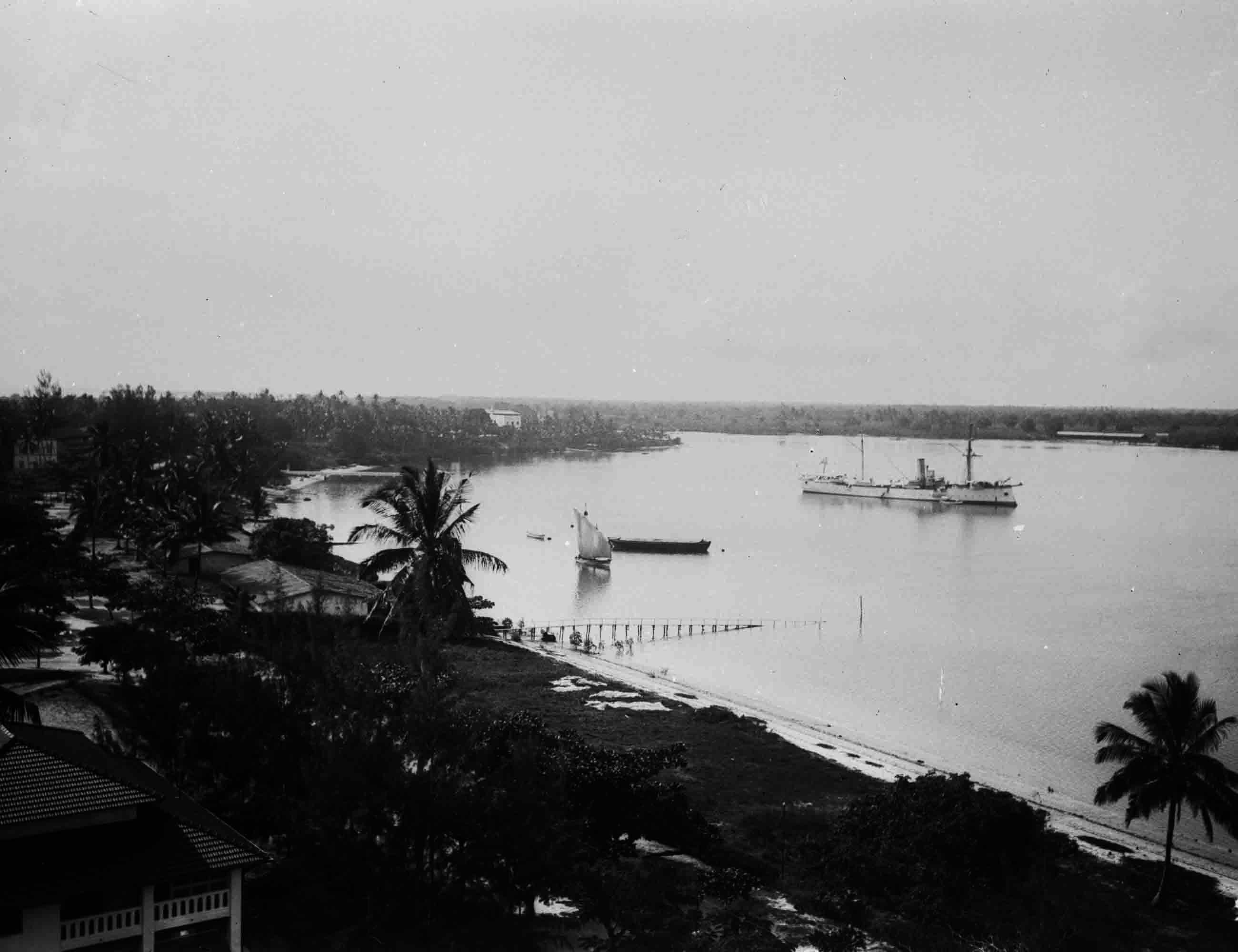
SMS Seeadler
On 19 April 1917, the water in the outer roadstead off Wilhelmshaven heaved. SMS Seeadler - Sea Eagle - had been moored there for years, a tired old cruiser repurposed as a storage hulk for naval mines. The mines went off. The ship went with them. The sound rolled across the Jade Bight, but by the time investigators counted, nobody was dead. The crew had been ashore. The Sea Eagle, which had spent more time abroad than any other major German warship of her era, ended her thirty-year career in a single inland flash, a few kilometres from where the German Imperial Navy had been born.
Born of Empire
Seeadler was laid down at the Kaiserliche Werft in Danzig in late 1890, launched on 2 February 1892, and commissioned in August of that year. She was an unprotected cruiser of the Bussard class, built for a navy that suddenly had colonies to patrol: territories scattered across East Africa, the South Pacific, and the China coast. At 82.6 metres long with eight 10.5 cm guns and a top speed of about 17 knots, she was a modest warship by the standards of the dreadnought age just dawning. But she was rigged for endurance, with coal bunkers stretched for long ocean passages, and the Kaiserliche Marine sent her almost immediately to the far ends of empire.
An Almost Embarrassing Debut
Before East Africa, Seeadler joined a goodwill flotilla bound for New York to mark - belatedly - the four hundredth anniversary of Columbus's first crossing. The crossing did not go smoothly. Someone at the Kaiserliche Werft miscalculated her coal consumption, and the new cruiser ran out of fuel in the middle of the Atlantic. Her consort, the protected cruiser Kaiserin Augusta, took her under tow to Halifax to refill the bunkers. They reached Hampton Roads on 18 April 1893, and Seeadler's elegant, yacht-like silhouette drew particular admiration when President Grover Cleveland reviewed the international fleet in New York harbour.
Africa, the Pacific, and a Sultan in Exile
From the Caribbean she steamed back across the Atlantic, into the Mediterranean and Red Sea, and finally dropped anchor in Zanzibar in September 1893. The next two decades were a tour of imperial troubles. She and the survey ship Möwe shelled slave traders who had attacked a small German police post at Kilwa. She evacuated German civilians from a rebellion in Portuguese Lourenco Marques. After the brief 1896 Anglo-Zanzibar War, it was Seeadler that quietly carried the deposed Sultan Khalid bin Barghash from Zanzibar to Dar es Salaam. In the Pacific she joined the international suppression of the Boxer Uprising in Qing China in 1900, then was recalled to East Africa in 1905 to help put down the Maji Maji Rebellion - one of the largest uprisings against German colonial rule, in which tens of thousands of Africans were killed.
The Longest Tour
When Seeadler finally returned to Kiel in March 1914, she had been continuously abroad since October 1899 - more than thirteen years away from her home waters. No other major German warship of her generation matched that figure. Her crew rotated through, her boilers were patched in Bombay and Cape Town, but the ship herself simply stayed out. She was reclassified as a gunboat in May 1914. Three months later, World War I broke out, and the German Navy looked at the aging cruiser and decided she was no longer worth fitting for combat. She was towed to Wilhelmshaven, stripped down, and pressed into service as a hulk - a floating warehouse for the most dangerous cargo the navy possessed.
Fire on the Jade
The end came without warning on 19 April 1917. The mines aboard - hundreds of them, primed for laying in the North Sea - detonated together. The wreck settled into the silt of the outer Jade and was never raised for scrapping. By a turn of luck unusual in the war, no one was killed. After three decades of patrolling other people's coasts, the Sea Eagle was destroyed at home, by her own cargo, within sight of the city that had ordered her built. Her remains still lie out there, a few metres beneath the tidal flats, somewhere between Wilhelmshaven and the open sea.
From the Air
Coordinates of the documented loss position: roughly 53.48 N, 8.20 E, in the outer Jade roadstead north of Wilhelmshaven. The wide V-shaped Jade Bight is unmistakable from altitude, with the German Navy facilities along its western shore. Recommended viewing altitude 3,000 to 6,000 feet to take in the bight, Wilhelmshaven, and the Mellum sandbank to the north. Nearest airport: JadeWeserAirport (EDWI). Bremen (EDDW) to the southeast.