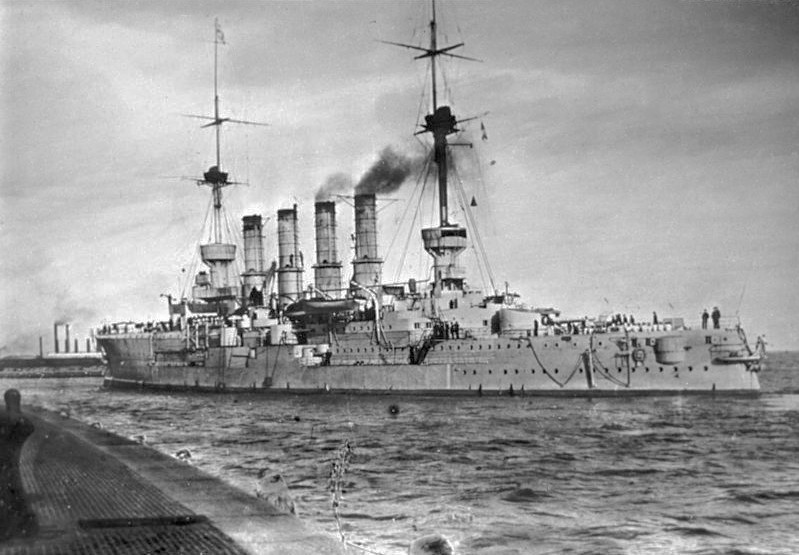
SMS Yorck
It was 04:10 in the early hours of November 4, 1914, and the fog over the Schillig roadstead off Wilhelmshaven was thick enough to lose a ship inside. SMS Yorck had been anchored there for hours, waiting out the weather with the rest of the High Seas Fleet after the raid on Yarmouth. Her captain, Waldemar Pieper, decided the fog had thinned enough to risk the passage back into port. The pilot who had come aboard to guide her refused to take responsibility for the move. Pieper ordered the ship underway anyway. Within minutes she struck a German mine, turned to escape, and struck a second. By dawn she was gone, and roughly 336 of the 629 men aboard her had died in the cold North Sea water.
Built for an Earlier War
Yorck was the second and final ship of the Roon class of armored cruisers, built for the Imperial German Navy at the Blohm & Voss yard in Hamburg. Her keel was laid in April 1903, she was launched in May 1904 by Josephine Yorck von Wartenburg - granddaughter of the Prussian general for whom the ship was named - and she was commissioned in November 1905. She carried a main battery of four 21 cm guns in two twin turrets, displaced about 9,500 tons, and could make 20.4 knots. The class was an incremental improvement on the previous design, with a longer hull and a few more boilers. Then in 1907 the Royal Navy launched HMS Invincible, the first battlecruiser, and overnight every armored cruiser in every fleet became obsolete. Yorck was a year and a half into her career when the world she had been built for stopped existing.
Peacetime, Mostly
For seven years she sailed with I Scouting Group, the reconnaissance arm of the Home Fleet. She made cruises across the Atlantic to Vigo, A Coruna, Funchal, Madeira; she served as a flagship under a succession of admirals including Hugo von Pohl, Maximilian von Spee, and Franz von Hipper, all of whom became famous later. She won the Kaiser's shooting prize twice. Trouble found her even in calm waters. In March 1911, a benzene explosion in her aft boiler room killed one man and injured several. In November 1912, one of her pinnaces detonated a naval mine, killing two more. In March 1913, during exercises off Helgoland, her bow tore into the torpedo boat S178 and sank her within minutes. Sixty-nine men aboard S178 died. Yorck was barely scratched. She was decommissioned two months later and placed in reserve.
The Fog at Schillig
World War I changed everything. Yorck was recommissioned in August 1914 under Captain Waldemar Pieper and assigned to III Scouting Group. On November 3, 1914, she screened the High Seas Fleet during the first German offensive operation of the war - the raid on Yarmouth, in which Hipper's battlecruisers shelled the English coast and minelayers seeded the approaches with mines that would later kill a British submarine. Returning to Wilhelmshaven that evening, the German ships ran into heavy fog and anchored in the Schillig roads to wait for visibility. Pieper, worried about a water supply contaminated with paratyphus, decided early on November 4 that the weather had cleared enough to bring his ship into port. The pilot disagreed and refused to take the helm. Pieper ordered the move anyway. At 04:10 the ship struck the first mine. She turned to retreat and struck a second. The water that morning was cold, the visibility almost nil, and she sank fast.
Three Hundred and Thirty-Six Names
Historians disagree on the exact figure. V. E. Tarrant records 127 men rescued out of 629; the Imperial German Navy historian Erich Groener counts 336 dead and 381 saved. The naval historians Hans Hildebrand, Albert Roehr, and Hans-Otto Steinmetz concur with Groener. The men who died on Yorck that morning were sailors, stokers, signalmen, gunners - some of them new to the fleet, some who had served on her for years. Many were trapped below as the ship rolled. Some made it into the water but did not survive the cold long enough to be reached. Pieper himself was rescued, court-martialed, convicted of negligence, disobedience of orders, and homicide through negligence, and sentenced to two years. He was later released and sent to advise the Ottoman defense during the Dardanelles campaign. The wreck lay between Horumersiel and Hooksiel, marked as a hazard and slowly dismantled over the next seven decades. The last of her hull was demolished in 1983.
The Quiet Place It Now Is
There is no land monument over the spot where Yorck went down. The Jade Bight has been dredged and reshaped repeatedly since the disaster - to expand the entrance for larger warships, then for postwar civilian shipping, then for the modern container terminal at JadeWeserPort. Her turrets were lifted in 1969. Today the water that runs past Horumersiel and Hooksiel is busy with cargo ships, tugs, and the occasional small craft on the way to the islands. The names of the dead are recorded in the German naval rolls and in a handful of memorials in their home towns. On still mornings, the fog still rolls over the Schillig roadstead exactly as it did in November 1914. The lesson written into the ship's loss is unromantic and worth saying plainly: in poor visibility, in waters seeded with mines you cannot see, the prudent answer is to wait.
From the Air
53.67N, 8.08E. The general area of Yorck's loss lies in the Jade Bight north of Wilhelmshaven, between Horumersiel and Hooksiel. Cruise at 2,000-4,000 ft for the best view of the bight, the shipping channels, and the long line of the Friesland coast. Wilhelmshaven (EDWI) is the closest larger field; Bremerhaven (EDWB) is about 40 km east. Visibility around the bight is highly variable, with coastal fog common at dawn and dusk - the conditions in which Yorck was lost are not historical curiosities here, they are a regular feature of the weather.