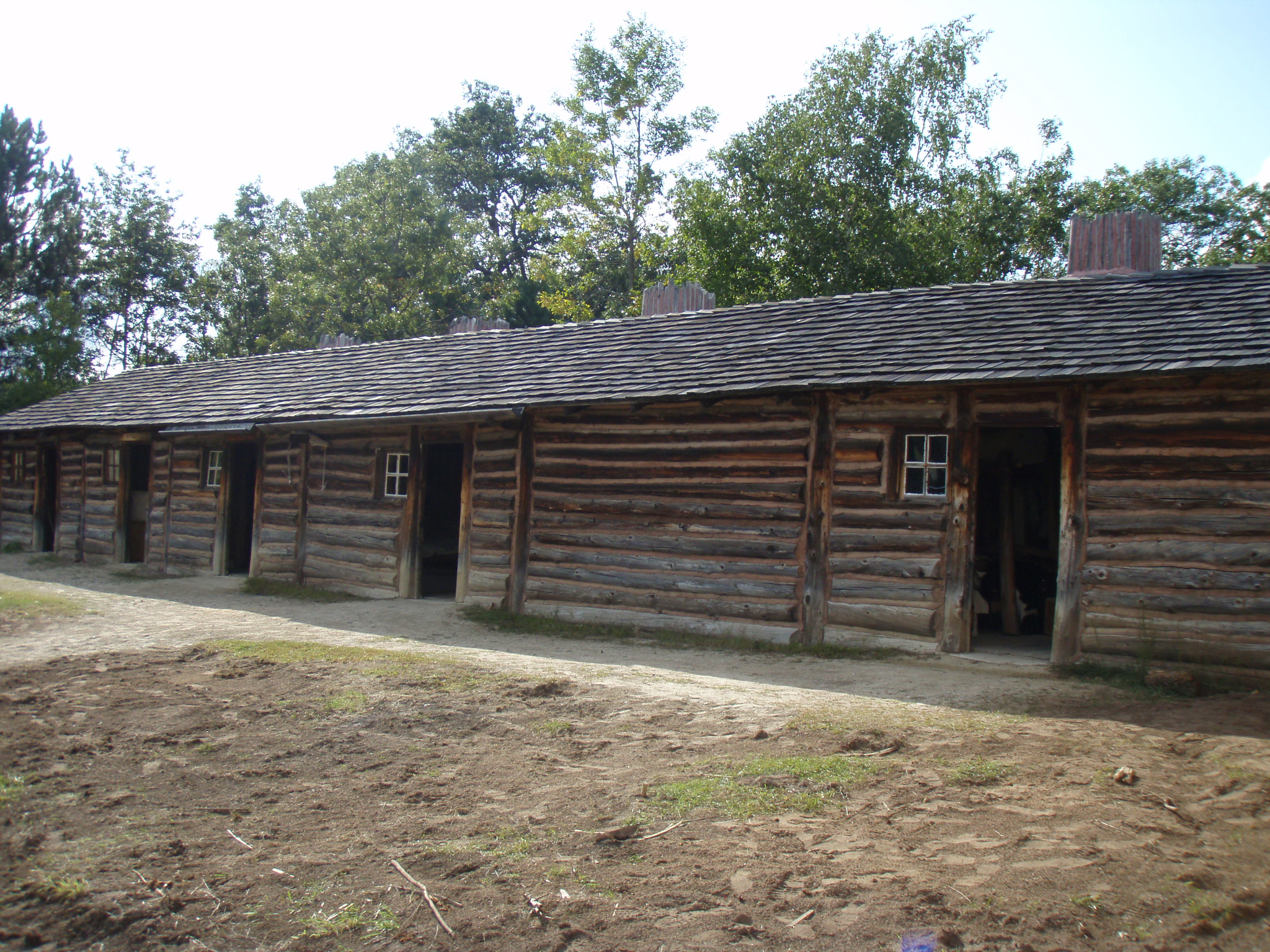
Snake River Trading Post
The musket flints turned up first. In 1931, a Pine City resident poking through soil along the Snake River found small chips of worked stone -- unmistakable artifacts of an earlier century. He kept returning over the next three decades, collecting fragments of a story buried under Minnesota farmland. In 1958, he discovered a book called Five Fur Traders in the North West that contained the journal of a man named John Sayer, and suddenly the scattered artifacts had a narrator. Sayer was a partner in the North West Company who had built a fur trading post on this very stretch of river in the fall of 1804. His crew of voyageurs raised the walls between October 9 and November 20 of that year, constructing a six-room rowhouse enclosed by a stockade with a main gate and a river entrance. The post operated through the winter trading season before the party departed on April 26, 1805. At some point afterward, fire consumed the buildings, and the forest reclaimed the site for over a century.
Beaver Pelts and British Ambition
The North West Company formed in Montreal in 1779 from a partnership of British merchants hungry to dominate the interior fur trade. They established a major depot at Grand Portage on Lake Superior's north shore and pushed westward with a network of wintering posts staffed by voyageurs -- the French-Canadian paddlers and laborers who did the grueling physical work of the trade. Besides the Snake River post, the company operated forts at Fond du Lac (now part of modern Duluth), Big Sandy Lake, and Leech Lake in Minnesota. Sayer, a bourgeois -- a wintering partner and stockholder -- had worked for British fur companies since the 1770s in the Fond du Lac District southwest of Lake Superior. The North West Company dispatched him to the Snake River in 1804, eager to expand business among the Snake River band of Ojibwe and to compete with the rival XY Company.
Winter Commerce on the River
A typical post included a dwelling for the clerk, a storehouse, and a bunkhouse for the ten to twenty voyageurs who spent the winter. The daily rhythm of the trade was a collaboration. Dakota and Ojibwe men hunted and trapped beaver, otter, muskrat, deer, bear, marten, and other fur-bearing animals. The women prepared the hides by stretching and drying them -- work that made the pelts their property by custom. They negotiated the trades with the post clerk, exchanging furs for firearms, blankets, cooking utensils, and other goods of early industrialization. The arrangement was mutually beneficial. Indigenous families gained access to manufactured tools and textiles, while the company shipped pelts eastward to Montreal and on to Europe, where the furs became felt hats and fur coats for a fashion-hungry market. This exchange had been moving westward for over a century by the time Sayer's men hammered their stockade into the Snake River bank.
Unearthed and Rebuilt
After the Pine City resident contacted the Minnesota Historical Society with his finds and the Sayer journal connection, professional investigation began. The Society performed field testing in 1963 to determine the character of the site. Between 1965 and 1967, students from Hamline University excavated the grounds and recovered hundreds of artifacts -- trade beads, iron tools, ceramic fragments, and personal items that fleshed out daily life at a frontier post. The archaeological evidence, combined with Sayer's detailed journal entries, gave the Society enough information to attempt an accurate reconstruction. Work began in 1968, and by 1969 the post stood again on its original footprint: a log stockade enclosing the rowhouse with its living quarters, warehouse, and trade shop. The site opened to the public as a state historic site in 1970 and was listed on the National Register of Historic Places in 1972.
A Living Window into the Fur Trade
Today the Snake River Fur Post, as it was renamed in 2018, operates as a living history museum under the Minnesota Historical Society. Costumed interpreters demonstrate the skills and routines of voyageur life -- portaging canoes, preparing food, mending equipment -- while explaining the complex economic and cultural relationships between European traders and Indigenous communities. The post sits on the Snake River, a tributary of the St. Croix, surrounded by the mixed forests of east-central Minnesota. The setting has changed less than many historic sites: the river still curves through wooded banks, and the quiet is broken mainly by birdsong and wind. What makes the site exceptional is the specificity of its story. Most fur trade posts survive only as place names or archaeological abstractions. This one has a named builder, a dated journal, excavated foundations, and a reconstruction grounded in primary evidence. Sayer wrote down what happened here, and the ground confirmed it.
From the Air
Located at 45.82N, 93.01W along the Snake River west of Pine City, Minnesota. The site sits in the forested lowlands of east-central Minnesota near the Snake River's confluence area with the St. Croix. The nearest airports include Pine City-Carlton Airport (private strip) and Rush City Municipal Airport (identifier: unavailable for small strips). Cambridge Municipal Airport (KCBG) lies approximately 25 miles to the southwest, and Minneapolis-St. Paul International (KMSP) is roughly 75 miles south. The Snake River corridor is visible as a tree-lined ribbon through agricultural land. Best viewed at 2,000-5,000 feet to spot the river bends and reconstructed post clearing.