Snake Temple
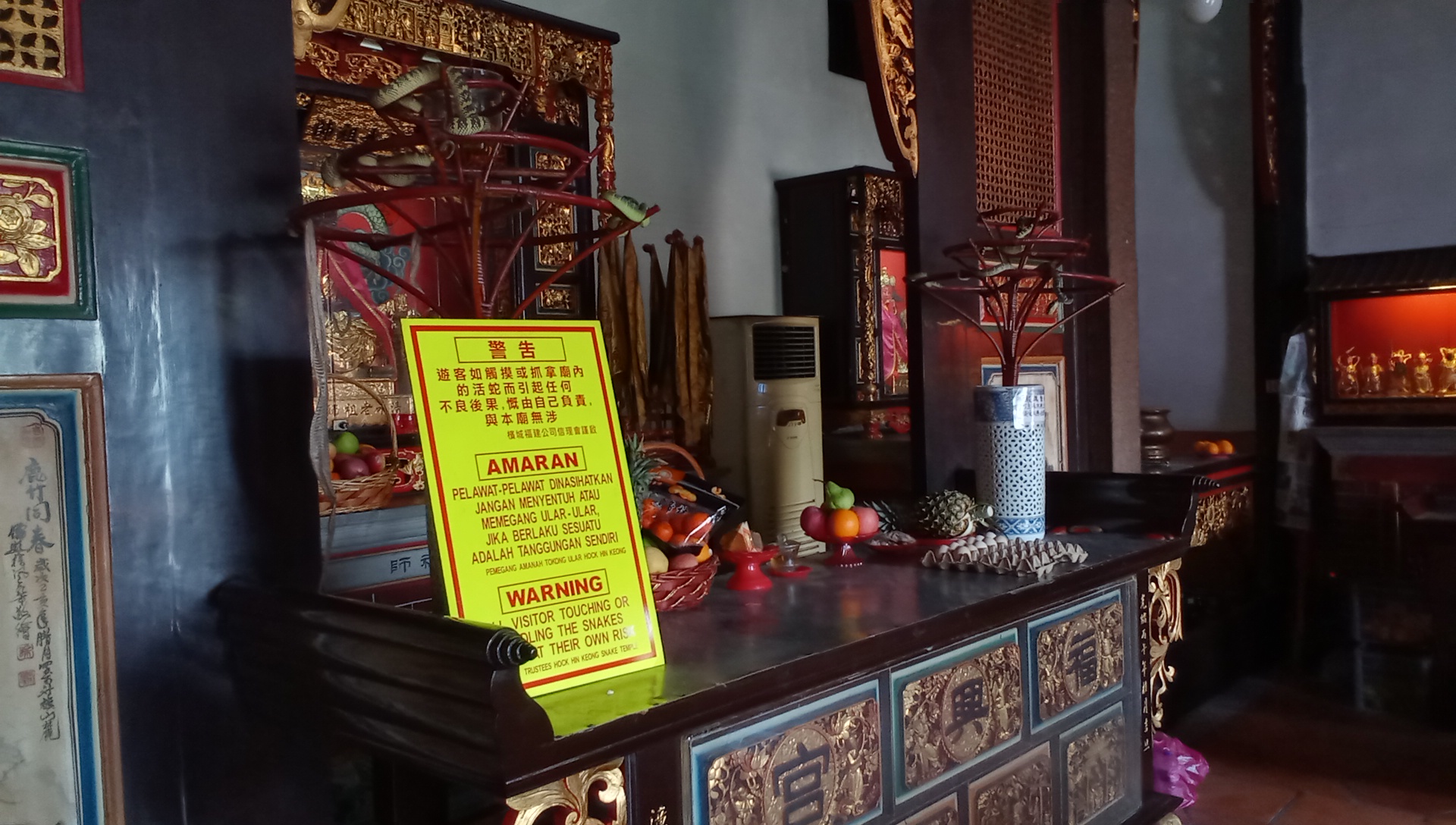
Thick incense smoke curls through the interior of a 220-year-old temple in Bayan Lepas, and coiled on nearly every surface - altar rails, candelabras, incense burners, offering tables - are pit vipers. They barely move. Visitors walk within inches of them. This is the Snake Temple, formally known as the Temple of the Azure Clouds, and the relationship between its resident serpents and its human worshippers has been the defining feature of this place since it was built in 1805 to honor a Buddhist monk who lived seven centuries earlier.
The Monk Who Sheltered Serpents
The temple is dedicated to Chor Soo Kong, better known as Master Qingshui, a Buddhist monk who lived during China's Song dynasty between 960 and 1279. He earned his reputation through acts of healing and charity, but one detail set him apart from other venerated monks: he gave shelter to snakes. The tradition holds that Qingshui saw no distinction between creatures deserving compassion - the sick, the poor, and the serpents were all welcome. When Chinese settlers in Penang built a temple in his honor at the beginning of the 19th century, the snakes came. Whether they arrived because of the dense surrounding jungle, the warmth of the incense, or something less easily explained depends on whom you ask. Devotees believe the vipers are reincarnated disciples of the master himself, drawn back to the temple across centuries to continue their devotion.
Smoke, Fangs, and Stillness
Step inside and the first thing that registers is the haze. Incense burns constantly, filling the temple with a sweet, heavy fog that devotees believe pacifies the snakes. The vipers - mostly Wagler's pit vipers, their green and yellow scales distinctive even in the dim light - drape themselves across altars with an almost theatrical stillness. As a practical matter, the temple's snakes have been de-venomed while retaining their fangs, a safety precaution that acknowledges the gap between faith and liability. Visitors are warned against handling the reptiles, though the temptation to pose with a coiled viper has proven difficult to discourage. Beyond the snakes, the temple houses two brick wells known as the Dragon Eye Wells, said to contain purifying water, and a pair of giant brass bells whose deep tones punctuate ceremonies. In 2005, a breeding center was established on the grounds to ensure the snake population's continuity.
Pilgrims and Cameras
Every year on the sixth day of the first lunar month - the anniversary of Master Qingshui's birth - devotees travel from as far as Singapore, Taiwan, and mainland China to pray at the temple. The occasion transforms the normally quiet grounds into a crowded festival of offerings, chanting, and communal meals. For the rest of the year, the Snake Temple draws a different kind of visitor. It appeared on the eighth leg of The Amazing Race 16 and serves as a setting in Tan Twan Eng's novel The Gift of Rain, cementing its reputation as one of Penang's most distinctive landmarks. The temple occupies an unusual position in the cultural landscape: simultaneously a functioning house of worship, a wildlife curiosity, and a tourist attraction. The vipers do not seem to mind the attention. They remain where they have always been - motionless, coiled, watching from the incense haze.
From the Air
The Snake Temple is located at approximately 5.314°N, 100.285°E in Bayan Lepas, on the southeastern side of Penang Island. It sits very close to Penang International Airport (WMKP), less than 2 kilometers to the southwest. From approach altitude into WMKP, the temple compound is visible as a traditional Chinese roofline amid the suburban development of Bayan Lepas. The Penang Bridge and Second Penang Bridge are both visible to the northeast and south respectively.