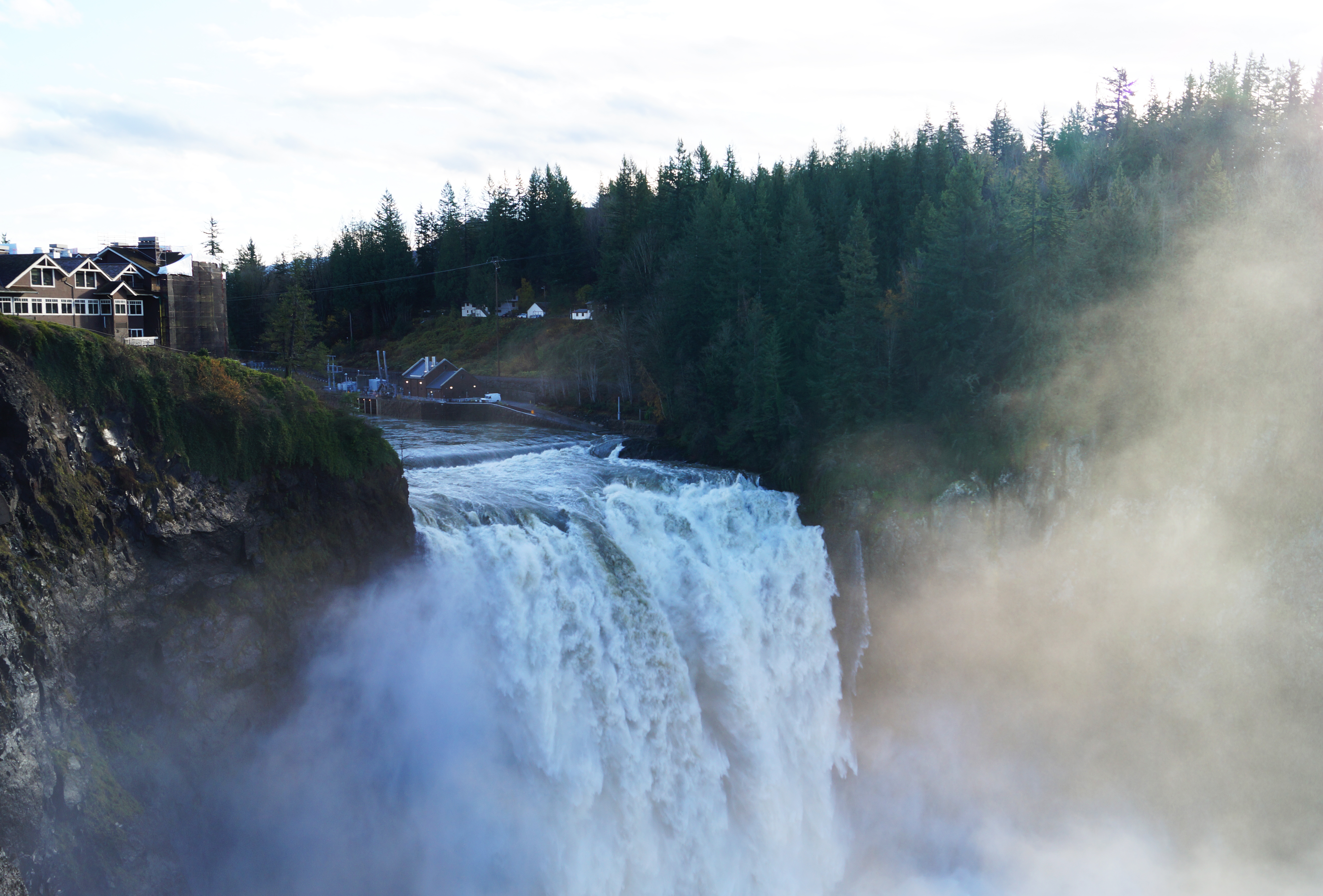
Snoqualmie Falls
Mist rises from the base of the falls in great billowing clouds, visible for miles. To the Snoqualmie people, whose ancestors have lived in this valley since time immemorial, these mists serve to connect Heaven and Earth, carrying prayers up to the Creator. This is the place where First Woman and First Man were created by Moon the Transformer - a site so sacred that burial grounds surround the falls. At 268 feet, Snoqualmie Falls is not Washington's tallest waterfall, but it may be its most meaningful, a place where natural power and spiritual significance merge in thundering spray.
Sacred Ground Reclaimed
In October 2019, the Snoqualmie Indian Tribe purchased the Salish Lodge and 45 acres of surrounding land for $125 million, returning stewardship of their sacred site to its original guardians after more than a century. The purchase ended years of conflict over proposed development near the falls and burial grounds.
The falls were listed on the National Register of Historic Places in 2009 as a Traditional Cultural Property - recognition of their profound spiritual significance to the Snoqualmie people. For them, this is not merely a scenic attraction but a living temple, where the mists rising from the cascade carry their ancestors' prayers skyward. The tribe's purchase ensures that development will never crowd the sacred waters.
Engineering Underground
Beneath the falls, hidden from view, lies a piece of engineering history. Plant 1 of the Snoqualmie Falls Hydroelectric Plant, built in 1899, was the world's first completely underground power plant. Workers carved a chamber into the rock 270 feet below the surface, harnessing the falls' power without visible infrastructure marring the view.
The 1899 generating system was designated a Civil Engineering Landmark by the American Society of Civil Engineers in 1981. Plant 2 followed in 1910, expanded in 1957, sitting just downstream of the falls. Today, most of the river is diverted through these plants, but during high water - following heavy rains or snowmelt from November through March - the full power of the Snoqualmie River pours over the precipice in a thundering curtain that sends spray rising like smoke.
The Twin Peaks Effect
In 1990, the falls gained international fame as the backdrop for the opening credits of David Lynch's television series Twin Peaks. The Salish Lodge, perched on the cliff edge above the falls, appeared as the mysterious "Great Northern Hotel" where FBI Agent Cooper stayed while investigating Laura Palmer's murder. Fans still make pilgrimages here, ordering coffee and cherry pie while gazing at the cascading water.
The cultural impact extended far beyond a TV show. Twin Peaks introduced millions of viewers to the Pacific Northwest's moody beauty - the mist, the towering evergreens, the sense that mystery lurks in every shadow. Snoqualmie Falls became an ambassador for the region's wild heart, drawing 1.5 million visitors annually who come not just for a fictional hotel but for the primal power of falling water.
The Trail Down
From the observation deck, a trail descends 300 feet in 0.7 miles, switchbacking through temperate rainforest thick with moss-draped bigleaf maples, Douglas firs, sword ferns, and salal. The forest here is so lush it seems tropical, every surface cushioned in green. The trail ends near the 1910 powerhouse, where you can stand at the base of the falls and feel their full force.
Heavy use means wildlife sightings are uncommon, but the forest itself is alive with birdsong. At the top, a small grassy meadow called Centennial Green hosts summer weddings - couples drawn by the romance of exchanging vows with the eternal roar of water as their witness. The falls never stop. The mist never stops rising. And for the Snoqualmie people, the prayers never stop ascending.
From the Air
Located at 47.54N, 121.84W east of Seattle in the Snoqualmie River valley. The falls are clearly visible as a white cascade with the distinctive Salish Lodge perched on the cliff edge above. The Snoqualmie River flows north to join the Snohomish River. I-90 passes nearby as the main Seattle-to-Spokane corridor. Look for the town of Snoqualmie to the south and Fall City to the north. Nearest airports: Seattle-Tacoma (KSEA) 30 miles west; Boeing Field (KBFI) 25 miles west; Snoqualmie Municipal (private, W10) nearby. The Cascade foothills can produce turbulence and obscured conditions; mountain wave activity possible when winds are from the east.