Snowdon
The Welsh name is Yr Wyddfa, meaning "the burial place" or "the tumulus," and the legend behind it is characteristically vivid: the summit is said to be the tomb of Rhitta Gawr, a giant who wore a cloak woven from the beards of the men he had slain. King Arthur killed Rhitta after the giant demanded Arthur's own beard as tribute. Whether or not a giant lies up there, something extraordinary does -- the highest point in Wales and England south of the Scottish Highlands, a mountain that has been climbed, painted, ridden by rail, and argued over for centuries.
The Only Rack Railway in Britain
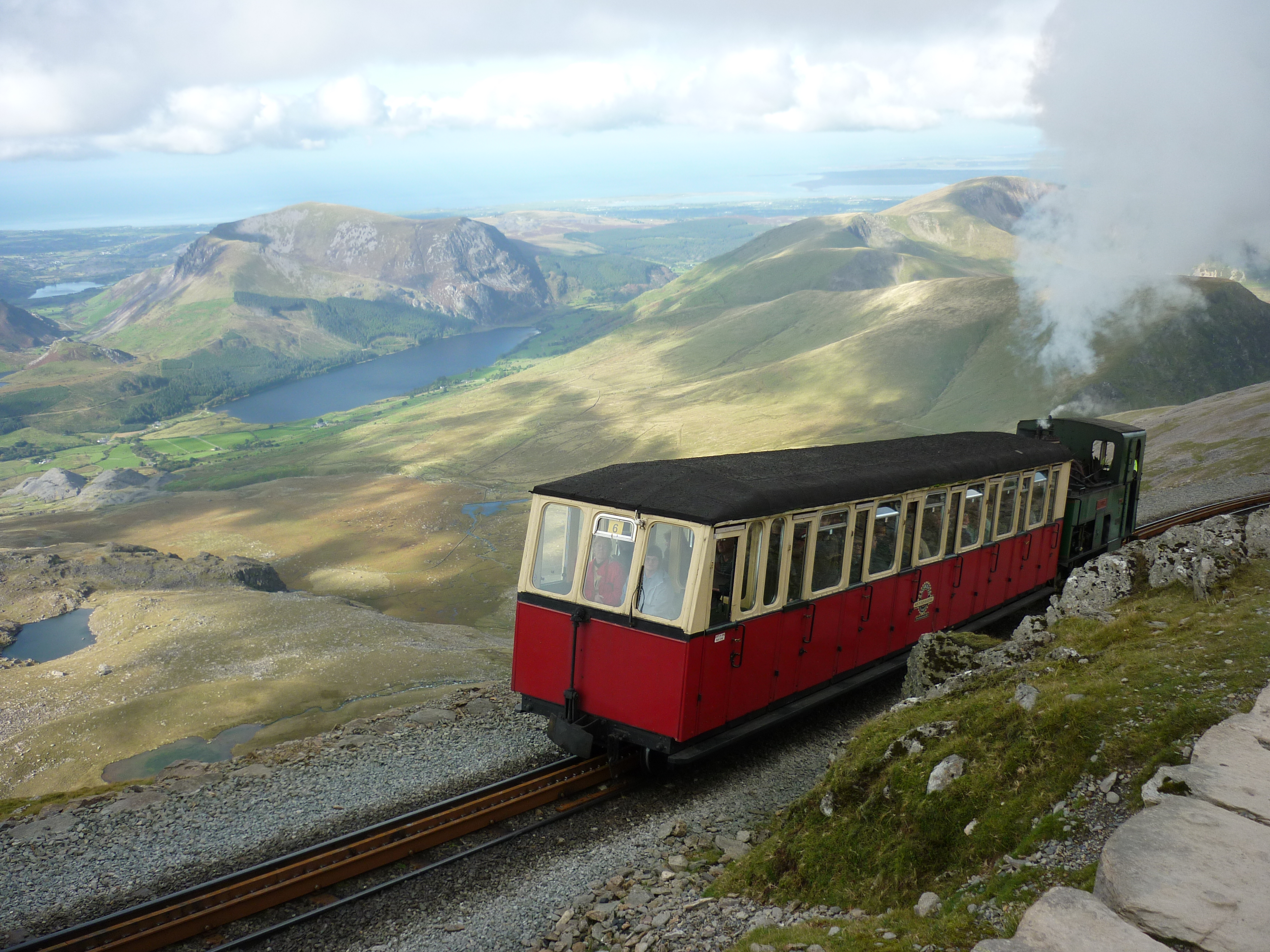
The Snowdon Mountain Railway has been pushing single-carriage trains up the mountain since 1896, the only public rack-and-pinion railway in the United Kingdom. Construction began in December 1894, when Enid Assheton-Smith cut the first sod (locomotive No. 2 was later named after her), and was completed by February 1896 at a cost of 63,800 pounds. The railway runs from Llanberis to the Summit station, carrying more than 130,000 passengers a year by steam and diesel. It is a feat of Victorian ambition: a narrow-gauge line climbing through cloud and scree to a summit where someone was already selling refreshments as early as 1838 and pouring drinks under license by 1845.
Nearer to Heaven
The summit has drawn commerce almost as long as it has drawn climbers. When the railway opened, the company tried and failed to obtain an alcohol license for a proposed summit hotel, eventually taking over two existing huts. By the early 21st century, the old summit building had become an embarrassment, and a campaign for its replacement succeeded. The new visitor center, Hafod Eryri, opened on 12 June 2009, an award-winning, 8.4-million-pound structure designed by Ray Hole Architects. The Welsh National Poet, Gwyn Thomas, composed a couplet for the building's entrance: "Copa'r Wyddfa: yr ydych chwi, yma, Yn nes at y nefoedd" -- "The summit of Snowdon: You are, here, nearer to Heaven." The name Hafod Eryri was chosen from hundreds of public submissions; hafod is Welsh for a summer upland dwelling, and Eryri is the Welsh name for Snowdonia.
Arthur, Merlin, and the Monster
Snowdon's slopes are thick with legend. Glaslyn, the lake below the summit, has been identified as the place where Bedivere threw Excalibur. Merlin is said to have hidden the golden throne of Britain among the cliffs north of Crib y Ddysgl when the Saxons invaded. Glaslyn was also supposedly the final resting place of an afanc, a water monster that had terrorized the Conwy valley until villagers lured it from the water with a young girl, chained it, and dragged it to the mountaintop lake. Llyn Coch in Cwm Clogwyn carries associations with the Tylwyth Teg, the Welsh fairies, including a version of the fairy bride legend. These are not quaint relics; they are woven into the Welsh-language culture that the mountain embodies.
Six Paths to the Top
The traverse of Crib Goch has been described as one of the finest ridge walks in Britain, a knife-edge scramble with exposure on both sides that is emphatically not for the casual walker. Snowdon offers six main ascent routes ranging from the relatively gentle Llanberis Path to the demanding Crib Goch and Watkin paths. The Watkin Path also served as a film set: in 1968, scenes representing the Khyber Pass were shot on its lower section for the comedy Carry On... Up the Khyber. A plaque unveiled in 2005 by one of the film's stars commemorates the location. The mountain attracts hundreds of thousands of visitors each year, and its dangers are real -- multiple fatalities occur annually from falls, exposure, and lightning strikes.
A Mountain's Name
In November 2022, Snowdonia National Park Authority voted to use Yr Wyddfa and Eryri rather than Snowdon and Snowdonia in its official communications, though statutory documents still require both languages by law. The decision followed years of debate. A 2021 YouGov poll found 60 percent of Welsh adults preferred the English name, but 59 percent of Welsh speakers preferred the Welsh one. By 2024, the authority declared the change a success, noting that many businesses and media outlets had followed suit and that the park had become more associated with its Welsh identity. Some confusion remains -- people unfamiliar with the Welsh language assume the names are new inventions rather than the original ones. A pronunciation guide is forthcoming. Whatever its name, the mountain itself has not changed: still 1,085 meters of volcanic rock and legend, still the highest point in Wales, still nearer to heaven than anywhere else in Eryri.
From the Air
Located at 53.07N, 4.08W in Snowdonia National Park (Eryri), Gwynedd. Yr Wyddfa / Snowdon is the highest terrain in Wales at 1,085m (3,560 ft). CRITICAL: Maintain safe altitude well above summit level, minimum 4,500 ft QNH. Mountain weather can change rapidly with cloud, strong winds, and reduced visibility. The Snowdon Horseshoe ridge and associated lakes (Glaslyn, Llyn Llydaw) are dramatic features. The mountain railway is visible on the Llanberis side. Nearest airports: Caernarfon (EGCK), RAF Valley (EGOV). Always check NOTAMS for the area.