Snowdon Mountain Railway
On the opening day, 6 April 1896, locomotive No. 1 Ladas derailed near the summit of Snowdon. The engine slipped off the rack rail, rolled down the mountainside, and was destroyed. The carriage, which had separated from the locomotive as designed, came to a stop on its own. One passenger who had jumped from the carriage during the incident later died from his injuries. The railway closed immediately and did not reopen until the following year, after modifications to the track and a rigorous safety review. It has operated without a fatal accident since. That opening-day disaster could have ended the Snowdon Mountain Railway before it began. Instead, it became Britain's most enduring mountain railway.
Swiss Engineering on Welsh Rock
The idea of a railway up Snowdon had circulated since at least 1869, when a proposal was put before Parliament and rejected. Subsequent attempts also failed. It was not until 1894 that the Snowdon Mountain Tramroad and Hotels Company Limited obtained the necessary Act of Parliament and began construction. The technology chosen was the Abt rack-and-pinion system, designed by the Swiss engineer Roman Abt, in which a toothed rail between the running rails meshes with a pinion gear beneath the locomotive. This was not speculative engineering: the system was already proven on steep Alpine railways. Construction took about fourteen months, with the track climbing 4.7 miles from the village of Llanberis at 353 feet above sea level to the summit station at 3,494 feet.
Pushed, Not Pulled
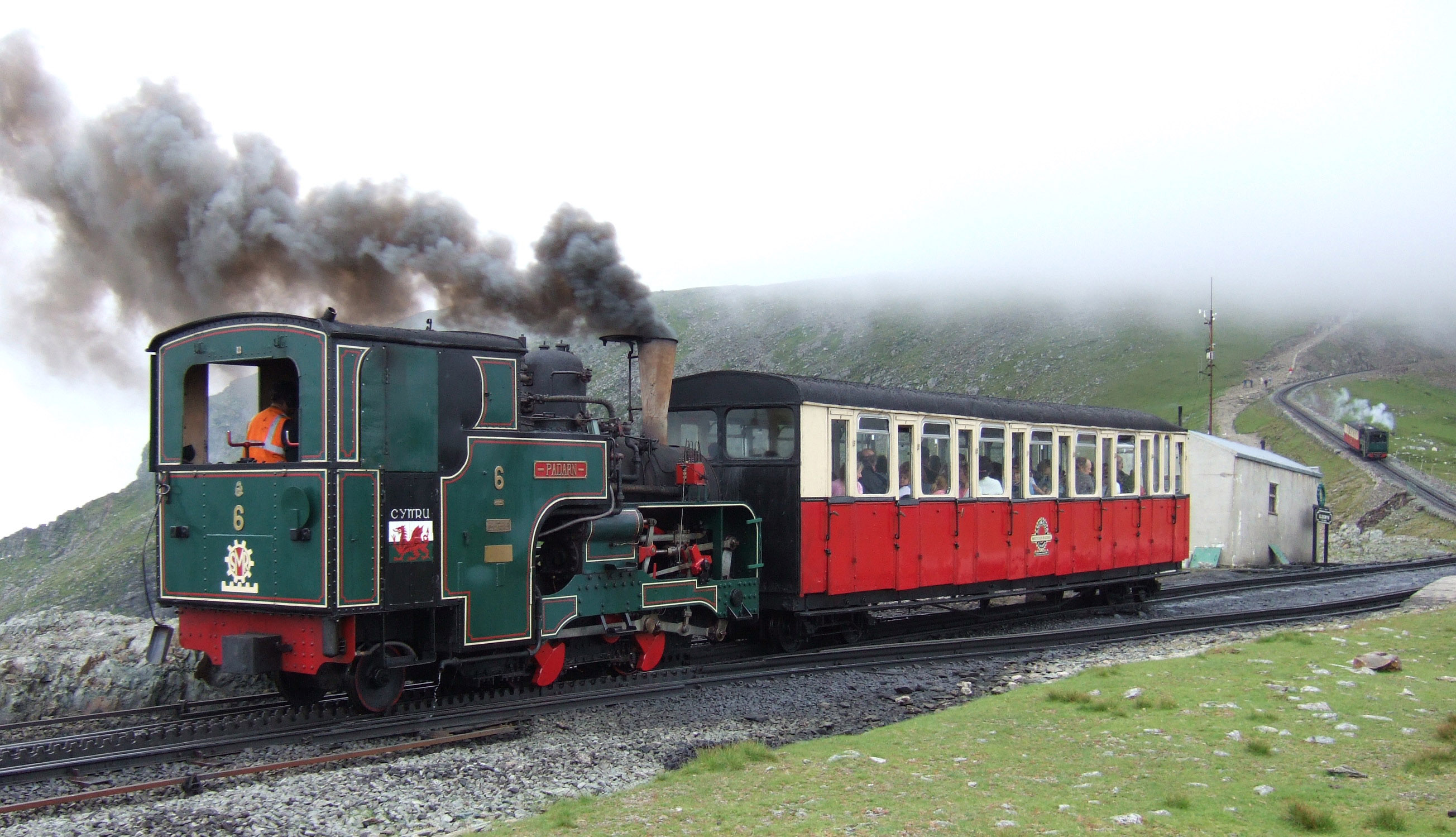
A distinctive feature of the railway is that locomotives push their carriages uphill rather than pulling them. Each train consists of a single carriage with the locomotive behind, ensuring that if the engine and carriage become separated -- as happened on opening day -- the carriage does not hurtle downhill attached to a runaway locomotive. The trains are not coupled together: the locomotive simply pushes the carriage from behind, and the carriage's own brakes can bring it to a halt independently. This fail-safe design has proven itself over more than a century of operation on gradients as steep as 1 in 5.5.
Weather and the Summit
Snowdon's weather is extreme by British standards. The summit regularly disappears into cloud, and wind, rain, and snow can make the upper sections of the line impassable. Services are curtailed from reaching the top in bad weather, and the railway closes entirely from November to mid-March. Despite these conditions, the railway carries more than 140,000 passengers a year. A new summit building, Hafod Eryri, opened in 2009, replacing the much-criticized 1930s café that Prince Charles once described as the highest slum in Wales. The granite-clad visitor center was designed to withstand sustained winds of over 150 miles per hour.
Steam and Diesel on the Mountain
The railway's original fleet consisted of Swiss-built steam locomotives manufactured by the Swiss Locomotive and Machine Works in Winterthur. Several of these Victorian-era engines remain in service, making the Snowdon Mountain Railway one of the few places in Britain where you can ride behind genuinely historic steam power on a working line. Diesel locomotives joined the fleet from 1986 onward, offering more reliable service in the harsh conditions but less romance. The railway has also experimented with diesel railcars as multiple units. Whether steam or diesel, every journey follows the same route: up through Waterfall station, past Clogwyn, along the exposed ridge, and -- weather permitting -- to the summit of the highest mountain in Wales.
The Only One of Its Kind
The Snowdon Mountain Railway is the only public rack-and-pinion railway in the United Kingdom, a distinction it has held since 1896. It is now owned and operated by Heritage Great Britain, which runs several other tourist attractions. The railway's traditional logo features a pinion ring engaged on a rack bar, an honest representation of the mechanical principle that makes the whole enterprise possible. Over the decades, the line has become inseparable from the mountain itself -- to many visitors, riding the railway is the experience of Snowdon, a slow, clattering ascent through changing landscapes and weather, ending, if the clouds cooperate, in a view that stretches to Ireland.
From the Air
Snowdon Mountain Railway runs from Llanberis (53.1187N, 4.1282W) to the summit of Snowdon/Yr Wyddfa (53.0685N, 4.0763W), the highest point in Wales at 3,560 ft. The track is visible from the air as a thin line ascending the mountain's northern flank. Llanberis sits at the foot of the mountain beside Llyn Padarn. Nearest airports: Caernarfon (EGCK), RAF Valley (EGOV). Recommended altitude: 4,000-5,000 ft AGL to see the full route; be aware of terrain clearance requirements in this mountainous area. Snowdon itself is a significant landmark visible from much of North Wales.