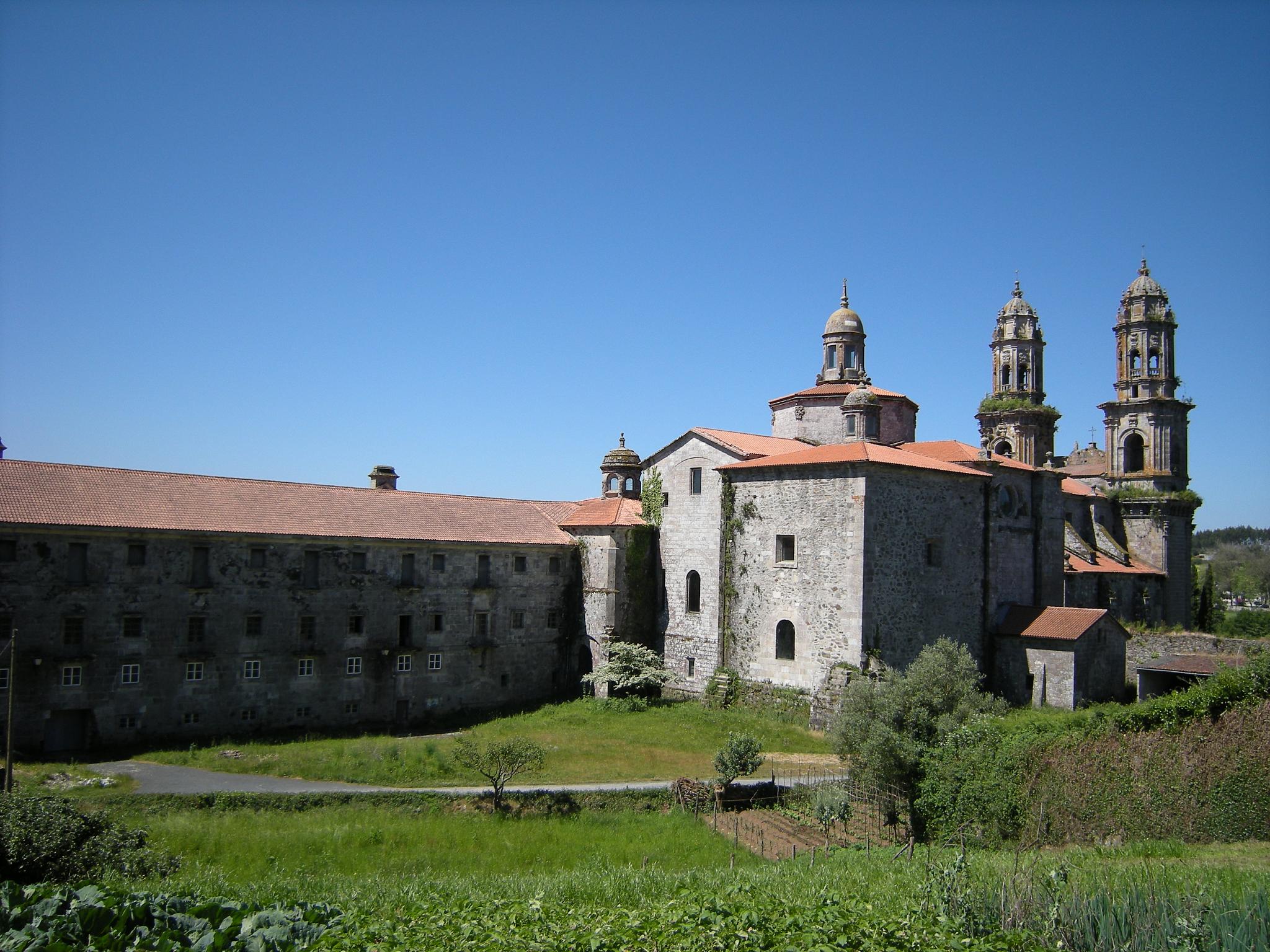
Sobrado Abbey
The roof had caved in. Trees grew from the cloisters. For more than a century after the Spanish government expelled its monks in 1835, Sobrado Abbey stood open to the sky and the Galician rain, its Baroque domes crumbling, its medieval kitchens colonized by vegetation. Then, in 1954, Trappist monks from Viaceli Abbey arrived with wheelbarrows and purpose. The reconstruction took twelve years. By 1966, a new community was living within walls that had been ruins a decade earlier.
The House of Traba
Sobrado Abbey was founded around 951 by Bishop Sisnando Menendez, son of the Counts Hermenegildo Aloitez and his wife Paterna. The founding family endowed it with properties, but their descendants eventually abandoned it. The monastery languished for nearly two centuries until January 1142, when Fernando and Bermudo Perez -- two of the most powerful members of the House of Traba, the leading noble family of medieval Galicia -- handed it over to Cistercian monks from Clairvaux Abbey in France. Under the Cistercians, Sobrado flourished. During the 12th and 13th centuries, it grew wealthy enough to found its own daughter house, Valdedios Abbey in Asturias, and was entrusted with the supervision of neighboring Monfero Abbey after it joined the Cistercian order.
Baroque Ambitions
After a period of decline, Sobrado became the first abbey in Galicia to join the Castilian Cistercian Congregation in 1498, beginning a renewal that would culminate in its most ambitious architectural project. The monumental Baroque abbey church, crowned with a collection of domes and cupolas that give its profile a distinctive silhouette against the Galician sky, was dedicated in 1708. Most of the conventual buildings were rebuilt at the same time, transforming the medieval monastery into a statement of Counter-Reformation confidence. The sacristy was designed by Juan de Herrera, the architect whose austere classicism defined the Escorial and much of late 16th-century Spanish architecture. Yet the Magdalene Chapel, dating to the 14th century, survived the rebuilding, and the medieval kitchen and chapter house still stand -- reminders that beneath the Baroque grandeur lies a much older institution.
The Empty Century
In 1835, Prime Minister Juan Alvarez Mendizabal's government dissolved Spain's monasteries and seized their properties. Sobrado's monks were expelled, and the buildings they had maintained for seven centuries were left to the elements. What followed was more than a century of slow destruction. Without maintenance, the Galician climate -- wet, mild, relentless -- took its toll. Roofs collapsed under the weight of moss and accumulated water. Walls cracked as tree roots pushed into mortar joints. The great Baroque church, designed to inspire awe, instead became a cautionary tale about the fragility of stone without stewardship. Sobrado was not unique in this fate; across Spain, dozens of monasteries suffered the same slow dissolution. What made Sobrado different was what came next.
Reconstruction as Devotion
The Trappist monks who arrived from Viaceli Abbey in Cobreces, Cantabria, in 1954 were practiced in the art of resurrection. They had already restored Huerta Abbey in 1929. At Sobrado, they found a challenge of a different magnitude -- a vast complex that had been open to the weather for more than a century. The restoration proceeded methodically, stone by stone, guided by the Trappist commitment to manual labor as a form of prayer. By 1966, a new monastic community was established, and the three cloisters were once again enclosed. Today, Sobrado sits at 540 meters above sea level in the municipality of Sobrado, about 46 kilometers southeast of Betanzos. It functions as both an active Cistercian monastery and a stop on the Camino del Norte route to Santiago de Compostela. The monks who rebuilt it understood something that the politicians of 1835 did not: a monastery is not just its buildings but the community that inhabits them, and both can be restored if the will exists.
From the Air
Located at 43.038N, 8.023W in the municipality of Sobrado, La Coruna province, Galicia. The abbey complex is visible from the air as a large stone compound with distinctive Baroque domes, situated in rolling green countryside at 540 m elevation. Nearest airports: A Coruna/Alvedro (LECO, ~50 km northwest) or Santiago de Compostela (LEST, ~60 km southwest). Best viewed at 3,000-5,000 ft AGL. The surrounding terrain is open pastureland with scattered villages.