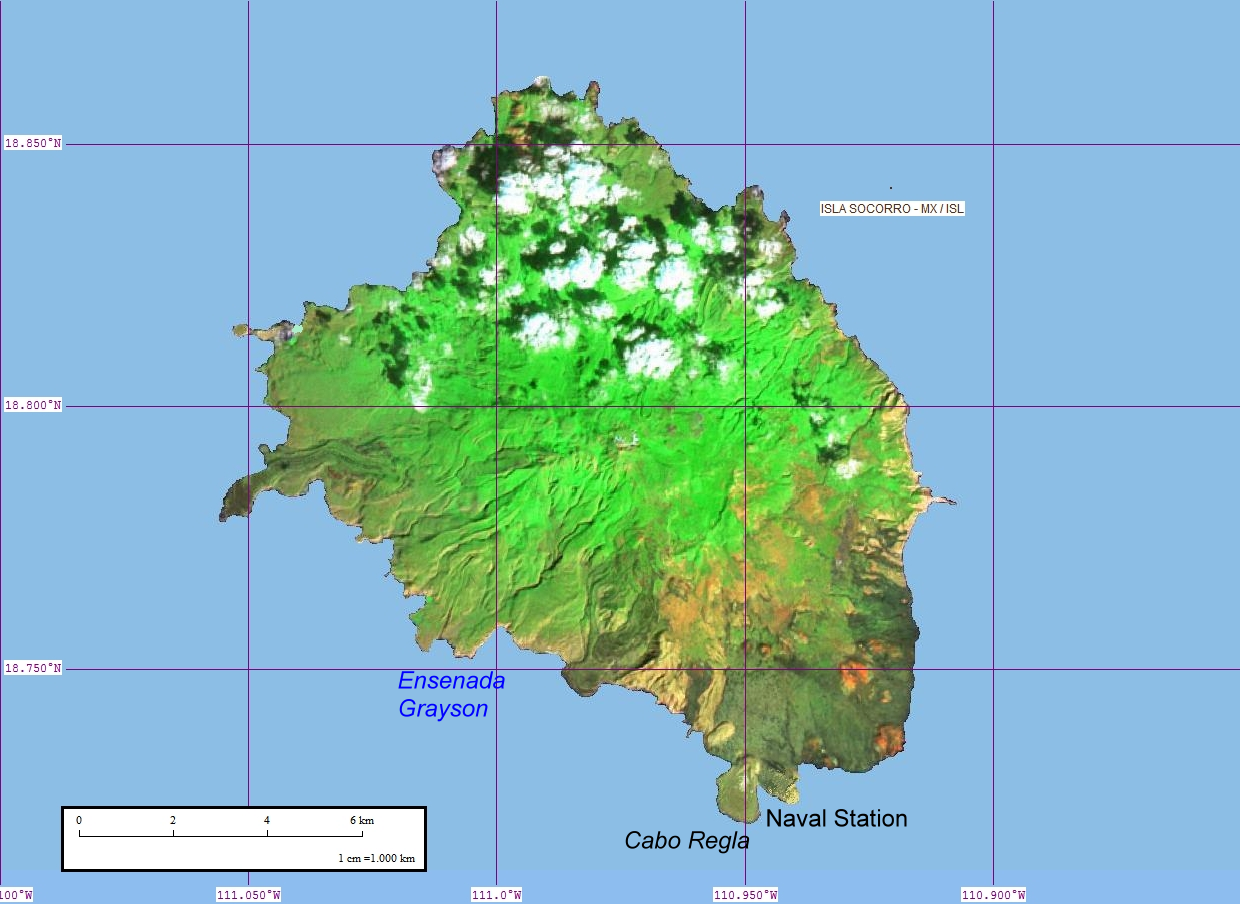
Socorro Island
In 1929, an American laborer named Archie Smith from San Diego was left stranded on a volcanic island 600 kilometers off the Mexican coast. The expedition that brought him there to shear wild sheep had sailed back to port for supplies, gone bankrupt, and never returned. For a month he survived alone on Socorro Island before a passing fishing boat spotted him. His story captures something essential about this place: it is far enough from the mainland to swallow people whole, wild enough to sustain them if they pay attention, and strange enough that the ordinary rules of geography seem not to apply.
A Shield in the Deep Pacific
Socorro Island rises abruptly from the ocean floor to 1,050 meters at its summit, the exposed peak of a massive submarine shield volcano. It sits on the northern Mathematicians Ridge, a mid-ocean ridge that went largely inactive 3.5 million years ago when tectonic activity shifted east to the East Pacific Rise. What makes Socorro genuinely unusual among Pacific islands is its chemistry -- it is the only dominantly silicic peralkaline volcanic island in the entire Pacific Ocean. The summit dome complex, Mount Evermann, is named for the ichthyologist Barton Warren Evermann, who championed scientific exploration of the island from the California Academy of Sciences in the early twentieth century. The island's surface tells its violent history plainly: furrows, small craters, ravines, lava domes, lava flows, and cinder cones cover the terrain. Socorro last erupted in January and February 1993, a submarine flank eruption off Punta Tosca. Earlier eruptions occurred in 1951, and likely in 1905, 1896, and 1848.
Names Layered Like Lava Flows
The island has been discovered, named, and renamed by successive waves of European navigators, each apparently unaware of their predecessors. In 1542, Ruy Lopez de Villalobos rediscovered what had been called Inocentes and renamed it Isla Anublada -- Cloudy Island -- for the clouds that perpetually gather on Mount Evermann's northern slopes. In 1608, Martin Yanez de Armida visited again and rechristened it Isla Socorro, after the Virgen del Perpetuo Socorro, Our Lady of Perpetual Help. The name stuck, though the help has always been sparse. A Mexican naval station established in 1957 supports about 250 people -- staff and families -- who live in a small village with a church on the western side of Bahia Vargas Lozano. Fresh water comes from a brackish spring near Ensenada Grayson, sometimes covered by the sea at high tide. The nearest airport is six kilometers north, and everything else is ocean.
An Ark Running Out of Time
Isolation shaped Socorro's ecology into something irreplaceable. Twenty-one plant species are found only on this island, with five more endemic to the Revillagigedo Archipelago. But it is the birds that make Socorro a conservation flashpoint. The Socorro dove is extinct in the wild, surviving only in captive breeding programs. The Socorro mockingbird is critically endangered. The Socorro elf owl has probably been gone since around 1970. The Socorro parakeet is endangered, and the Townsend's shearwater is critically endangered across its shrinking range. What went wrong is a familiar story: sheep, cats, and rodents introduced by human activity tore through ecosystems that had evolved without ground predators. Feral cats prey on nesting seabirds; introduced sheep stripped vegetation. The island remains an important breeding location for several seabird species at the northeastern edge of their ranges, but the damage compounds with each generation.
Whales and Divers in Winter Waters
Each January and February, humpback whales migrate through the Revillagigedo Archipelago, and scuba divers follow them. Socorro has become one of Mexico's premier diving destinations, offering encounters with mantas, whale sharks, and dolphins in deep blue waters far from any continental shelf. The archipelago's UNESCO World Heritage designation in 2016 recognized both the marine and terrestrial significance of these islands. In September 1997, Hurricane Linda passed near Socorro at peak intensity, causing only minor damage to meteorological instruments -- a reminder that even powerful storms merely glance off a volcanic summit that has been absorbing the Pacific's fury for five thousand years.
From the Air
Located at 18.78N, 110.98W, approximately 600 km west of Mexico's Pacific coast in the Revillagigedo Archipelago. The island is visible from altitude as a solitary volcanic landmass surrounded by open ocean. Mount Evermann rises to 1,050 m (3,445 ft). The island has a small airstrip (Isla Socorro Airport) on its northern end. No nearby civilian airports -- the closest is in Manzanillo (MMZO) on the mainland, roughly 600 km east. Expect maritime cloud formations around the northern slopes.