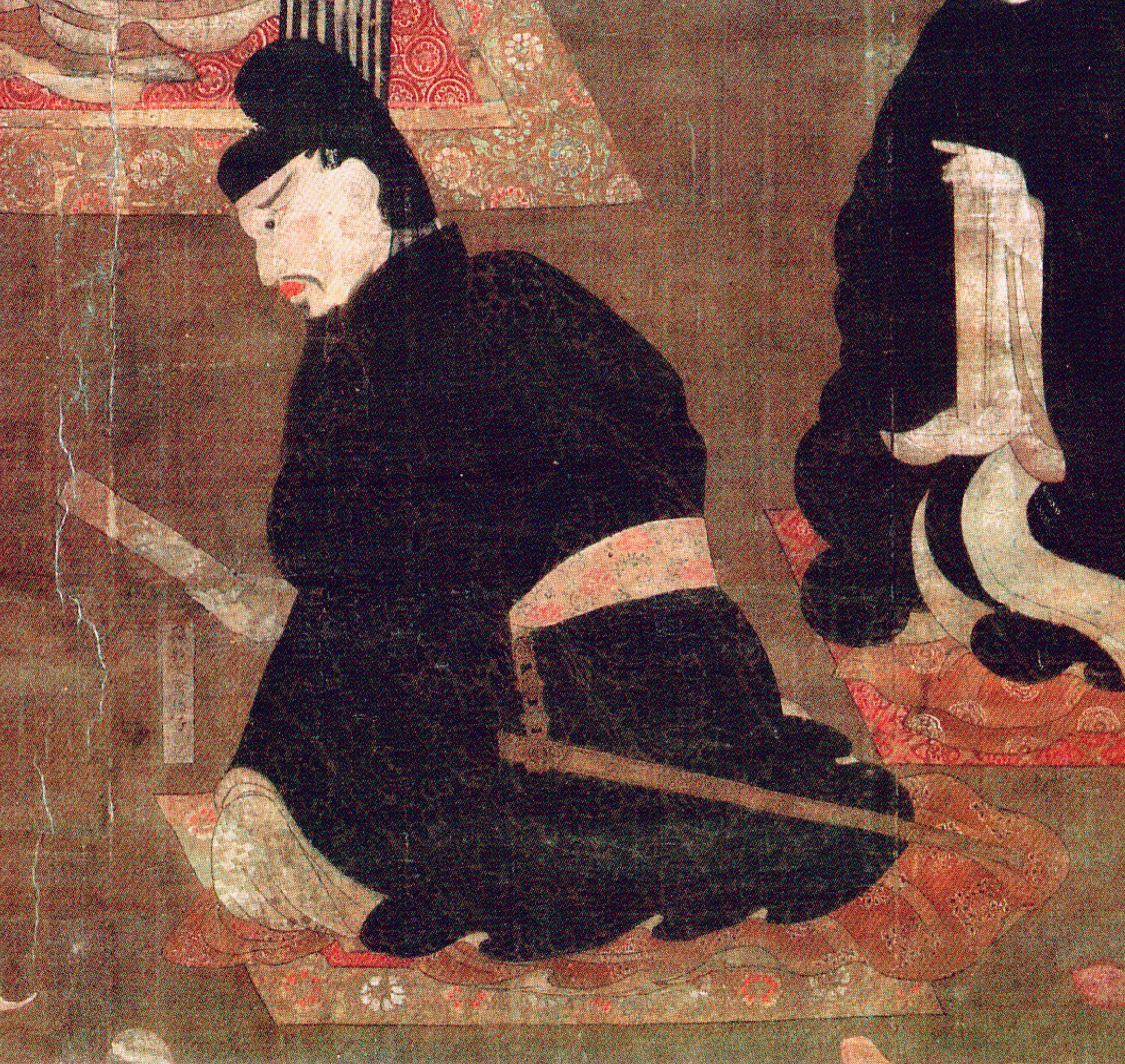
Soga no Umako: The Man Who Brought Buddhism to Japan
In the village of Asuka, at the edge of rice paddies that have been cultivated for fourteen centuries, a massive stone chamber lies open to the sky. Ishibutai Kofun -- the Stone Stage Tomb -- is the largest exposed megalithic tomb in Japan, its enormous granite slabs weighing an estimated 2,300 tons combined. The earthen mound that once covered it eroded away long ago, leaving the burial chamber naked to the elements. The man believed to rest here shaped the course of Japanese civilization. Soga no Umako did not merely participate in the politics of the Asuka period. He bent the entire era to his will -- defeating the powerful Mononobe clan in open warfare, placing rulers on the throne through strategic marriages, and championing a foreign religion called Buddhism that would transform Japanese culture forever.
The Clan That Held the Throne
Soga no Umako was the son of Soga no Iname and inherited leadership of the Soga clan at a pivotal moment in Japanese history. The clan had built its power by employing immigrants from China and Korea who brought advanced technology, administrative knowledge, and new ideas -- including the teachings of the Buddha. Umako understood that controlling access to continental knowledge meant controlling the future of the Japanese state. He conducted political reforms alongside Prince Shotoku during the reigns of Emperor Bidatsu and Empress Suiko, weaving Soga influence deep into the fabric of imperial governance. His method was as old as power itself: he married his daughters to members of the imperial family. Kahakami no Iratsume became consort of Emperor Sushun in 587. Tojiko no Iratsume became consort of Shotoku Taishi himself. Hode no Iratsume married Emperor Jomei. The Soga bloodline threaded through the imperial succession like a root system beneath a forest.
The Battle That Decided a Religion
The introduction of Buddhism to Japan was not a peaceful affair. The Mononobe clan, guardians of Japan's traditional Shinto rites, fiercely opposed the foreign faith. The Soga clan championed it. The tension escalated into armed conflict. In 587, Soga no Umako met Mononobe no Moriya on the battlefield at Shigisan, and the Soga forces prevailed. The defeat of the Mononobe was decisive -- it broke the back of organized opposition to Buddhism and secured Soga political dominance for a generation. Umako pressed his advantage. He ordered the construction of Asuka-dera, one of the first full-scale Buddhist temples in Japan. On January 15, 593, according to the Nihon Shoki, relics of Buddha Shakyamuni were deposited inside the foundation stone beneath the central pillar of the temple's pagoda. It was a statement carved in stone and sealed with holy relics: Buddhism had arrived in Japan, and the Soga clan had delivered it.
Power and Its Contradictions
Some scholars have noted conflicting evidence suggesting Soga no Umako may have held power equivalent to that of an emperor -- a claim that muddies the clean narrative of imperial succession during the Asuka period. What is certain is that Umako operated at the highest levels of authority for decades, serving as a kingmaker who placed sympathetic rulers on the throne and removed inconvenient ones. His political partnership with Prince Shotoku produced reforms that modernized Japanese governance, drawing on Chinese and Korean models of statecraft. Umako's wife was, remarkably, a daughter of Mononobe no Ogushi and sister of the very Mononobe no Moriya whom Umako had defeated in battle. This marriage, likely arranged before the conflict, speaks to the intricate web of alliances and obligations that defined Asuka-period politics. Power was personal, familial, and ruthless -- and Umako navigated it with extraordinary skill until his death in 626.
The Stone Stage
Ishibutai Kofun sits in the Asuka landscape like a geological anomaly -- enormous granite boulders stacked into a burial chamber, stripped of their covering mound, exposed to the open air. The tomb is the largest of its kind in Japan, and while definitive proof is elusive, scholarly consensus identifies it as the likely resting place of Soga no Umako. The scale of the tomb matches the scale of the man's ambition. In the Asuka region today, visitors can walk among the stone chambers, stand where the burial goods once lay, and look out over the same rice paddies and gentle hills that Umako surveyed fourteen centuries ago. The temples he championed still stand nearby. Asuka-dera, the temple he ordered built, continues as an active place of worship. The religion he fought to establish permeates every corner of Japanese life. The earthen covering of his tomb may have washed away, but what Soga no Umako built into the foundations of Japanese civilization has proven far more durable than soil.
From the Air
Located at 34.47N, 135.83E in the Asuka region of Nara Prefecture, Japan. Ishibutai Kofun -- the massive stone tomb believed to be Umako's burial site -- is visible from moderate altitude as a distinctive exposed stone structure amid rice paddies. The broader Asuka region is a compact archaeological landscape dotted with ancient tombs, temple compounds, and palace ruins. Best viewed at 2,000-4,000 feet AGL. Nearest major airports are Osaka Itami (RJOO) approximately 30 nautical miles northwest and Kansai International (RJBB) approximately 30 nautical miles southwest. The area lies in a broad valley surrounded by low forested hills.