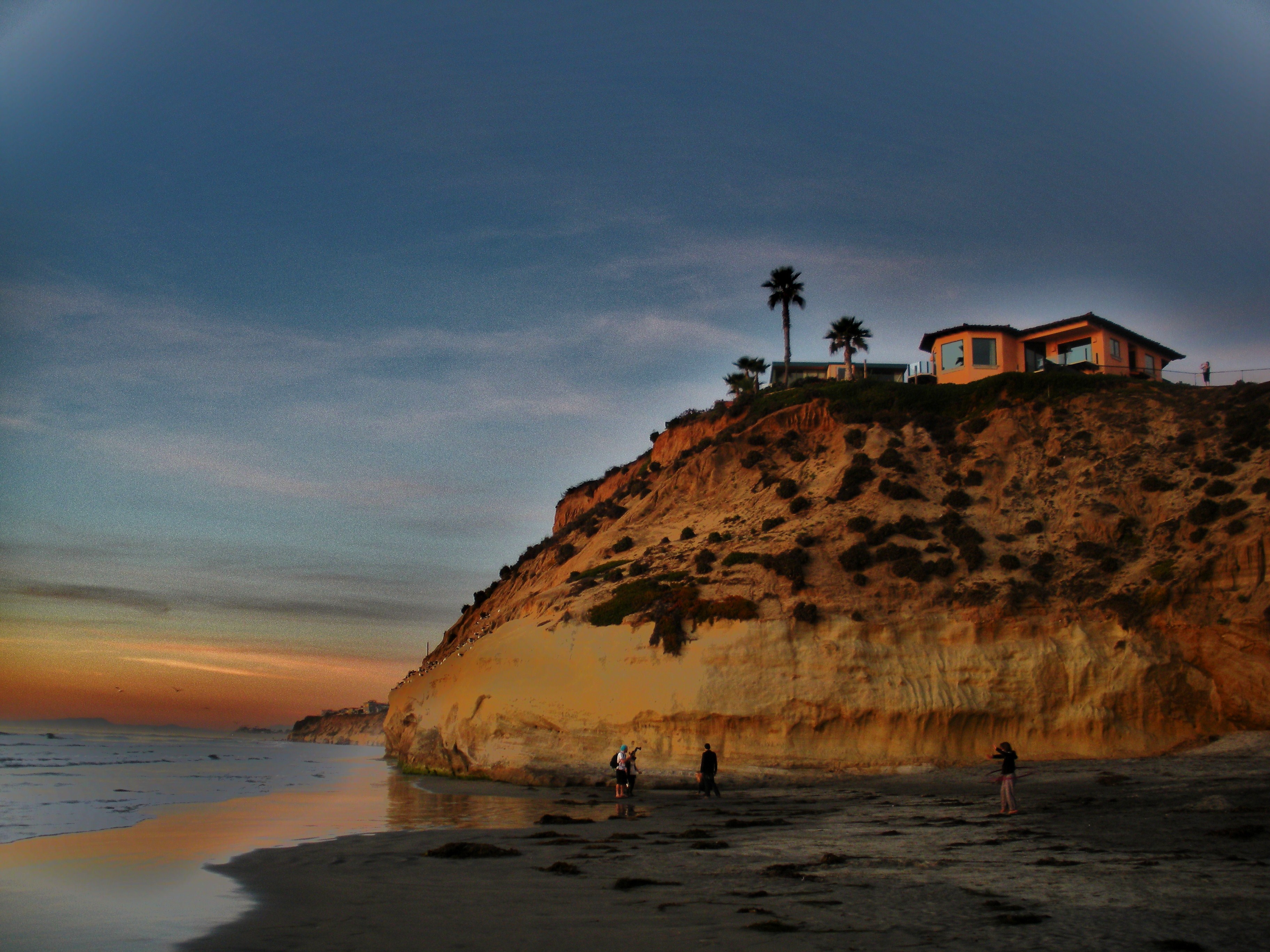
Solana Beach, California
Solana Beach incorporated in 1986, the same year as its neighbor Encinitas to the north, and with roughly the same logic: residents of a small coastal community decided they would rather govern themselves than be absorbed by a larger municipality. The city they incorporated covers about 3.6 square miles and held 12,941 people in the 2020 census, making it one of the smaller cities in San Diego County. Within those modest boundaries, Solana Beach has managed to concentrate several institutions that give it an outsized cultural footprint: a music venue with a national reputation, a design district with eighty-plus galleries and studios, and a rail station where both Amtrak's Pacific Surfliner and the Coaster commuter rail stop.
The Cedros Design District
Cedros Avenue, running parallel to the coast through the heart of Solana Beach, became something unusual for a Southern California commercial street: a destination for design. The Cedros Design District encompasses more than eighty art galleries, home furnishing stores, antique dealers, clothing boutiques, and studios, all within walking distance of each other on a street that manages to feel like a place rather than a strip mall.
The district's character reflects a longer trend in coastal California communities where artists and designers, attracted by climate and light, established studios and galleries that over time created the critical mass for a functioning arts economy. Solana Beach's proximity to both the San Diego art market and the Los Angeles market — two hours north by car, accessible by rail — made Cedros Avenue a viable destination rather than simply a local shopping street.
The farmers market held on Sundays in the district adds an element of weekly civic life to the commercial functions. Farmers markets in California beach communities tend to become social institutions, regular points of contact for a population that might otherwise remain as diffuse and car-dependent as the suburban geography suggests.
The Belly Up
Since 1974, the Belly Up Tavern has been one of the most reliable live music venues on the California coast. The venue seats approximately 600 people in a converted metal building, an intimate scale that allows proximity to performers that large theaters cannot provide. The Belly Up books acts across genres — rock, folk, country, blues, jazz, world music — and has presented artists ranging from Bob Dylan and Joni Mitchell to local San Diego bands playing their first significant regional gigs.
In the geography of live music, small venues with strong reputations occupy an important position. They provide a proving ground for acts not yet large enough for theater-scale shows, and they offer established artists who prefer the energy of smaller rooms an alternative to the arenas and sheds where large tours play. The Belly Up has occupied both roles over fifty years of operation, making it a fixture not just of Solana Beach's cultural life but of the Southern California music scene more broadly.
The venue's longevity is partly a function of the community that supports it. Solana Beach and the surrounding North County communities have sustained the Belly Up through decades of economic cycles, changing tastes, and the general difficulty of running a live music venue profitably. The continued operation of an independent, single-location music venue in the era of corporate consolidation and streaming represents a genuine cultural achievement.
The City and the Coast
Solana Beach is defined by its relationship to the Pacific. The city's western edge meets the ocean at beaches accessible via staircases cut into the sandstone bluffs — bluffs that are actively eroding, a geological process that the city manages through beach nourishment projects and restrictions on construction at the cliff edge. The beaches themselves are public, but access is controlled by the bluff geography and the staircase infrastructure, creating a coastal experience that requires some effort to reach.
Patti Page, who was born in Claremore, Oklahoma, and became one of the most successful recording artists of the 1950s, chose Solana Beach as her home. Her most famous recording — 'How Much Is That Doggie in the Window?' — sold more than two million copies in 1953 and became one of the best-known novelty songs in American popular music. Page represents Solana Beach's claim on a particular strand of mid-century American popular culture that might not be obvious from looking at the Cedros Design District or the Belly Up's booking calendar.
The city is also connected by rail, which distinguishes it from most California beach communities. The Solana Beach station, served by the Coaster commuter rail to San Diego and by the Amtrak Pacific Surfliner running between Los Angeles and San Diego, gives the city a transportation option that reduces its dependence on Interstate 5 for connection to the broader region. In a metropolitan area organized around the automobile, a functioning rail station is a meaningful amenity — and a reminder that this stretch of coast was connected to California's rail network long before the highway era.
From the Air
Solana Beach sits at approximately 33.00°N, 117.26°W on the coast between Del Mar to the south and Encinitas to the north. From altitude heading south along the coast, Solana Beach is visible as a compact beach city between the San Elijo Lagoon to the north and the San Dieguito Lagoon to the south. The rail station is identifiable as a transit facility near the coast. Nearest airports: KCRQ (McClellan-Palomar, Carlsbad, 9 miles north) and KMYF (Montgomery-Gibbs Executive, 14 miles southeast). The coastal bluffs are visible from 2,000–4,000 feet MSL in clear conditions.