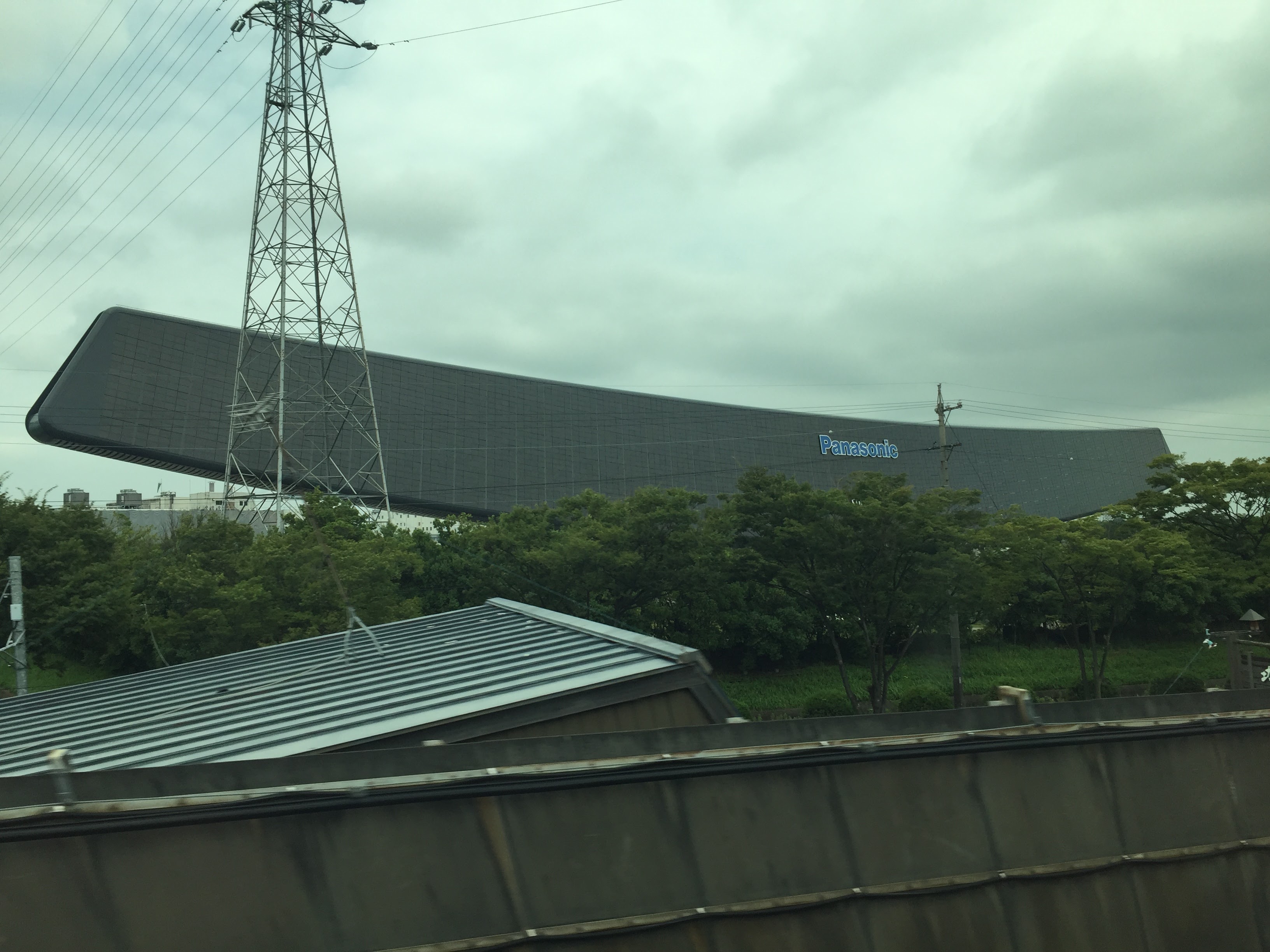
Solar Ark
Passengers on the Tokaido Shinkansen, hurtling between Nagoya and Kyoto at 285 kilometers per hour, would catch it for only a few seconds: a vast silver crescent hovering above the flat farmland of Gifu Prefecture, wider than three football fields laid end to end. The Solar Ark was one of those structures that seemed to belong to a different era entirely, a spacecraft from a future where energy was harvested in cathedrals rather than power plants. For twenty years, its 5,046 solar panels turned sunlight into electricity in the geographical center of Japan. But the most extraordinary thing about this 315-meter monument to clean energy was never its size or its output. It was the story of why it was built in the first place.
A Confession in Steel and Silicon
The Solar Ark began as an act of corporate penance. In the late 1990s, Sanyo Electric was preparing to celebrate its 50th anniversary with what it planned to be the world's largest photovoltaic system, a 3.4-megawatt showcase of cutting-edge solar technology. Engineers had designed a combination of crystal silicon and thin-film amorphous silicon cells with 14 to 15 percent efficiency. Then disaster struck: Sanyo discovered it had to recall several batches of monocrystalline cells due to insufficient output. Rather than quietly disposing of the defective panels, Sanyo made an unusual decision. The company incorporated the recalled cells into the Solar Ark itself. As Sanyo publicly stated, they did this to show sincere regret and express their determination to remember what happened and how important it is to maintain quality. Construction was completed in December 2001, and the result was a building that transformed corporate failure into an architectural statement about accountability.
An Ark for the 21st Century
The design team envisioned a vessel embarking on a journey into the future, and the structure delivered on that ambition with theatrical scale. Stretching 315 meters from tip to tip and rising 31.6 meters at its center, the Ark sat atop four massive G-Columns, custom-built pillars by Kubota weighing approximately 5,000 tonnes combined. These pillars were manufactured using a seamless centrifugal-force method that made them homogeneous enough to resist winds of 34 meters per second and level 7 earthquakes on Japan's seismic intensity scale. The Ark's entrance featured solar wings composed of HIT cells that generated electricity on both their top and bottom surfaces while filtering sunlight through like translucent awnings. Five-meter-high water fountains flanked the structure, feeding into twin ponds with cascading waterfalls. At night, 75,000 computer-controlled red, green, and blue LEDs nestled between the individual panels came alive, transforming the Ark into a luminous screen that displayed images and text across its entire breadth.
The Solar Lab Within
Housed at the center of the Ark was the Solar Lab, a hands-on science museum dedicated entirely to solar energy. Divided into ten zones, the museum offered visitors everything from a solar system simulator to an adventure wall, an artistic exploration of the sun, a solar library, and a control deck displaying real-time power generation data from the Ark's panels. The exhibitions, workshops, and science classes were designed primarily for younger generations, aiming to cultivate awareness of photovoltaic science. The Solar Ark served as an enterprise partner for the 2005 World Exposition in nearby Aichi Prefecture, and it earned a string of awards including the Good Design Award in 2002, the Grand Prix of the Environment Advertising Award, and the Outstanding Performance Award for Environmental Design. At its peak, the facility generated approximately 530,000 kilowatt-hours annually with a maximum system output of 630 kilowatts.
From Sanyo to Silence
The Ark's story traced the arc of Japan's electronics industry. Panasonic acquired Sanyo in 2009, and by August 2011 the red Sanyo logo that had blazed across the structure was replaced with Panasonic's blue branding. For another decade the panels kept generating power, but in 2022, solar energy production at the site ended. Panasonic sold the land to an Osaka real estate developer, and initial reports indicated the building faced demolition. However, in late 2024, the new owner, UI JAPAN, announced that the structure would not be torn down, reversing course to explore other uses for the site. The structure that began as a monument to accountability survived the era of the company that built it as an apology, its recalled solar cells outlasting Sanyo itself.
From the Air
Located at 35.33N, 136.67E in Anpachi, Gifu Prefecture. The massive ark shape is visible from altitude as a distinctive silver crescent along the Tokaido Shinkansen line. Look for it just west of the tracks between Gifu-Hashima and Ogaki. Nearest airports: RJNA (Nagoya Airfield/Komaki, ~35 nm northeast), RJGG (Chubu Centrair International, ~55 nm south). Best viewed at 3,000-5,000 ft AGL for full appreciation of the 315-meter span. Clear weather recommended.