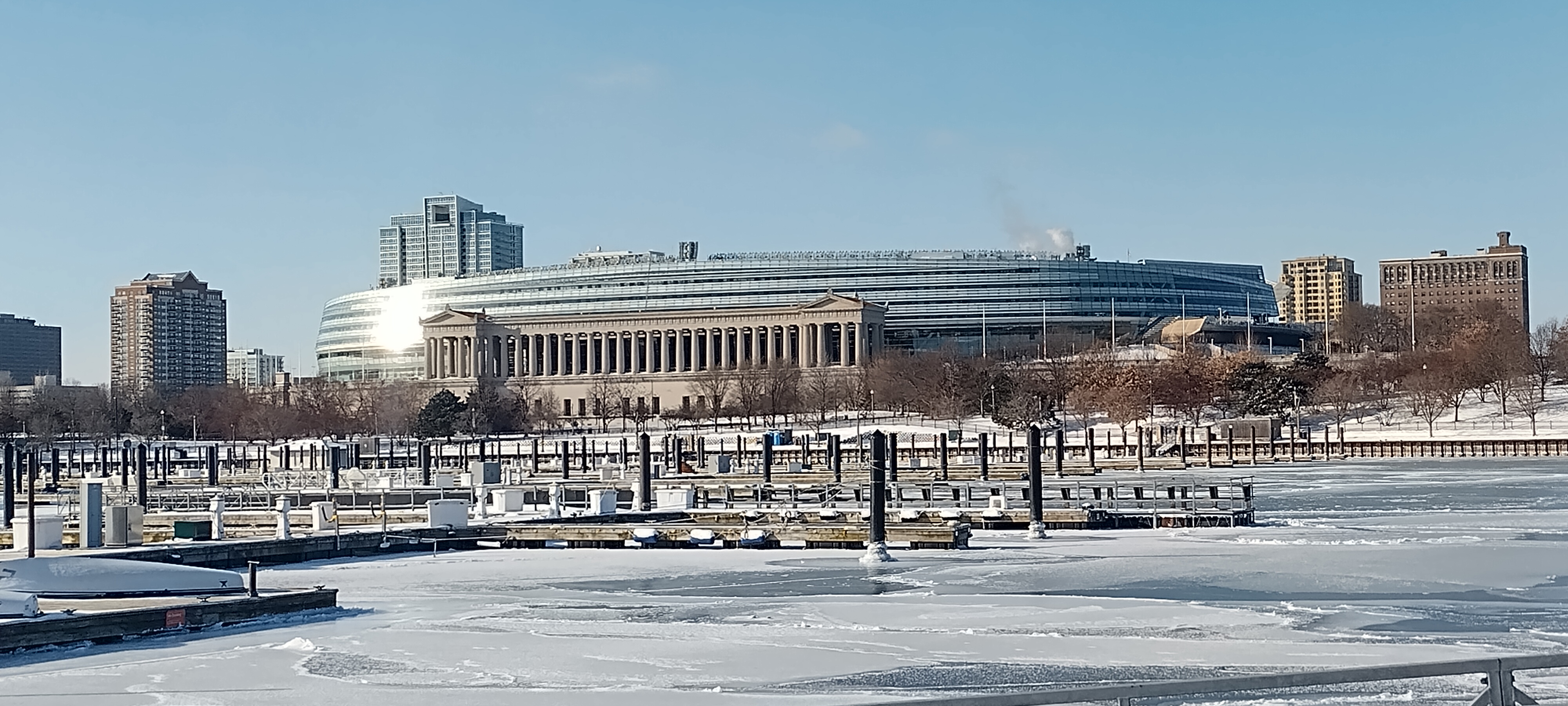
Soldier Field
The first commercial cell phone call in history was made from the parking lot of Soldier Field. On October 13, 1983, David D. Meilahn picked up a Motorola DynaTAC in his Mercedes-Benz, dialed from the stadium grounds, and connected to the future. It was a fitting location. For a century, this lakefront colossus on Chicago's Near South Side has been the place where the future arrives, sometimes gracefully, sometimes with the subtlety of a spaceship landing on a Greek temple. Opened in 1924 as Grant Park Stadium, dedicated on the 53rd anniversary of the Great Chicago Fire, Soldier Field has hosted everything from 123,000 screaming football fans to the first Special Olympics, from a jitterbug contest that drew an estimated 200,000 people to Martin Luther King Jr. rallying 75,000 for the Chicago Freedom Movement. It is the oldest stadium in the NFL, the smallest in the league at 62,500 seats, and the only one that had its National Historic Landmark status stripped away. Soldier Field does not do things quietly.
Columns and Concrete
The architectural firm Holabird & Roche was selected to design the stadium on December 3, 1919. Construction broke ground on August 11, 1922, and the $13 million price tag was enormous for its time -- the Los Angeles Memorial Coliseum cost less than a million dollars in 1923. The design was Neoclassical, with massive Doric columns flanking the East and West entrances, giving the structure the gravity of a Roman arena. In its original U-shaped configuration, Soldier Field seated 74,280, but temporary seating along the field, promenades, and the open terrace beyond the north end zone could push capacity past 100,000. On November 16, 1929, an estimated 123,000 fans watched Notre Dame defeat USC 13-12, still one of the largest crowds in college football history. The stadium's name honored American military veterans, and its dedication on October 9, 1924, linked it symbolically to the city's rebirth from fire. Before the name was official, it had already hosted its first football game -- Louisville Male High School versus Austin Community Academy, on October 4, with Louisville winning 26-0.
The Stage for Everything
Soldier Field's history reads like a compressed timeline of twentieth-century America. In September 1927, the Long Count Fight between Jack Dempsey and Gene Tunney drew the nation's attention to its turf. During the 1933 Century of Progress World's Fair, it served as the main stage. President Franklin D. Roosevelt made his only Midwestern campaign appearance of 1944 here, drawing over 150,000 people. In 1951, General Douglas MacArthur addressed 50,000 after returning to the United States for the first time in fourteen years. Martin Luther King Jr. held rallies at the stadium in 1964 and 1966, with crowds reaching 75,000. The first Special Olympics were held here on July 20, 1968, with over 1,000 athletes competing from 26 states and Canada. And in 1938, a free jitterbug event spiraled beyond control when as many as 215,000 people showed up, flooding the field, trapping people inside and outside simultaneously, and ultimately crashing the sound system under the weight of the dancing crowd.
Da Bears Come Home
The Chicago Bears had been playing at Wrigley Field, sharing the cramped baseball park with the Cubs, but post-merger NFL rules demanded stadiums seating at least 50,000 with lighting for night games. After a failed attempt to build in Arlington Heights, the Bears moved to Soldier Field and won their first home game there on September 19, 1971, defeating the Pittsburgh Steelers 17-15. The AstroTurf lasted until 1988, when natural grass took its place. Over the decades, the stadium hosted playoff moments that etched themselves into Bears lore: the 1988 Fog Bowl, where visibility dropped to 15-20 yards; the 2006 NFC Championship that sent the team to its first Super Bowl in 21 years; and the 2018 "Double Doink" field goal against the Eagles that became an instant emblem of heartbreak. Soldier Field also welcomed the 1994 FIFA World Cup and the 1999 FIFA Women's World Cup, bringing international soccer to Chicago's lakefront.
The Spaceship on the Columns
In 2001, the Chicago Park District announced a radical renovation designed by Benjamin T. Wood and Carlos Zapata. The stadium's interior would be demolished and a modern seating bowl built within the historic exterior walls -- an extreme example of facadism. On January 19, 2002, the night of the Bears' playoff loss to the Philadelphia Eagles, demolition began while tailgate fires still smoldered in parking lot trash cans. A crew removed 24,000 seats in 36 hours, a speed record that has never been broken. The $632 million renovation -- $432 million from taxpayers, $200 million from the Bears and the NFL -- drew fierce criticism. Prominent Chicago architect Stanley Tigerman called it "a fiasco." The Chicago Tribune's Blair Kamin dubbed it "the Eyesore on the Lake Shore." Others tried "Monstrosity on the Midway" and "Mistake by the Lake." The most vivid description stuck: it looked as if a spaceship had landed on the stadium. The renovation reduced capacity from nearly 67,000 to about 62,500 but brought fans dramatically closer to the field. It won design awards from the American Institute of Architects and structural engineering associations. None of that mattered to the National Park Service.
Landmark Lost, Legacy Found
Soldier Field had been designated a National Historic Landmark in 1987. On September 23, 2004, a ten-member federal advisory committee unanimously recommended stripping that status because the renovation had destroyed the stadium's historic integrity. Architectural historian Carol Ahlgren, who prepared the recommendation, was blunt: "If we had let this stand, I believe it would have lowered the standard of National Historic Landmarks throughout the country." The delisting became official on February 17, 2006, making Soldier Field the only structure ever to lose the designation due to renovation. The stadium has continued evolving. In 2012, it became the first NFL venue to achieve LEED environmental certification. Chicago Fire FC returned in 2020 after leaving SeatGeek Stadium in Bridgeview. In 2016, Ireland defeated New Zealand 40-29 on the field -- the first time Ireland had beaten the All Blacks in 111 years of rugby test matches. Even the Bears' future at Soldier Field remains uncertain; in 2021, they purchased the Arlington Park Racetrack property, and proposals for a roof structure appeared in 2024. Whatever comes next, the Doric columns will still stand along the lake, the oldest bones of the NFL's oldest stadium, reminders that some structures outlast even the teams that call them home.
From the Air
Soldier Field sits on the lakefront of Chicago's Near South Side at approximately 41.862N, 87.617W, immediately south of the Museum Campus that includes the Field Museum, Shedd Aquarium, and Adler Planetarium. From altitude, the stadium is unmistakable -- the distinctive clash of Neoclassical colonnade and modern glass-and-steel seating bowl is visible as a bright, elongated oval along the shore of Lake Michigan. Burnham Park Harbor lies to the east, and Northerly Island (formerly Meigs Field) is directly adjacent. Lake Shore Drive runs along the western edge. Nearest airports: Chicago Midway International (KMDW), approximately 8nm southwest; Chicago O'Hare International (KORD), approximately 15nm northwest. Meigs Field (KCGX) no longer operates. The Museum Campus, Grant Park, and the distinctive curve of Monroe Harbor to the north provide orientation from the air.