Soldiers' and Sailors' Monument: Indiana's Silent Victors
No governor ever slept in the mansion they built for him. When Indianapolis was platted in 1821, the circular plot at the city's center was reserved for the governor's residence, but the building erected there in 1827 was so poorly constructed and so publicly situated that every governor refused to live in it. By 1857 the mansion was torn down, leaving a vacant lot at the heart of Indiana's capital. Three decades later, that empty circle became the foundation for something far more enduring: a 284-foot neoclassical obelisk honoring the ordinary soldiers who fought America's wars. The Soldiers' and Sailors' Monument, dedicated on May 15, 1902, was the first monument in the United States built to honor the common soldier rather than a general or statesman. Its inscription reads simply: "To Indiana's Silent Victors."
Thirteen Years of Stone and Bronze
German architect Bruno Schmitz won the commission in February 1888, beating out Percy Stone of London for the design. Schmitz knew monuments. He brought a neoclassical vision that would take thirteen years and $598,318 to realize, a sum that would exceed $500 million if replicated today. The obelisk rose from oolitic limestone quarried in Owen County, Indiana, the same geological formation that gave the state its reputation as the limestone capital of the world. Rudolf Schwarz carved massive limestone groupings of War and Peace for the base. Nikolaus Geiger and George Brewster wrapped bronze astragals around the shaft. John Mahoney sculpted bronze statues of George Rogers Clark, William Henry Harrison, and James Whitcomb to represent Indiana's role in earlier American conflicts. At the summit, Brewster placed Victory, a ten-ton winged figure modeled on Nike, the Greek goddess, facing south with sword, torch, and eagle. The statue became known as Miss Indiana.
A Day the City Stopped
The dedication on May 15, 1902, was Indianapolis at its most ceremonial. The day began at 8 a.m. with a parade of flags and veterans from three wars: the Mexican-American, Civil, and Spanish-American. General Lew Wallace, the Hoosier who wrote Ben-Hur, served as master of ceremonies. Governor Winfield T. Durbin and former Secretary of State John W. Foster delivered speeches. Then James Whitcomb Riley, Indiana's beloved poet, stepped forward and read "The Soldier," a poem composed specifically for the occasion. John Philip Sousa contributed "The Messiah of the Nations," a march he had written for the event. The formal ceremony gave way to a second afternoon parade, an evening vesper service, and fireworks that lit the Indiana sky. The bells of Christ Church rang out, and its choir sang "My Country, 'Tis of Thee" to close the day.
The Circle That Holds a City Together
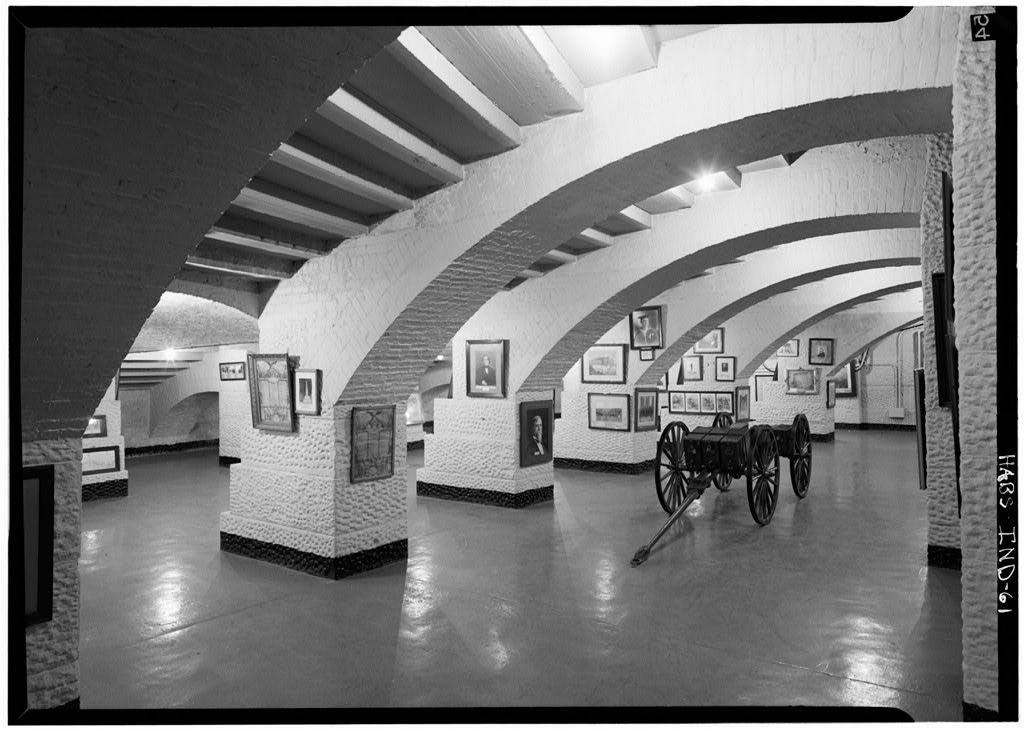
Monument Circle is more than a traffic roundabout. The circular, brick-paved street where Meridian and Market intersect has been the focal point of Indianapolis since Alexander Ralston platted the city in 1821. Today the Circle is lined with the Hilbert Circle Theatre, home of the Indianapolis Symphony Orchestra, the Columbia Club, Christ Church Cathedral, and the Circle Tower, a 1930 building with Egyptian-motif ornamentation. The monument itself contains an elevator to an observation deck and formerly housed the Colonel Eli Lilly Civil War Museum in its basement until water leakage forced a move to the Indiana War Memorial in 2018. In 2019, more than 369,000 visitors rode the elevator or climbed the stairs. Every Christmas since 1962, cables of lights have transformed the monument into what Indianapolis calls the world's largest Christmas tree, garlands stretching from base to summit.
Woven Into the City's Identity
The monument has embedded itself into Indianapolis so thoroughly that it appears on the city's flag, a graphic representation of Monument Circle and its two intersecting streets. The Indianapolis Metropolitan Police Department features the monument on its badge. The Indy Eleven soccer team placed Victory prominently in its logo. President Benjamin Harrison, who had once delivered speeches at the site during its earlier incarnation as Circle Park, returned as president to lay the cornerstone. The monument was listed on the National Register of Historic Places in 1973 and became part of the Indiana World War Memorial Plaza National Historic Landmark District in 2016. In 2011, the ten-ton Victory statue was removed for restoration and returned to her perch atop the obelisk, still facing south, still holding her torch above the Crossroads of America.
From the Air
Located at 39.768°N, 86.158°W at the exact center of downtown Indianapolis. The monument sits at the intersection of Meridian and Market streets, forming the distinctive circular pattern of Monument Circle visible from altitude. The obelisk rises 284 feet. Indianapolis International Airport (KIND) is 12 miles southwest. The flat terrain of central Indiana makes the downtown skyline and the circle's geometry readily visible on approach.