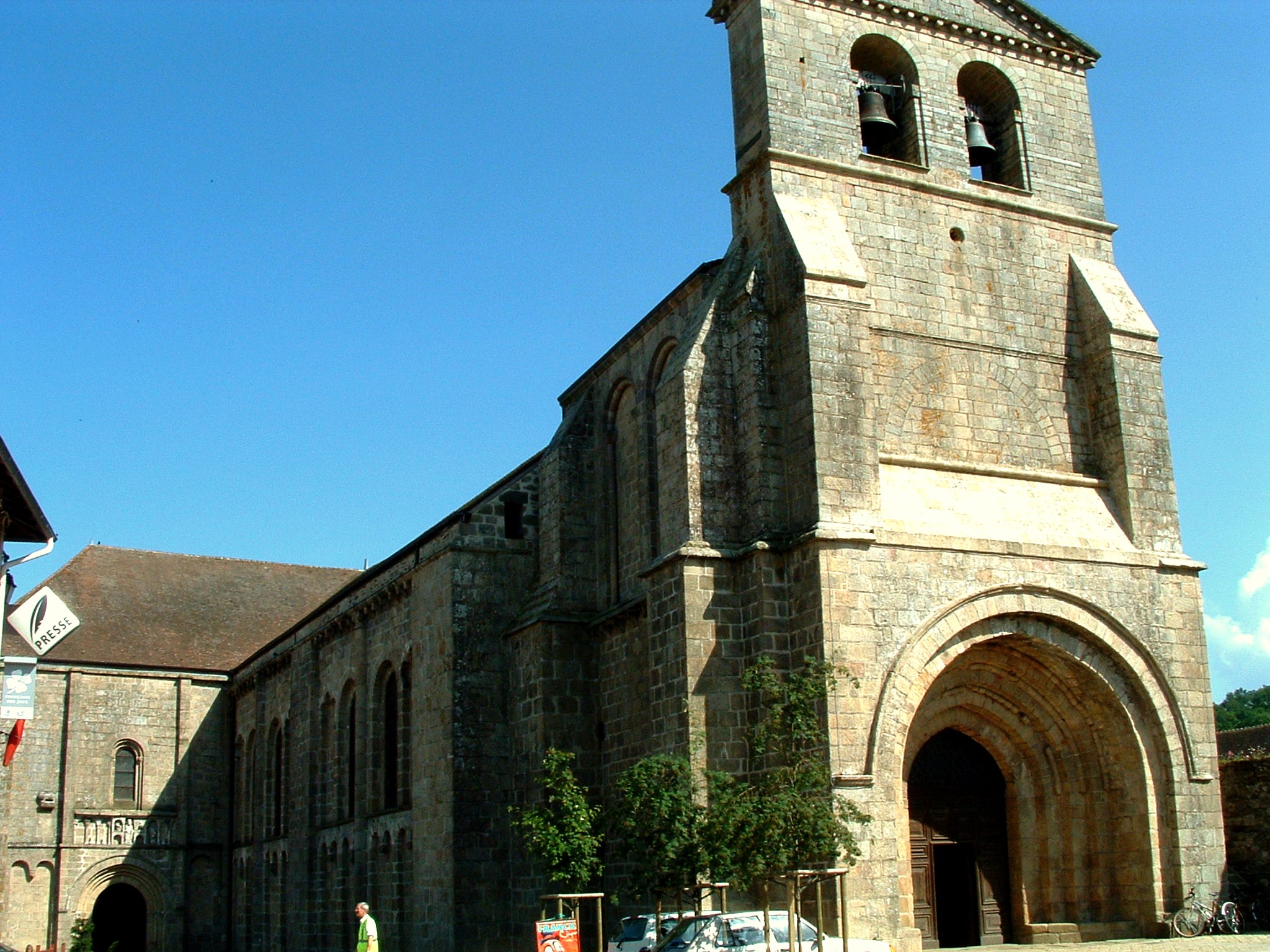
Solignac Abbey
According to legend, Saint Eligius climbed a rock above the village of Solignac, threw a hammer, and founded his abbey where it landed. The story suits the man. Eligius was the royal goldsmith of the Merovingian court, a master metalworker who parlayed his skill at the forge into the favor of King Dagobert I. In 631 AD, he asked the king for the land of Solemniacum to build a monastery. Dagobert granted it. Within a generation, the abbey had 150 monks and had become one of the finest silversmithing workshops in Gaul. Nearly fourteen centuries later, after Vikings, English raiders, revolutionaries, and a porcelain factory had each taken their turn with the buildings, Benedictine monks returned in 2021 to resume the contemplative life that Eligius began.
The Goldsmith's Foundation
Eligius was no ordinary saint. Before he took holy orders, he served as the master goldsmith for the Merovingian kings, crafting reliquaries and sacred objects of extraordinary skill. His friend Saint Audoin described Solignac as a 'fertile and pleasant' place with 'copious and well-watered orchards' near 'a beautiful river,' calling the monastic observance 'almost unique in its kind when compared to that of the other monasteries of Gaul.' The monks were not merely contemplatives -- they were accomplished craftsmen. Audoin noted 'many skilled workers in different arts and crafts' brought to perfection through discipline. Eligius sent for monks from Luxeuil Abbey, and the first abbot was Saint Remacle, who would later become Bishop of Maastricht. A young Saxon slave purchased by Eligius entered the community and became Thillo, who succeeded Eligius in directing the silverwork. The abbey's founding charter, countersigned by seven bishops, placed it directly under the king's authority rather than the local bishop's.
Centuries of Fire and Recovery
The abbey's history follows a relentless pattern of destruction and renewal. Saracen raiders struck around 732-735. A mysterious incursion in 793 caused damage severe enough that both Pepin the Short and Charlemagne had to grant special privileges for rebuilding. Louis the Pious issued further privileges in 817. Viking incursions around 860 forced the monks to flee to Vic-Fezensac after the abbey was looted and burned. Charles the Simple gave sixteen churches to Solignac in 922 to help it recover from decades of anarchy. Each time, the community rebuilt. By the 11th century, the abbey's influence had grown so large that the Abbey of Saint-Pierre du Vigeois joined it, bringing a community of roughly a hundred monks. Popes Eugene III and Adrian IV confirmed its rights. Emperor Frederick Barbarossa personally wrote to the King of England in 1157 recommending the abbey to his protection.
Domes of the Limousin
The current abbey church, built primarily during the first half of the 12th century, is the only domed abbey church in the Limousin -- a jewel of Romanesque architecture. Its nave features a distinctive row of cupolas, linking it stylistically to the domed churches of Cahors, Angoulême, and Souillac. The consecration date has been debated for centuries: one tradition places it at 1143, another at 1211, when Bishop Jean de Veyrac performed the ceremony as recorded by the contemporary monk Bernard Ithier. A fire in 1178 destroyed the roof and furnishings, necessitating extensive reconstruction of the choir. The porch tower dates from the early 13th century, its vault distinctly Gothic amid the Romanesque surroundings. Lightning destroyed the transept bell tower in 1734, and the western bell tower collapsed in 1783. Inside, 15th-century stalls carved with beggar figures and half-human, half-animal hybrids survived the centuries -- along with a painting of Saint Christopher on a transept pillar, uncovered during restoration work in 1951.
From Prison to Porcelain Factory
The French Revolution expelled the abbey's last fourteen monks in 1790. What followed was a remarkable series of reinventions. The buildings first served as a prison, particularly for refractory priests who refused the revolutionary oath -- many of whom were later sent to the notorious Rochefort prison ships. Under the Second Empire, the abbey became a boarding school for girls. Then came its most unlikely incarnation: a porcelain factory, which operated within the medieval walls until 1930. The cloister, rebuilt in the 18th century in a style respectful of the original Romanesque, was destroyed during the factory years. From 1939 to 1945, students from Obernai in Alsace found wartime refuge there. The Missionary Oblates of Mary Immaculate turned it into a seminary in 1946, but their community dwindled, and the Diocese of Limoges acquired the buildings in 2011.
The Thread Reconnected
In November 2021, Benedictine monks from the Abbey of Saint-Joseph de Clairval in Flavigny-sur-Ozerain arrived at Solignac to reestablish monastic life. Their arrival reconnected a thread of Benedictine presence stretching back 1,150 years. The scale of the undertaking is formidable: 10,000 square meters of developed surface, six hectares of land, 4,000 square meters of roofing, and 250 windows, all in need of attention after two decades of vacancy. The most urgent repair was the Saint-Jean porch, which had threatened to collapse and was stabilized in the winter of 2020-2021. For a place that has been rebuilt after Saracen raids, Viking attacks, English burnings, Protestant plundering, revolutionary arson, and industrial conversion, one more restoration seems perfectly in character. Eligius's hammer, wherever it landed, chose well.
From the Air
Located at 45.75°N, 1.28°E, approximately 10 km south of Limoges in Haute-Vienne. The abbey's Romanesque church with its distinctive row of domes is visible from moderate altitude along the Briance river valley. Nearest airport is Limoges-Bellegarde (LFBL). Best viewed at 2,000-3,000 ft AGL in clear conditions.