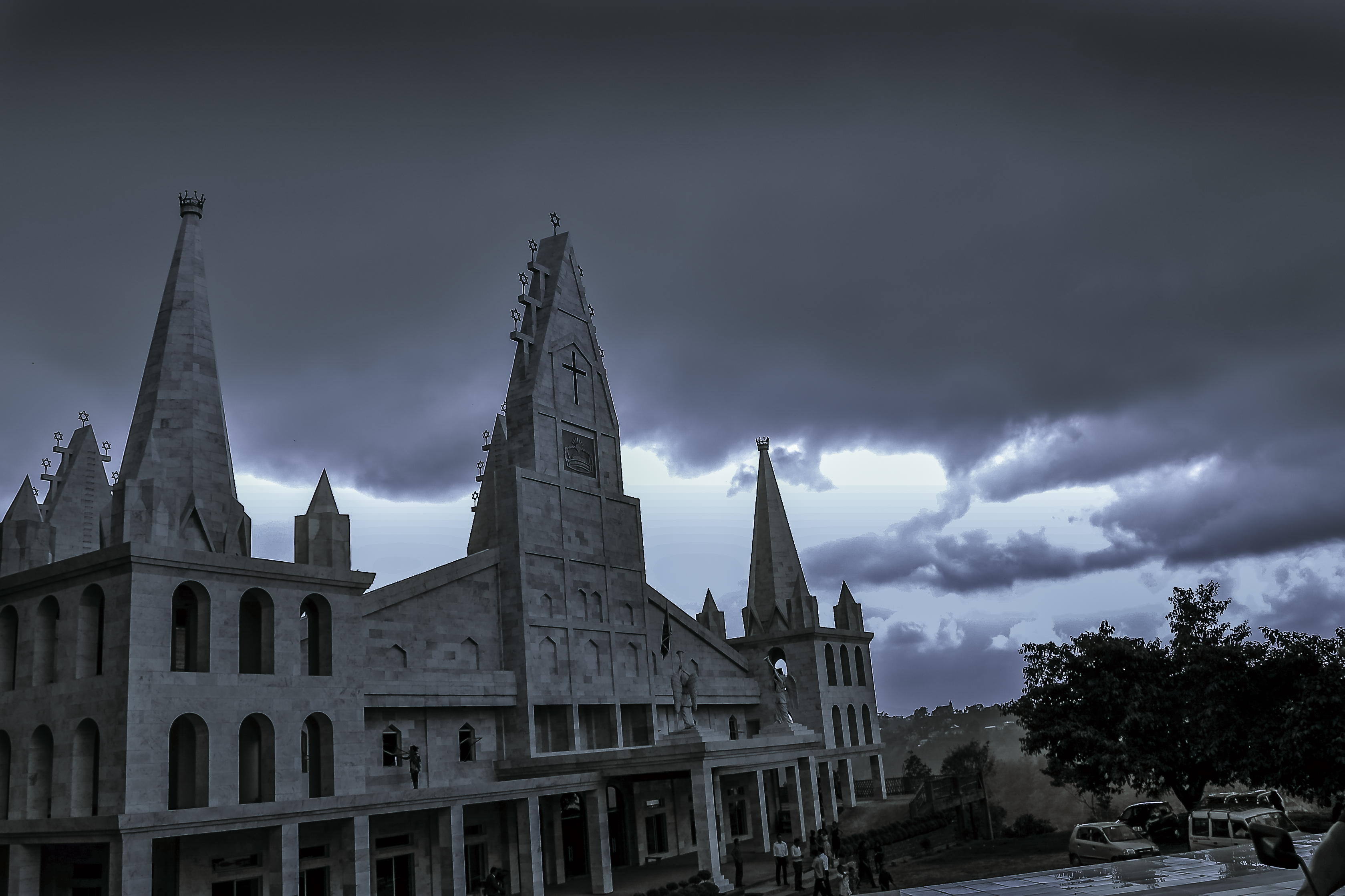
Solomon's Temple, Aizawl
Seen from an aircraft above Aizawl, the roofline gives away its purpose before any other detail resolves. Two intersecting ridges cross at the center of the pitched roof, forming a clear cross against the green Mizo hills. Solomon's Temple was designed to be read from the sky as much as from the ground -- a statement of faith embedded in architecture, visible to anyone passing over one of India's most remote state capitals. That the largest church in Mizoram was built because of a dream only deepens the resonance.
The Dream That Built a Church
In 1991, Dr. L.B. Sailo, founder of the non-denominational Kohhran Thianghlim -- "The Holy Church" in English -- saw Solomon's Temple in a dream. He had never thought about the biblical temple before, had no plans to construct anything resembling it. But the vision was vivid enough that when he woke, he immediately wrote down what he had seen. From that sketch, over the following years, one of the most distinctive religious buildings in northeast India took shape on a hillside in Chawlhhmun, Aizawl. Kohhran Thianghlim had been founded in 1984, but the temple project transformed it, giving the congregation a physical anchor and a landmark that would draw visitors from across Mizoram and beyond.
Architecture as Scripture
Every element of the building carries symbolic weight. The main structure has twelve doors -- three per wall -- echoing the twelve gates of the New Jerusalem described in the Book of Revelation. The exterior walls face exactly south, north, east, and west. Four pillars stand above the porch, each bearing seven Stars of David, representing the seven churches addressed in Revelation. On each pillar: the Cross of Christ and the emblem of the Holy Church. Atop the porch, two sculpted angels blow trumpets toward the sky. The temple has four corner towers, each crowned to represent a different spiritual crown -- Salvation, Righteousness, Life, and the Overcomer. With 32 windows, 32 ventilation openings, and 32 skylights, the building breathes and glows with natural light.
A Hilltop Among Hills
Aizawl itself is a city built entirely on ridgelines, its buildings stacked along steep slopes in a way that makes flat ground a luxury. Solomon's Temple occupies one of these prominences, visible from multiple vantage points across the capital. Mizoram's Christianity runs deep -- the state has one of the highest proportions of Christians in India, a legacy of Welsh Presbyterian and Baptist missionaries who arrived in the late 19th century. Against that backdrop, Solomon's Temple stands as something different: not a mainline denomination's church but an independent, homegrown expression of faith, rooted in local vision rather than imported tradition. It opened to the public in December 2017, drawing coverage from national media outlets that described it as the first temple of its kind in India.
Where Worship Meets Service
Sunday services fill the multi-story interior, but the temple's calendar extends well beyond weekly worship. The annual Zanlai Au Aw -- Midnight Herald Anniversary -- is organized by Kohhran Thianghlim's Publication Board, while Missionary Day and the Jerusalem Khawmpui gathering in late December draw congregants from across the region. Perhaps most distinctively, the temple serves as a regular venue for blood donation drives organized by the church's youth wing, the Youth Evangelical Front. The sight of donation banners draped across the temple's facade, with David's Pillar rising in the background, captures something essential about the congregation's character: a community that expresses devotion through both worship and practical service to their neighbors.
A Cross in the Sky
The intersecting roof ridges that form a cross when viewed from above represent the New Covenant -- a theological statement made architectural, legible only from the perspective of a bird or an aircraft. For a church built from a dream, the choice to embed meaning in the roofline feels deliberate. The ground-level experience is one of symbolic density: stars, crowns, angels, scripture encoded in structural geometry. The aerial view simplifies everything to a single form. From above, all the architectural detail falls away, and what remains is a cross on a green hilltop in one of India's smallest, most mountainous states -- a signal sent upward by a congregation that believes the sky is listening.
From the Air
Located at 23.7479N, 92.6884E in Aizawl, the capital of Mizoram. The church's distinctive cross-shaped roofline is visible from the air, set on a prominent hilltop amid the ridgeline city. Best viewed below 3,000 feet. Nearest airport: Lengpui Airport (VELP), approximately 35 km west of Aizawl. The terrain is extremely hilly with deep valleys; approach with caution. Visibility is best October-March; monsoon months bring dense cloud cover.