Somalia
The 14th-century Berber traveler Ibn Battuta visited Mogadishu and recorded his surprise: the people were very fat, he wrote, because everybody ate as much as they could. The sultan was powerful, the residents wore fine white clothes and turbans, and the city thrived on Indian Ocean trade. Seven centuries later, Mogadishu's story has grown immeasurably more complicated -- civil war, terrorism, piracy, and the collapse and slow reconstitution of central government have defined the modern narrative. But Ibn Battuta's Mogadishu has not entirely vanished. Somalia remains a country of traders, poets, and fierce hospitality, where a guest is showered with generosity even in the most difficult circumstances and where refusing a meal would be considered a kind of insult.
The Land of Punt and the Sultanates
Somalia's recorded history stretches back roughly 3,500 years, to when Egyptian Queen Hatshepsut dispatched five ships and 210 men to what the Egyptians called the Land of Punt -- a place prized for myrrh, gold, ivory, ostrich feathers, and aromatic spices used in religious ceremonies. Between the 7th and 9th centuries, Muslim Arab and Persian traders established posts along the coast, and a chain of trading empires rose along the northeast shore. By the medieval period, Mogadishu was among the great port cities of the Indian Ocean world. The country's internal history is marked by powerful sultanates -- the Ajuran, the Geledi, the Majeerteen, the Sultanate of Hobyo -- that governed through sophisticated bureaucracies, maintained standing armies, and conducted trade with Arabia, Persia, India, and the Swahili coast. The Dervish State, founded around 1896 by Mohammed Abdullah Hassan, was the only non-emperor African kingdom to maintain its independence by force of arms throughout the entire Scramble for Africa period.
Division, Independence, and Collapse
At the 1884 Berlin Conference, European powers carved Somalia into five parts: British Somaliland in the north, Italian Somalia in the south, the French Somali coast at Djibouti, the Ogaden in the west, and Kenya's Northern Frontier District. Independence came in 1960 when the Italian trust territory and British Somaliland merged to form the Somali Republic. A decade of democratic governance ended in 1969 when General Siad Barre seized power in a coup. Barre's military government launched large-scale literacy campaigns and public works, but it also grew authoritarian. Cold War alliances -- first with the Soviet Union, then the United States -- allowed Somalia to build the largest army in Africa, but popular disillusionment set in during the 1980s. When Barre was overthrown in 1991, the central state collapsed entirely. Civil war, clan conflict, and the emergence of Islamist militias like Al-Shabaab plunged the country into a crisis that persists in diminished but dangerous form. A federal government established in 2012 has slowly expanded its authority, though much of the country remains contested.
Hospitality in a Hard Land
What strikes visitors who do make it to Somalia -- and some do, despite everything -- is the warmth. Somalis consider it shameful not to welcome a guest properly, and tourists report being treated like celebrities, offered meals and gifts with no expectation of return. The culture runs on spiced tea, strong coffee sipped with dates, and conversation. The cuisine reflects centuries of trade: Somali, Yemeni, Persian, Turkish, Indian, and Italian influences blend into dishes of spiced meat and basmati rice, canjeero (a spongy pancake-like bread), and sambusas. All food is halal. The Somali language, an Afro-Asiatic tongue rich in Arabic and Persian loanwords, was given a standard written form only in 1972, but oral poetry has been central to Somali culture for centuries -- a tradition so important that Somalia is sometimes called the Nation of Poets. Any attempt by a foreigner to speak even a few words of Somali is received with genuine delight.
Coastline, Climate, and the Longest Shore
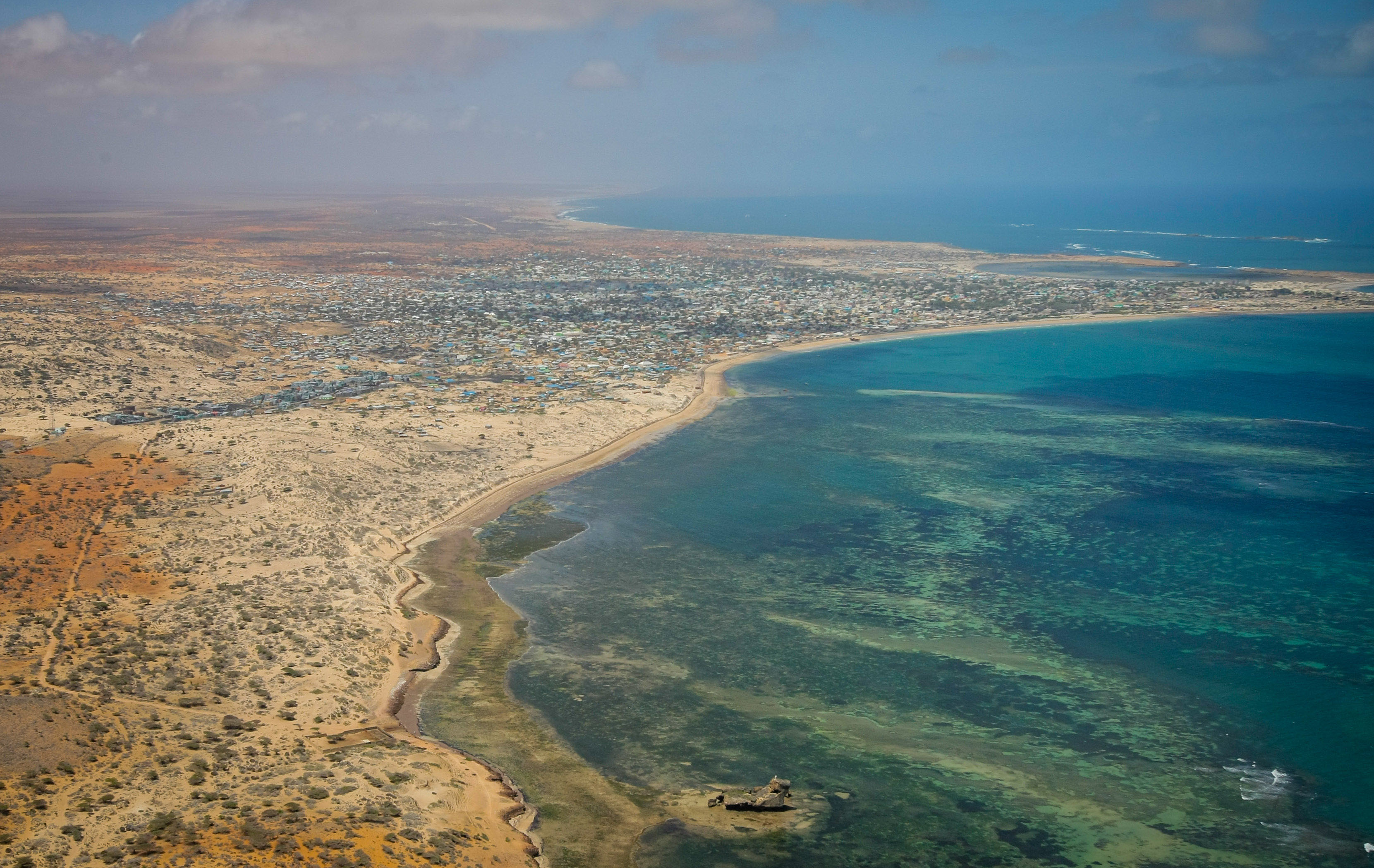
Somalia occupies the easternmost point of the African continent, its horn-shaped peninsula jutting into the Indian Ocean and the Gulf of Aden. The coastline is the longest of any mainland African nation, running from the Kenyan border in the south to Djibouti in the northwest. The landscape is principally desert and semi-arid scrubland, with temperatures ranging from 30 to 40 degrees Celsius. Two monsoon seasons -- the southwest from May to October and the northeast from December to February -- punctuate a climate of recurring drought. The Shabelle and Jubba rivers, both originating in the Ethiopian highlands, provide the country's only significant fresh water, sustaining agriculture in the southern interior. Beaches along the coast near Mogadishu -- Liido Beach, Gezira Beach -- are beautiful by any measure, and families gather there on weekends, though security concerns shadow even these ordinary pleasures.
Getting There and the Reality on the Ground
Somalia is not a conventional destination, and the infrastructure reflects that. Air travel is the safest way in: airlines including African Express Airways, Jubba Airways, and Daallo Airlines connect Mogadishu's Aden Abdulle International Airport (renovated with Turkish government funding) to Dubai, Nairobi, Jeddah, and Djibouti. Overland travel from Ethiopia into Somaliland is possible via Wajaale, but borders elsewhere are generally sealed and dangerous. Within the country, roads are in poor condition, landmines remain a concern in some areas, and foreigners in Mogadishu are required to travel with security escorts. The telecommunications sector, ironically, boomed during the years without government -- Somalia has some of the cheapest cellular calling rates on the continent. Somaliland and Puntland in the north are substantially safer and more accessible than the south, with Western-level hotels in Hargeisa and Bossaso. For the adventurous traveler willing to accept real risk, Somalia offers historical sites, mountain ranges, and national parks that very few outsiders have seen.
From the Air
Located at 5.15N, 46.20E, centered on Somalia's geographic midpoint on the Horn of Africa. Major airports include Aden Adde International Airport in Mogadishu (HCMM), Hargeisa (HCMH), and Bossaso (HCMF). The coastline -- Africa's longest mainland shore -- is the dominant visual feature from altitude, with the horn-shaped peninsula clearly visible above 20,000 ft. The Shabelle and Jubba river valleys create green corridors through otherwise arid terrain.