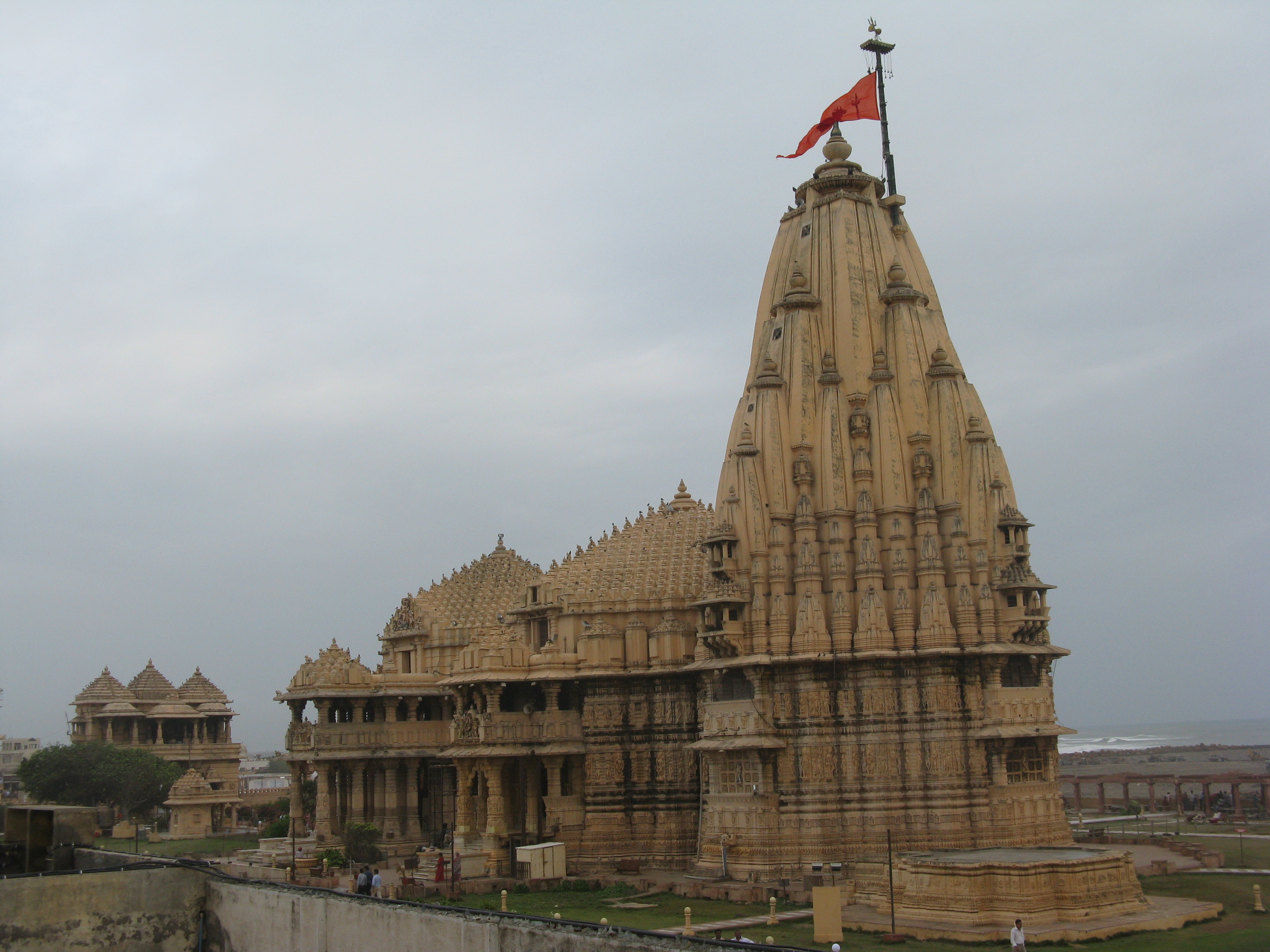
Somnath Temple
Six times destroyed, seven times rebuilt. No temple in India carries a heavier ledger of ruin and resurrection than Somnath, which stands where the Saurashtra coast meets the Arabian Sea. The name means "Lord of the Moon" - it is one of twelve Jyotirlingas, the most sacred shrines to Shiva - and its story spans so many centuries of devotion and destruction that the ground beneath it holds archaeological layers dating to the pre-Harappan era, before 2000 BCE. The present temple, completed in the early 1950s, is not a replica of what was lost. It is something more complicated: a statement that what invaders took, faith would return.
Stone Memory
Walk the south and southwest walls of the current temple and you encounter the old alongside the new. Recovered panels from earlier structures sit embedded in fresh sandstone, the color difference between ancient and modern stone marking centuries of separation. A Nataraja - Shiva as cosmic dancer - survives with chopped arms and a defaced visage. A mutilated Nandi bull stands nearby. Traces of Shiva and Parvati, of Ramayana scenes in decorative bands, of Surya holding two lotuses, all hint at what Henry Cousens, surveying the ruins in 1931, described as a temple "exceedingly richly carved." The architectural style is Maru-Gurjara, the same tradition that produced the breathtaking Luna Vasahi temple at Mount Abu. Architect Prabhashankarbhai Sompura, from Gujarat's hereditary master mason lineage, designed the reconstruction in the late 1940s, weaving salvaged fragments into a new two-level temple with a pillared mandapa and 212 relief panels. The main spire rises 15 meters above the sanctum, crowned by an 8.2-meter flag pole.
The Weight of 1026
The date that shadows Somnath is 1026 CE, when Mahmud of Ghazni sacked the temple. The event echoed for a thousand years, not merely as a military campaign but as a symbol that different civilizations loaded with different meanings. In Persian literature, the destruction became a celebrated narrative of religious zeal, retold in poems and histories for centuries. On the Indian side, Somnath became a wound in Hindu collective memory - not just a temple lost, but a question of heritage and sacred space. What makes this legacy so layered is how many hands have shaped it. In 1842, during the First Anglo-Afghan War, Lord Ellenborough ordered British troops to retrieve wooden gates from Mahmud's tomb in Ghazni, believing they had been taken from Somnath. No evidence supports this - the temple likely never had wooden gates. The episode reveals less about Somnath than about how colonial powers projected their own narratives onto India's contested history.
Deeper Than Temples
Archaeologists in the 1970s, led by M. K. Dhavalikar and Z. D. Ansari, dug beneath the Prabhas-Patan site and found evidence of five distinct periods of human settlement. In 1992, Dhavalikar and Indus Valley specialist Gregory Possehl dated one layer to a "pre-Harappan phase" - before the second millennium BCE. The discoveries are ceramics, wares, and amulets rather than temple fragments, but they place Somnath-Patan in the same league as Dholavira and Rojdi, significant Harappan-era sites in Gujarat. Post-Harappan settlement continued through roughly 2000-1800 BCE. The poet Kalidasa mentioned the tirtha at Prabhasa; Brahmi script inscriptions reference it at sites in Maharashtra. This is not a place that became sacred when someone decided to build a temple. People have lived here, prayed here, and traded here for four thousand years. The temple is the most visible layer of something much older.
Reconstruction as Reckoning
When India gained independence in 1947, the reconstruction of Somnath became one of the new nation's earliest symbolic acts. Sardar Vallabhbhai Patel championed the rebuilding, and the work proceeded through the early 1950s under the Sompura masons. But the significance ran deeper than architecture. According to scholar Donald Smith, the reconstruction was not about restoring an ancient building - it was Hindu repudiation of nearly a thousand years of subjugation and a reassertion of sacred space in post-partition India. The temple has since become Gujarat's most important pilgrimage site, often paired with the pilgrimage to Dwarka. Pilgrims arrive from across India, walking the same coastal ground that has drawn the faithful since at least the time of Kalidasa. The Arabian Sea crashes against the shore just meters from the temple walls, and at dawn the spire catches the first light over water that stretches unbroken to the Antarctic coast.
From the Air
Located at 20.89°N, 70.40°E on Gujarat's southern coast where the Saurashtra peninsula meets the Arabian Sea. The temple complex is visible near the shoreline at Prabhas-Patan, adjacent to the town of Veraval. Nearest airport is Diu Airport (DIU/VADU), approximately 80 km southeast. Junagadh Airport is about 80 km to the north. At low altitude, look for the prominent white temple structure against the coastline. Recommended viewing altitude: 3,000-5,000 feet AGL for the coastal temple setting.